
New Release: Berneron Quantième Annuel – the world’s best annual calendar or a confused newcomer in a cooling market segment?
I was drawn to the Berneron Quantième Annuel project primarily because of the Mirage watch – Sylvain Berneron’s previous and first creation as the head of an independent brand, launched in 2023—and his team. Having witnessed countless launches over the past three decades, including the most ambitious and truly grand creations, I found the Mirage by Berneron to be the perfect concept watch.
For example, in this context, I recall the Lange Zeitwerk, which was clearly outstanding in both movement and design from the very moment of its launch. I prefer to use the term “conceptual” not in the sense of highly complex watch mechanics or high-tech materials, as is now commonly associated with the term, but rather in the sense of subordinating all aspects of the watch to a single idea, or, in other words, a single concept.
The Mirage, therefore, seems ideal: all the key elements align with the overall concept of creating a “molten” watch – the case, which can only be described as Dali-esque; the “molten” dial with its “molten” sector-style scale and hands; and, most impressively, the “molten” movement, remarkably thin with a 72-hour power reserve, developed specifically for this project and available in two versions for the 38 mm and 34 mm models. A remarkable and beautiful prodigality sure to please any true connoisseur.
The Mirage was received enthusiastically by almost all reviewers (my search revealed no negative comments), and this, it seemed to me, was a genuine reaction, unrelated to any prospect of a share in the marketing budget or the hope of one. In any case, this sincerity matches my own response.
Three elements of a concept
After launching the beautiful “molten” Mirage, with its appeal in every aspect and a pleasant aftertaste still lingered, Sylvain Berneron decided to begin a new chapter in his adventures in the world of haute horlogerie: an annual calendar. The timing was perfect. As with the Mirage, the Quantième Annuel project started from scratch, once again focusing on three key elements: movement, case, and dial.
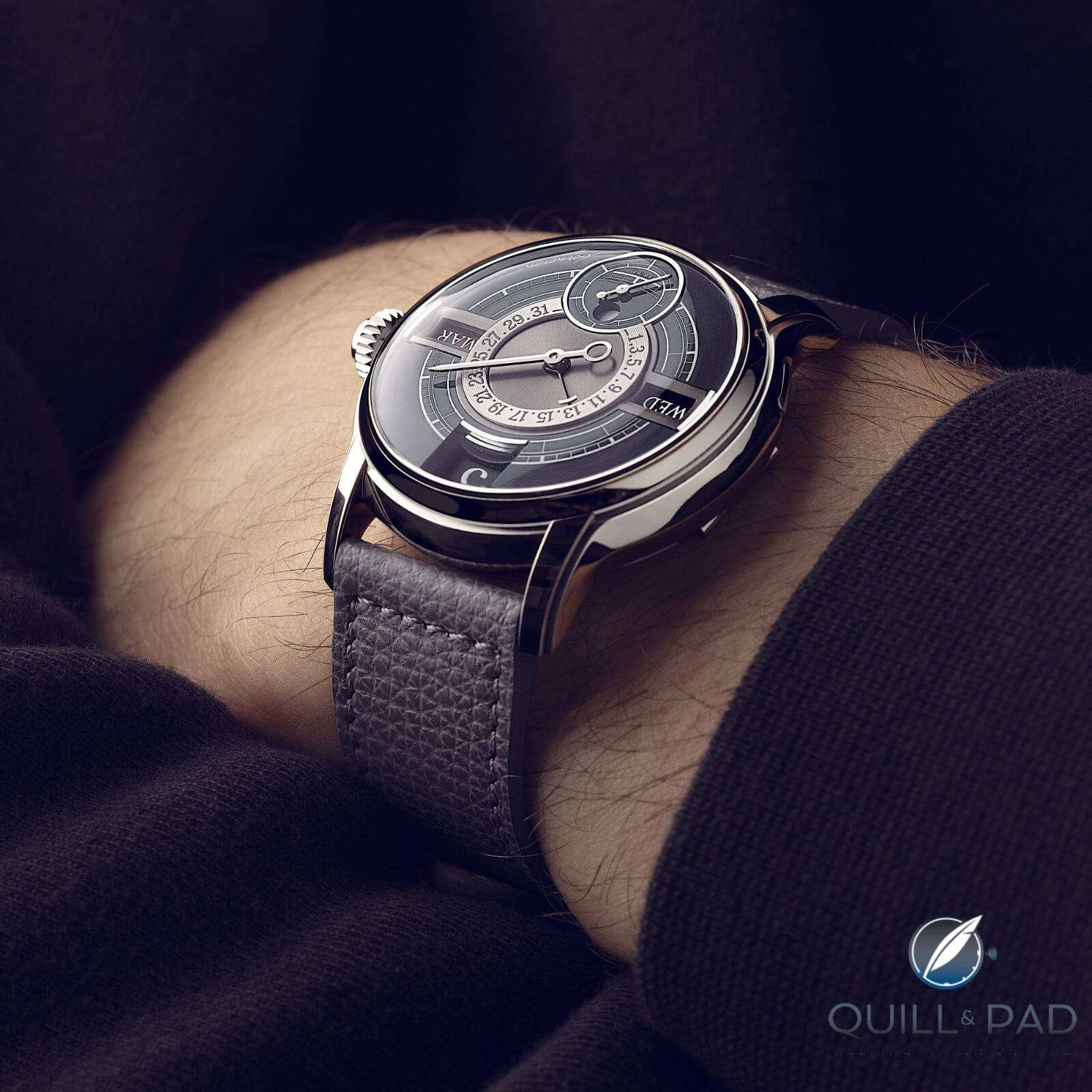
Compared to the Mirage’s free-flowing design, which gives the impression of an animated soul, the Quantième Annuel’s layout feels very rigid and extremely organised. This applies to all three main elements of the watch: the traditionally round case, the dial, and the movement, all executed with a traditionalist approach. In this sense, Sylvain Berneron is absolutely consistent once again.
The dial
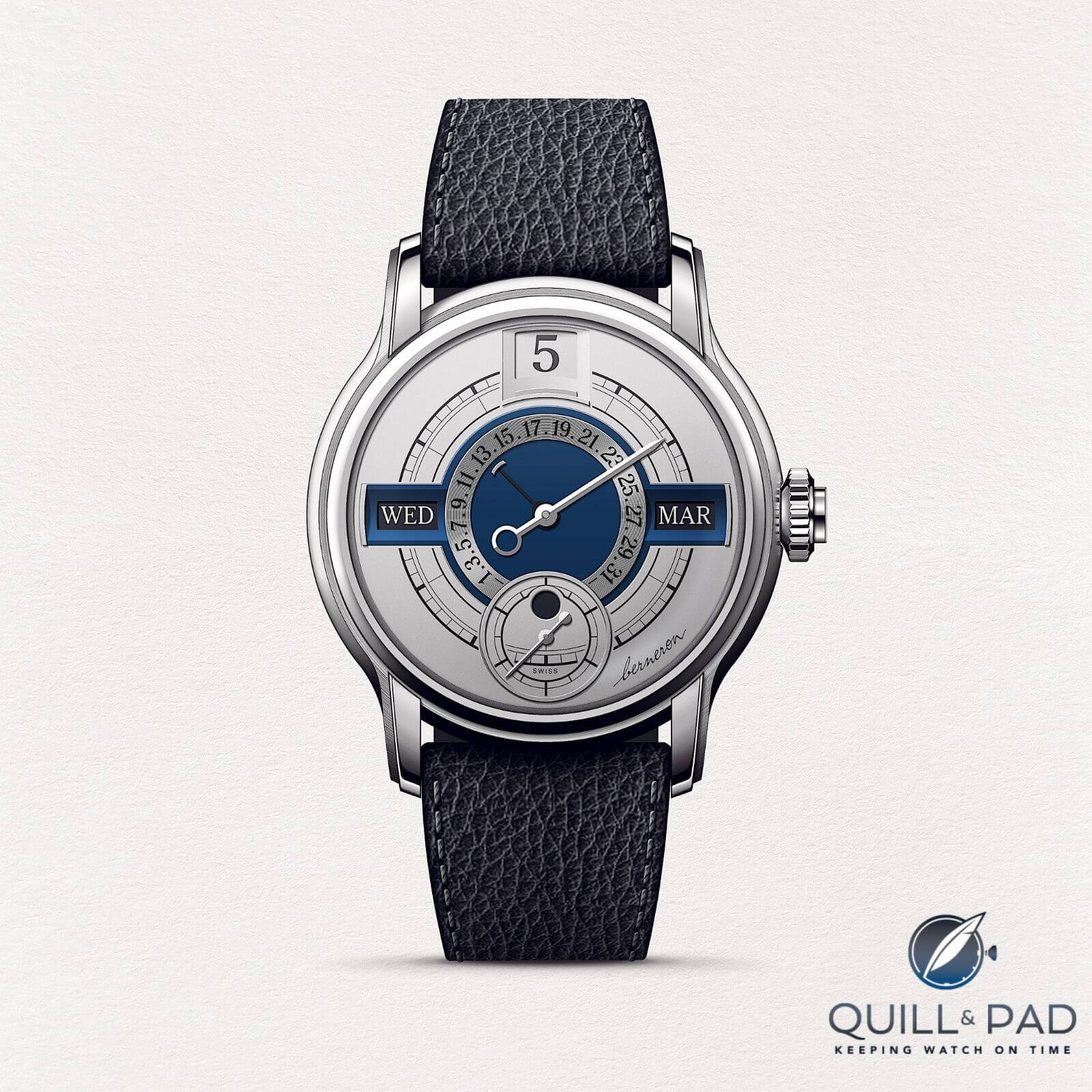
Let us begin our review of the watch with the dial, as it is the first feature to catch the eye. Berneron refers to his chosen dial structure as a “double regulator,” since both the time display – with a jumping digital hour at the top, sweep minutes in the center, and small seconds at the bottom – and the calendar displays – with the day of the week on the left, the retrograde date in the center, and the month on the right – are arranged according to the regulator dial principle and are intuitively clear for reading the time and date.
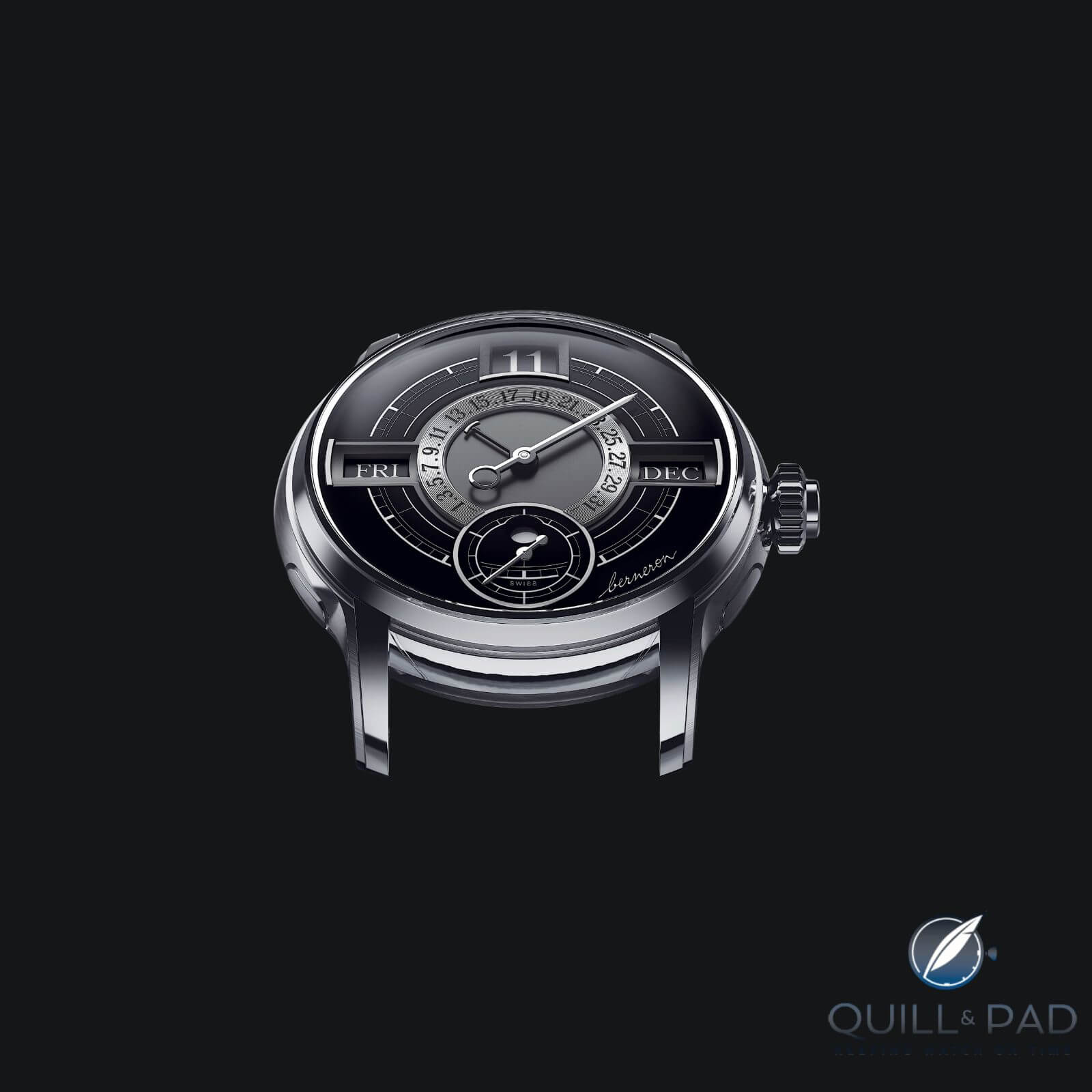
The day/night indicator window, a very useful feature in a calendar watch, is integrated into the break in the retrograde date scale at the top of the small seconds. The widely spaced day and month windows immediately recall the design of the Zeitwerk and, in particular, the Odysseus, both from the A. Lange & Söhne collection.
The font chosen for the indices is not the same as that used by Lange, but it is very similar in style. However, the Lange and Berneron Quantième Annuel watches feel distinctly different, with a touch of glamorous baroque splendour in the case of the Lange watch and a heavy, military Art Deco feel in the case of the Quantième Annuel.
For a sector-style dial – the type Sylvain Berneron selected as the basis for his design – the Quantième Annuel dial is overly detailed, creating a sense of clutter, particularly in the black version. However, this is balanced by the clever adaptation of the date scale to the width of the numerals. At first glance, the dial may seem confusing: in the center of the scale, instead of the usual 15 or 16, there is a dot-shaped marker representing 18.
The key to this unusual technical solution lies in the retrograde hand mechanism, which provides a minimal increment for the scale from 1 to 11, a medium increment for 13 to 21, and a large increment for 23 to 31. As a result, the scale appears uniform, matching the corresponding increase in the width of the numerals. I always find it very pleasing to discover such a feature in a watch, as it demonstrates the meticulous development of the project, with attention even to the smallest detail.
The case
The same applies to the case, which presents a reversed concept of the bimetallic steel and platinum design. Rolex, with its gold Rolesor bezel, and the recent steel Parmigiani Fleurier models with platinum bezels, have led us to believe that a relatively small addition of precious metal adds a pleasing touch to gold or platinum but does not dramatically increase the price compared to all-steel models.
However, Sylvain Berneron once again challenges this stereotype with remarkable energy, choosing to protect the platinum, which he considers too soft, with an armour of 904L steel – a special grade renowned for its use by Rolex since 1985. The majority of the case, 85% of its weight to be precise, is intended to be platinum.
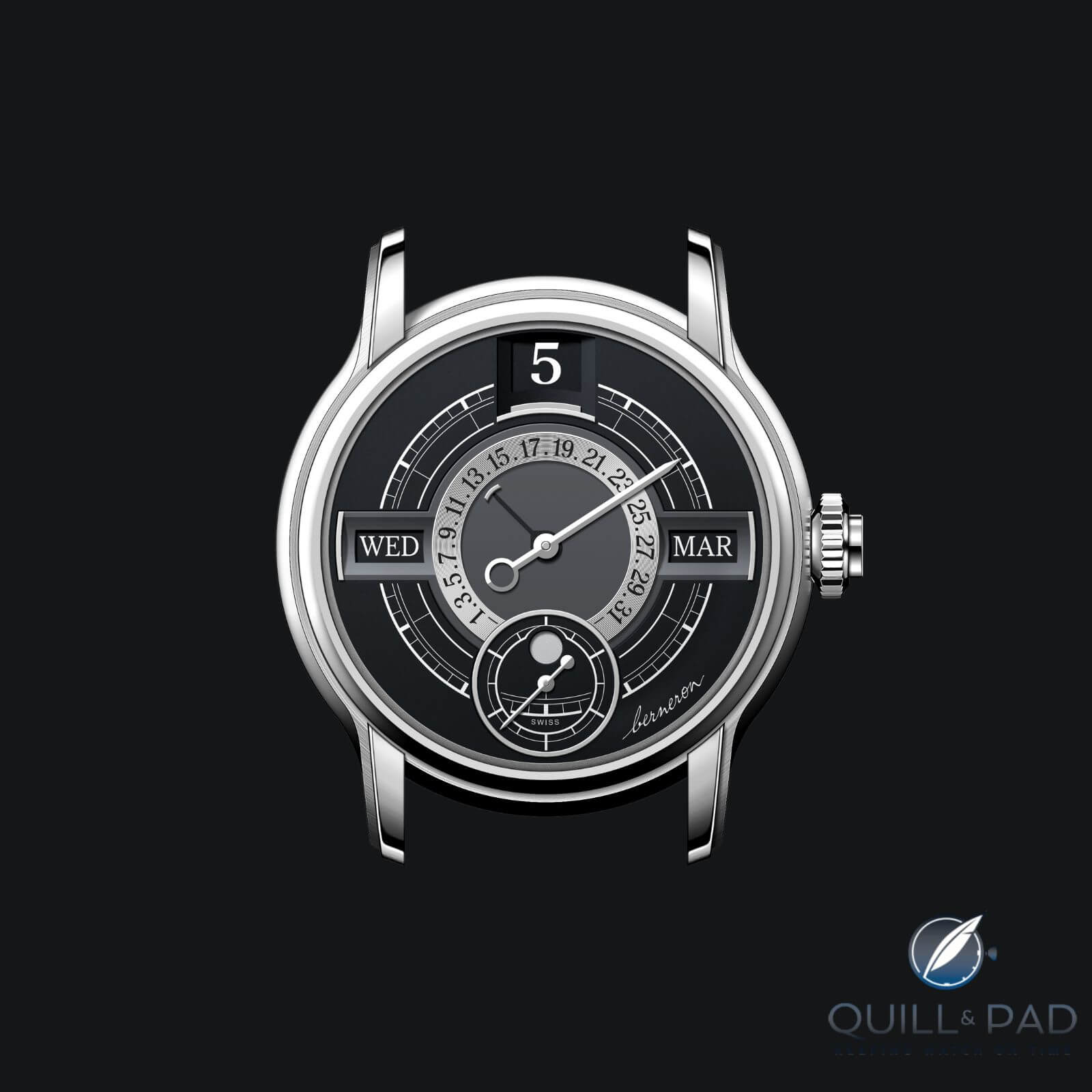
The conceptual approach is clear, but is it an advantage or a disadvantage? The steel armour protects exactly those parts of the case most prone to wear: the bezel, the upper surfaces of the lugs, and the button on the crown that opens the hinged caseback of the officer’s case. By installing the steel armour, Berneron promises to have spare steel parts available so that, if necessary, the case can be refreshed in the future by replacing the steel armour parts without affecting the platinum components.
How acceptable is this for the watch owner? Despite the low cost of stainless steel, this operation will never be inexpensive, given the watch’s price of CHF 120,000. However, the rigid conceptual nature of the platinum case with steel armour is softened by the inclusion of a collector’s attraction: the traditional officer’s case design with its hinged caseback.
The movement design
When discussing the Quantième Annuel movement, the manual-winding calibre 595, with its twin barrels and 100-hour power reserve, two aspects should be considered: design and functionality. A commitment to mechanical beauty characterises the work of many emerging independent watchmakers, including Sylvain Berneron, which is certainly welcome.
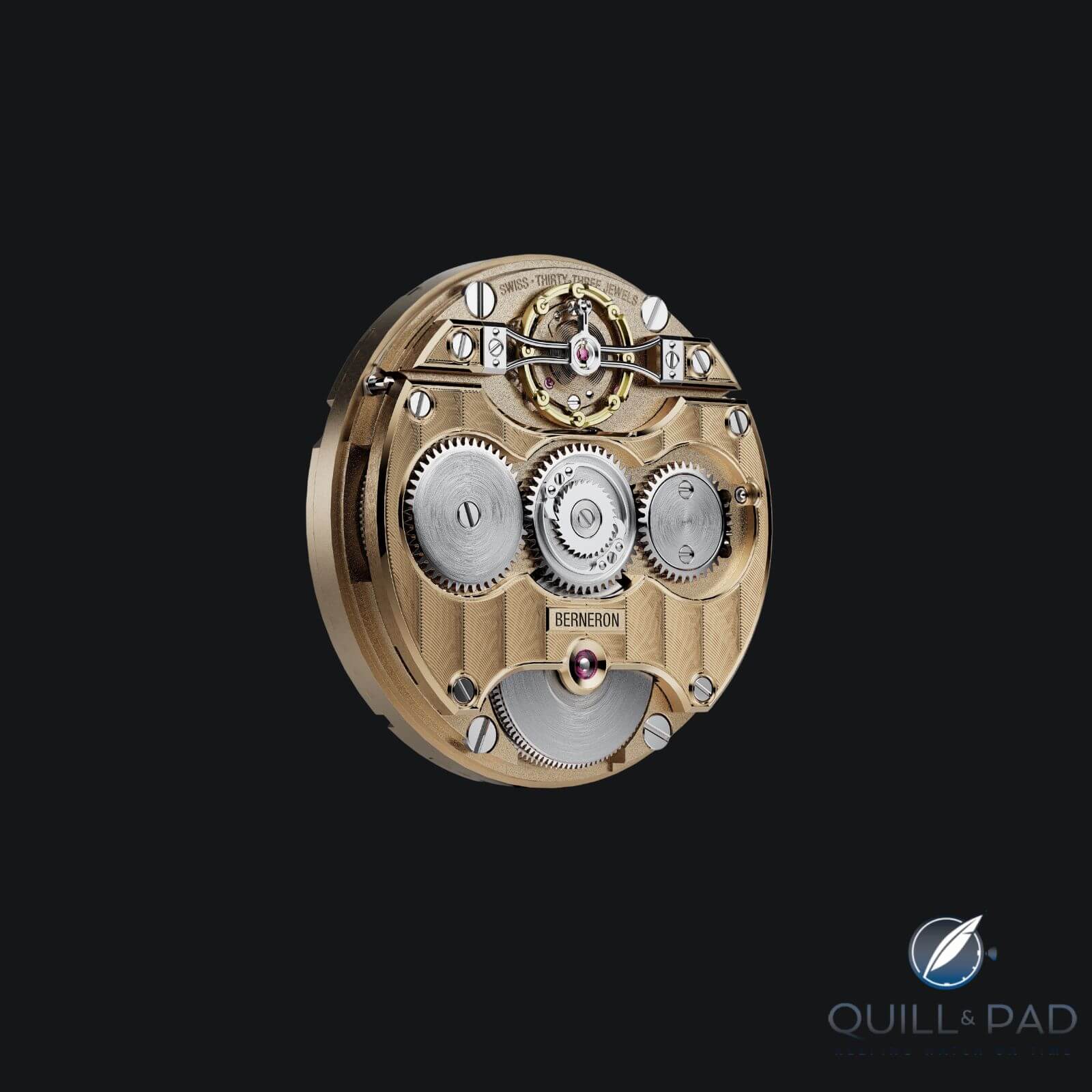
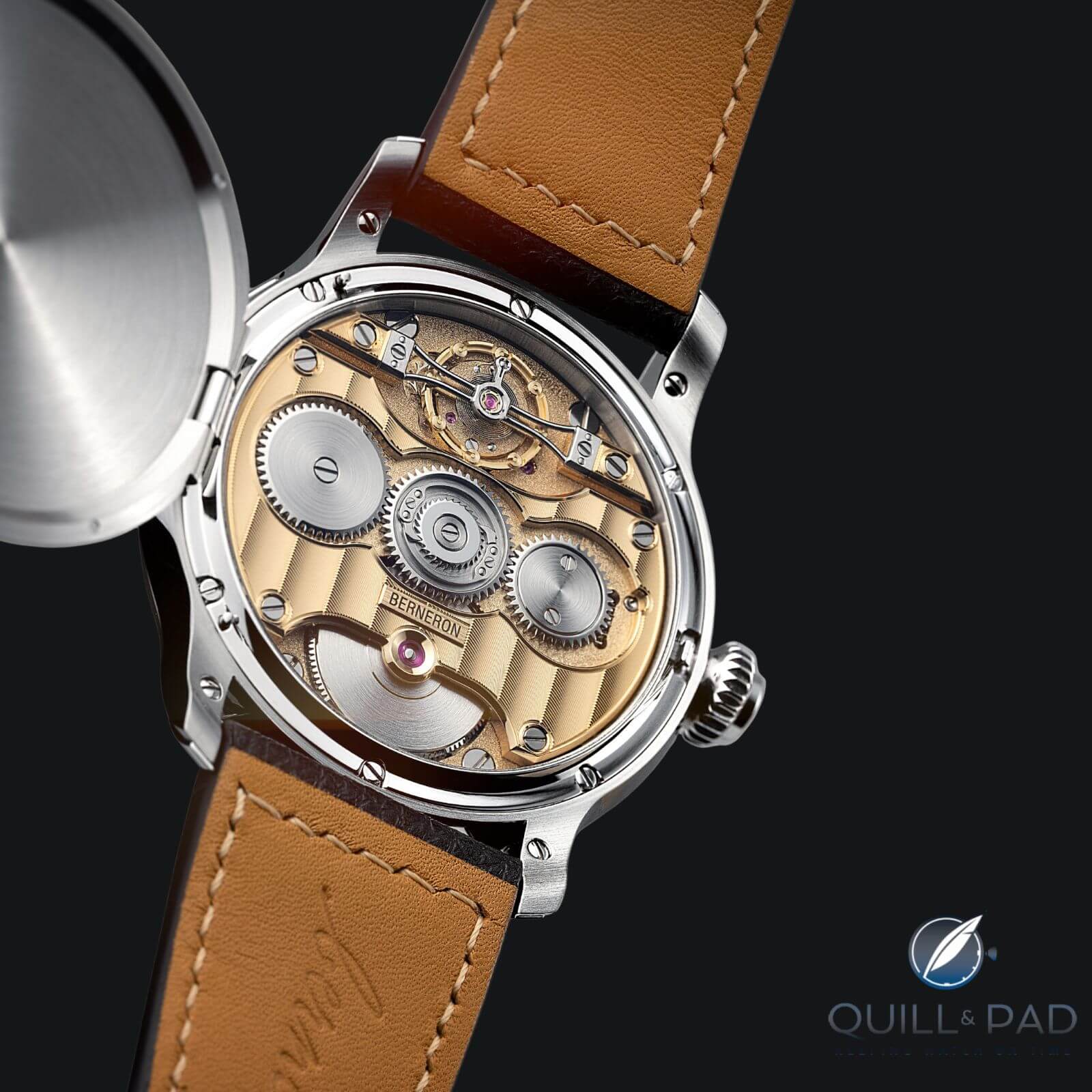
The movement’s design features a cruciform symmetrical layout, very similar in structure to the Quantième Annuel dial. This symmetrical layout originally appeared at the turn of the 18th and 19th centuries in movements by Abraham-Louis Breguet, Jacques-Frédéric Houriet, and Urban Jürgensen, and was subsequently adopted by many watchmakers, particularly in the early pocket watches of George Daniels, Derek Pratt, François-Paul Journe, and Kari Voutilainen, to name a few.
Recently, this style has increasingly appeared in wristwatches by independent watchmakers, and not necessarily in tourbillons, as in the case of the Berneron Quantième Annuel.
The influence of the tourbillon movement’s aesthetics is evident in the composite full balance bridge of calibre 595, whose openworked steel upper section recalls that of the Jaeger-LeCoultre tourbillon calibre 170, produced in the 1940s. Sylvain Berneron raises the stakes by choosing to craft the bridges and mainplate from solid gold. The combination of a sandblasted (or similar) finish on the mainplate with a guilloché reproduction of the Clous de Paris on the bridges appears conventional, yet more is expected from Berneron. However, as the saying goes, the best is the enemy of the good.
The movement’s technical aspects
At this moment, I would be tempted to turn the movement over to examine the intricacies of Berneron’s proposed annual calendar from the under-dial side. However, since this is impossible (as only a photograph is available), we must rely on Berneron’s description in the press release. The stated technical specifications appear promising, which is understandable, as Berneron had to compare his approach against the technical level of annual calendars from Patek Philippe, the market leader in complicated calendar watches and the originator of the annual calendar complication.
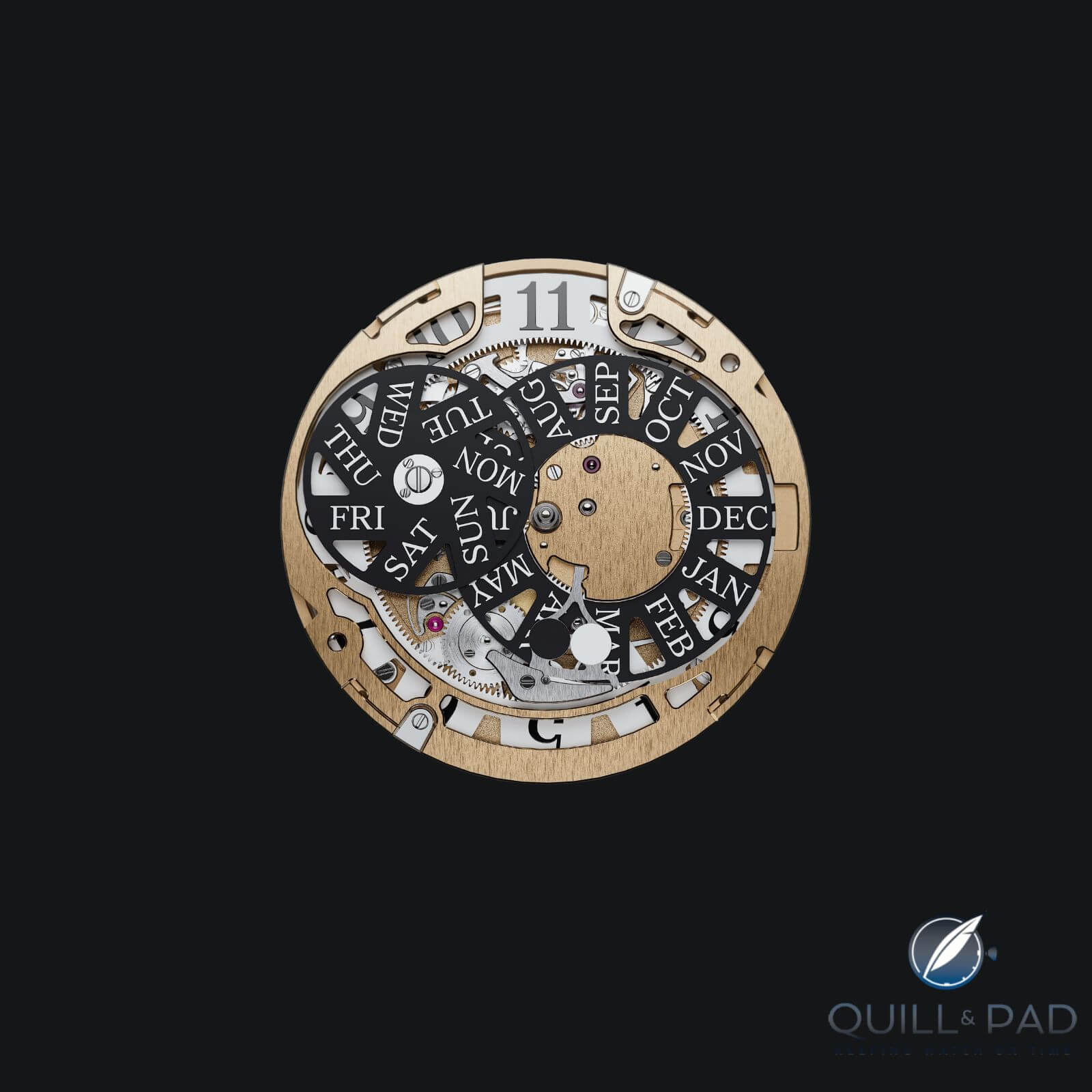
In such a situation, it is logical to aim high. And he succeeded: the calendar displays (retrograde date, day of the week, month) and the adjacent day/night indicator of the Quantième Annuel switch instantly. To this, we should add the jumping hour, resulting in five instantly switching indicators and placing significant strain on the movement.
Berneron notes that, to ensure smooth operation, the movement incorporates four springs designed to gradually accumulate the energy needed to instantly advance the indicators. As there are fewer springs than jumping indicators, it is assumed that the date and day of the week share one spring. Having five jumping indicators in a single movement is highly complex and therefore risky, requiring significant expertise and experience to ensure proper functioning.
Berneron has about a year remaining before the scheduled delivery of the first Quantième Annuel pieces in October 2026, so there is still time to run in the movement and address any potential issues. I wish him luck – and not only him. Calibre 595 was developed and will be produced in partnership with a third-party company, whose name Sylvain Berneron has not yet disclosed. It is at least known that it is not Le Cercle des Horlogers, the manufacturer of the movements for Mirage watches. Perhaps the company’s name will be revealed after the publication of two patents filed in connection with the development of the Quantième Annuel; I expect these will concern the irregular date indication and a security system.
The second feature that makes the Berneron Quantième Annuel watch a superior alternative to other annual calendars on the market is its safety system, which prevents calendar failure under any circumstances. This enables the calendar to be adjusted at any time and in any manner. The available methods include a crown for setting the date (forwards and backwards) and two pushers for setting the day of the week and the month.
Berneron states that every aspect of the safety system has been thoroughly considered, citing the example of attempting to change the month on 31 January, which would otherwise result in the non-existent date of 31 February and could potentially damage the calendar mechanism. Instead, the safety system resets the indicators to 1 February. The calendar is set for 29 days in February, so three adjustments are required over four years; this is also an advantage.
The market position
The complexity of the 595 calibre is evident, as it comprises 476 components. This is significant. Among other factors, this helps explain the watch’s high price: currently, and until the end of 2026, it is CHF 120,000 (excluding VAT). Let us examine the current state of annual calendars on the market:
- The simplest in design, yet certainly ingenious, is the Ochs und Junior Annual Calendar. The annual calendar module comprises six parts, including the dial. The basic automatic calibre is the ETA 2824. The price of the 42 mm titanium version is CHF 8,290 (excl. VAT).
- Laurent Ferrier École Annual Calendar in stainless steel, Ref. LCF025.AC.C2WO-2; calibre LF126.01 with manual winding and back-and-forth calendar adjustment, comprising 235 parts; price CHF 52,500 (excl. VAT).
- Patek Philippe Annual Calendar Regulator Ref. 5235/50R-001 in 18k rose gold, selected as it is the only model in the Patek Philippe collection with a regulator dial. The self-winding calibre 31-260 REG QA with mini-rotor comprises 313 parts. Price: €62,919 (incl. VAT).
- A. Lange & Söhne 1815 Annual Calendar Ref. 238.032E in 18k rose gold; manual-winding calibre L051.3 with 345 parts; price €55,300 in Germany.
- Parmigiani Fleurier Tonda PF Annual Calendar Ref. PFC907 in 18k rose gold; self-winding calibre PF339 with retrograde date, comprising 359 parts; price CHF 77,000 (tax information not specified on the website).
- Rolex Sky-Dweller Ref. 336239 in 18k white gold; the self-winding calibre 9002 with an instantaneous annual calendar consists of 380 parts (information refers to the previous-generation calibre 9001); price €49,350 (incl. VAT).
I have not included Omega Constellation Globemaster here, as the brand did not specify the number of parts in the self-winding calibre 8923 on its website.
Conclusions
Suitable conclusions for Sylvain Berneron would highlight that his Quantième Annuel is undoubtedly the most complex, both in terms of functionality (retrograde date with irregular scale, instantaneous calendar mechanism, comprehensive safety system) and movement, which contains 476 components – more than any other model on the market. He can rightfully call it the best, following the successful launch of production.
What are the cautious conclusions? The Berneron Quantième Annuel is the most expensive on the market – approximately twice the price of competing models – so Sylvain Berneron will have difficulty justifying the price difference: the Berneron Quantième Annuel is roughly equivalent to the Patek Philippe Ref. 5235/50R-001 plus the A. Lange & Söhne Ref. 238.032E (I would not have any doubts, even considering the solid gold movement).
The Berneron Quantième Annuel is entering the market at a time when the already narrow segment of annual calendars is cooling. Cartier, IWC, and F. P. Journe have all exited this segment, where at least the F. P. Journe Octa Calendrier was notable and, I assume, successful, judging by the current situation on the secondary market, where the Octa Calendrier (since 2004, also with a solid gold movement) significantly exceeds its official prices.
Offerings from other brands are limited, with only A. Lange & Söhne standing out by providing two options – the 1815 Annual Calendar and the Saxonia Annual Calendar – and Patek Philippe, the pioneer of the genre and its most successful player, offering 11 basic references. Considering the complicated calendars market as a whole, it is worth noting that traditional perpetual calendars are performing much better than annual calendars.
The most noticeable trend in recent years is not the emergence of simpler versions of the perpetual calendar, such as the annual calendar, but rather the development of more complex, so-called secular perpetual calendars, which will undoubtedly appeal to collectors, Sylvain Berneron’s core audience.
For more information, please visit www.berneron.ch/quantieme
Quick Facts:
Dimensions
- Platinum 950 case with an officer hinged caseback opened by winding crown pusher.
- 904L steel armour for long term case protection (6 components).
- Case diameter: 38 mm.
- Lug to lug distance: 45 mm.
- Thickness: 10 mm.
- Top crystal: sapphire with inner AR coating.
- Bottom crystal: sapphire with inner AR coating.
- Water resistance up to 30 meters (3 atm)
- Hands in 18k white gold.
- Silver opalin dial, with 18k gold base plate.
- Buckle in 904L stainless steel.
- Spring bars in 904L stainless steel.
- 20-16 mm Barenia leather strap.
Caliber 595
- Manual wound with annual calendar complication.
- Mainplate & bridges in 18k gold.
- 100 hours power reserve.
- Diameter: 30,00 mm
- Thickness: 5,95 mm
- Complications: Annual calendar & Jumping hour.
- Correction: once per year on Feb.28
- 476 components & 33 jewels.
- Free sprung balance wheel.
- Frequency 21,600 VpH (3Hz).
- Swiss lever escapement.

