
League of severe decorative style, thanks to the preserved gold part of the 7750
In early April 2026, Kudoke unveiled the Tremblage versions of the Kudoke 1 and 2 models from the Handwerk collection. The eye-catching dials, decorated with traditional centuries-old hand-engraving techniques, now adorn the brand’s leading models.
The defining feature of this technique, which distinguishes it from other engraving methods, is the burin’s creation of a uniform yet chaotic texture on the treated surface, whereas other engravings produce a clearly structured image – ranging from the figurative motifs of classical techniques to the precise geometric ornaments of guilloché. To achieve the uniform, chaotic texture characteristic of tremblage, each section of the surface is traversed many times in different directions by an oscillating burin. This is both the advantage and the challenge of the tremblage technique: creating this seemingly modest texture demands a skilled engraver and a great deal of time.
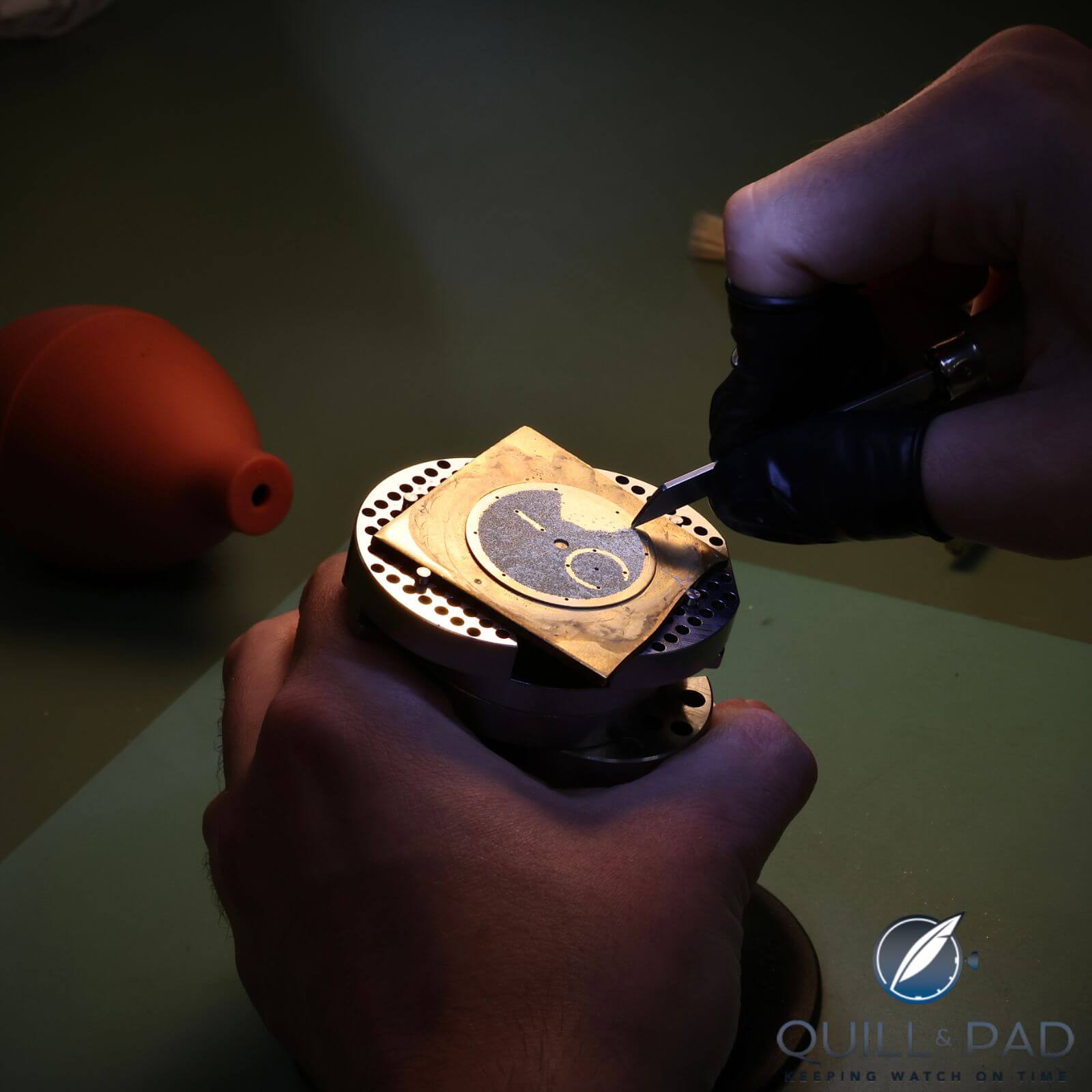
A tremblage dial: how it’s produced by Kudoke.
It’s not surprising that only a few brands practice this decoration. A. Lange & Söhne brought the tremblage technique to modern watchmaking, using it to decorate the dials of some models in the Handwerkskunst line, which are produced in very small quantities. The first watch to feature tremblage was the Richard Lange Tourbillon “Pour le Mérite” Handwerkskunst Ref. 761.050, introduced in 2011, with a total of 15 pieces produced.
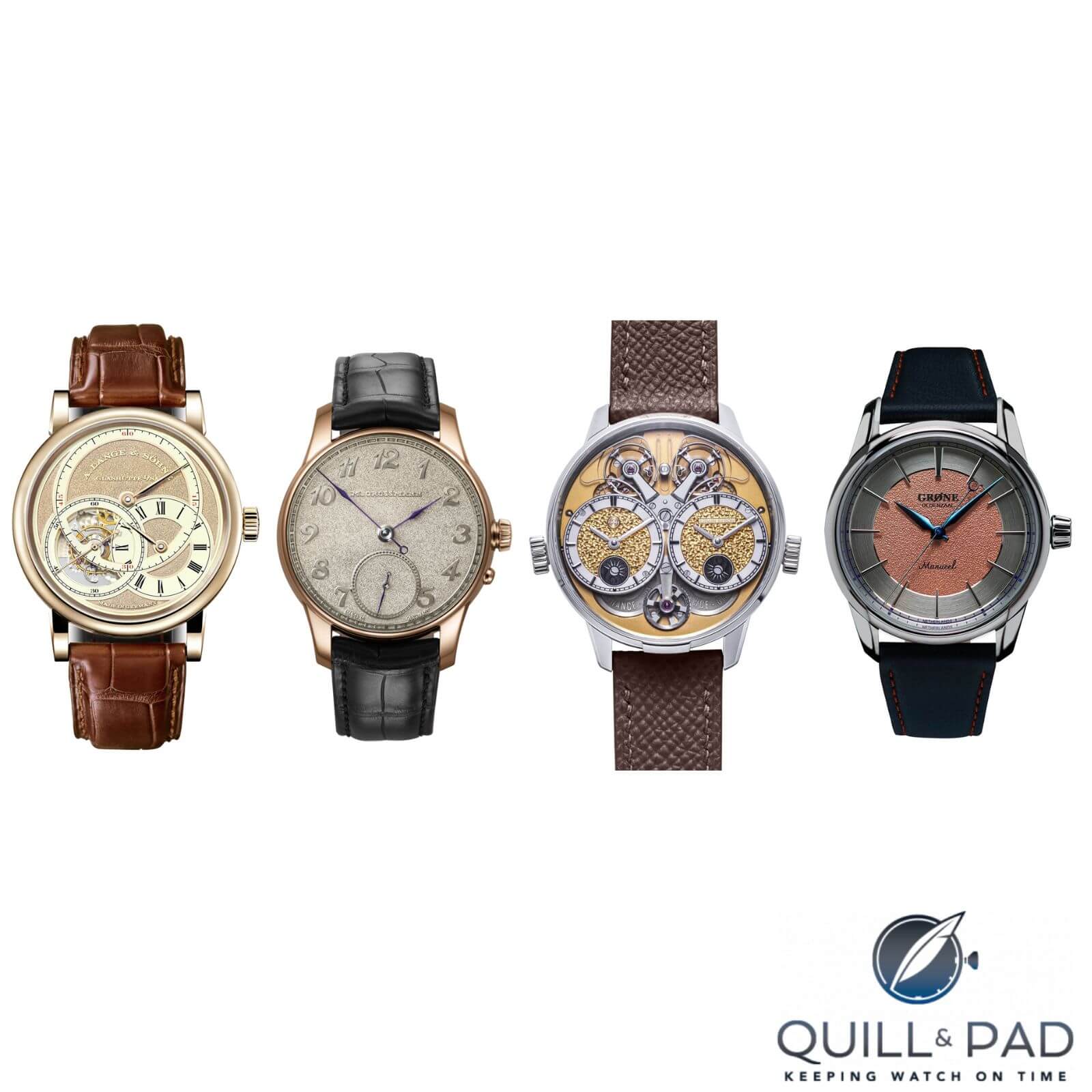
Tremblage club: A. Lange & Söhne Richard Lange Tourbillon “Pour le Mérite” Handwerkskunst Ref. 761.050; Moritz Grossmann Tremblage; Armin Strom × Revolution Dual Time GMT Resonance “Tremblage”; Grøne Oldenzaal Manueel One (left to right; photo courtesy of the companies mentioned).
Moritz Grossmann, Lange’s neighbor in Glashütte, launched the Tremblage series in 2021, featuring a nickel silver dial with tremblage engraving that produces unpredictable color shifts thanks to the emerging patina characteristic of nickel silver. Since then, Moritz Grossmann’s Tremblage line has expanded to include at least four more core designs: the Backpage Tremblage, the Tourbillon Tremblage, the Tremblage Gold (including, surprisingly, a platinum model), and the Tremblage Green. This activity is paying off – Moritz Grossmann’s Tremblage models now show up online far more frequently than those of the pioneer, A. Lange & Söhne.
In 2024, Grøne Oldenzaal, a sub-brand of Grönefeld (Manueel One watches), joined the tremblage club, followed in 2025 by Armin Strom with the Armin Strom × Revolution Dual Time GMT Resonance “Tremblage” watch (reportedly only five pieces produced), and in 2026 by Stefan Kudoke with tremblage versions of the Kudoke 1 and Kudoke 2.
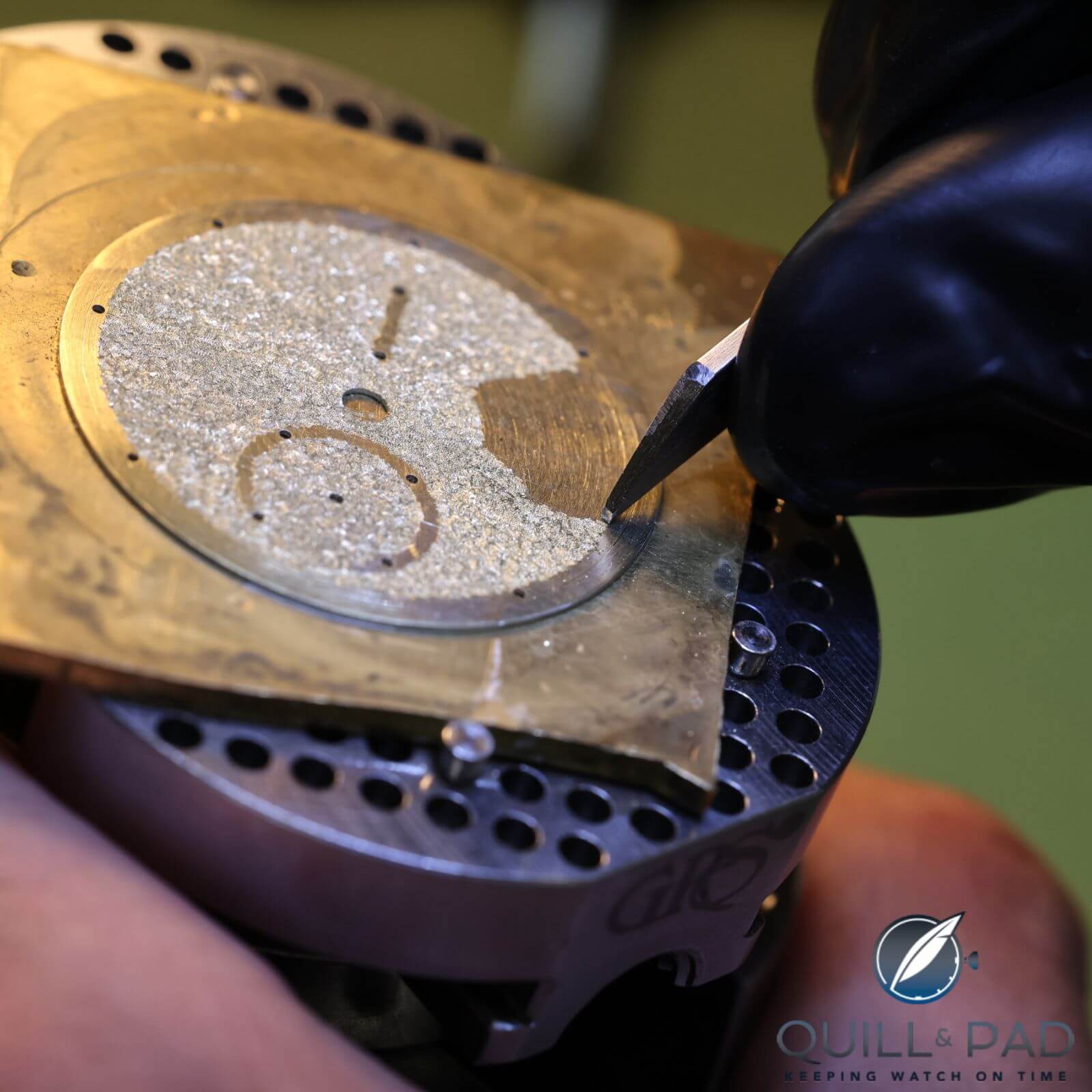
A tremblage dial: how it’s produced by Kudoke.
He’s quite a crafty man, this Stefan Kudoke, which isn’t surprising, as he consistently shows he can offer collector-grade watches at a reasonable price. I can vividly imagine Stefan figuring out how to deliver the right tremblage texture at a fraction of the “normal” cost. Essentially, he’s done three things to achieve that. First, he uses a brass plate as the dial base – not solid gold or German silver. Second, the design is based on a flat plate, which is then electroplated and fitted with appliqués. This means that when engraving, the areas adjacent to the appliqués don’t need to be precisely or perfectly finished right up to the edge – the margins of the engraved area are simply hidden beneath the appliqués. Finally, the engraving is done with a serrated burin, which allows him to obtain a consistent tremblage texture much more quickly.
When producing a tremblage dial, Stefan Kudoke focuses on the most important thing: providing the maximum amount of tremblage, and that’s exactly what we want. In the Kudoke 1 model, the main tremblage dial section is combined with a small seconds subdial at 9; in the Kudoke 2 model, with a day/night indicator.
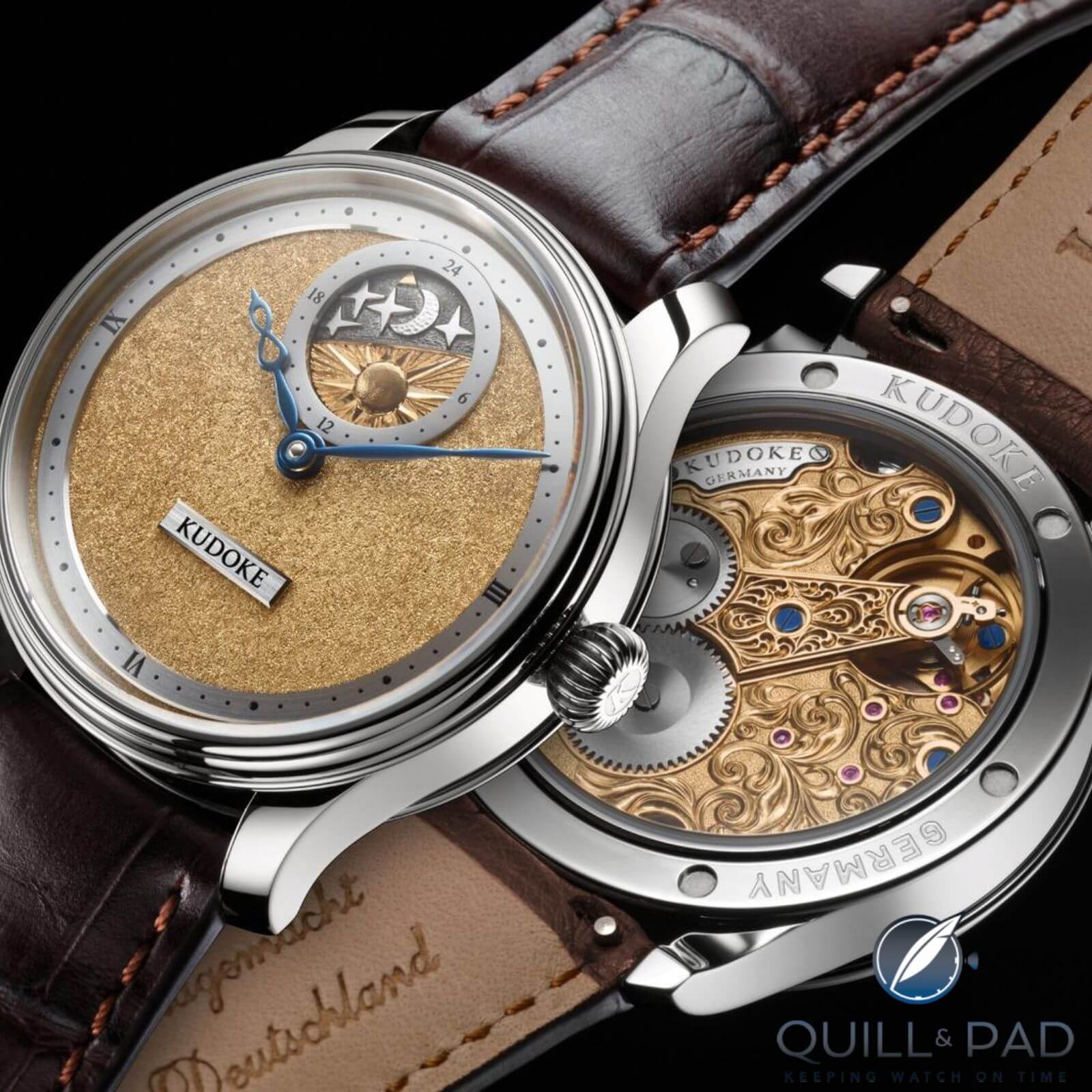
The Kudoke 1 Tremblage watch features a dial with blued spade and whip hands, including the characteristic double-spade hour hand.
The uniform, chaotic texture of tremblage gives the watch a look far beyond what we typically expect from decorative pieces. The matte finish it creates brings these watches aesthetically somewhat close to a military style. This is not a sugary take on the decorative genre but a partly austere, partly military offshoot.
Stefan Kudoke achieves this in all three versions of the Kudoke 1 Tremblage, with gold-plated, rhodium-plated, and black rhodium-plated dials. All three are convincing, and if I had to choose, I’d go for the versions with blued hands. They add an additional, fitting archaic note, largely thanks to the well-chosen spade-and-whip shapes that – coincidentally? – first appeared in the late 18th century. One of the first watchmakers to regularly use such hands in the 1770s was none other than John Arnold.
I’ll also note that the double-ended hour hand, which Stefan Kudoke intended to resemble a horizontal figure eight, the infinity symbol, seems to me more of a nod to the double-spade hour hand, a hallmark of traditional half-hunter pocket watches. Indeed, the Kudoke 1 wristwatch would benefit from a half-hunter front case cover (if someone wants my opinion).
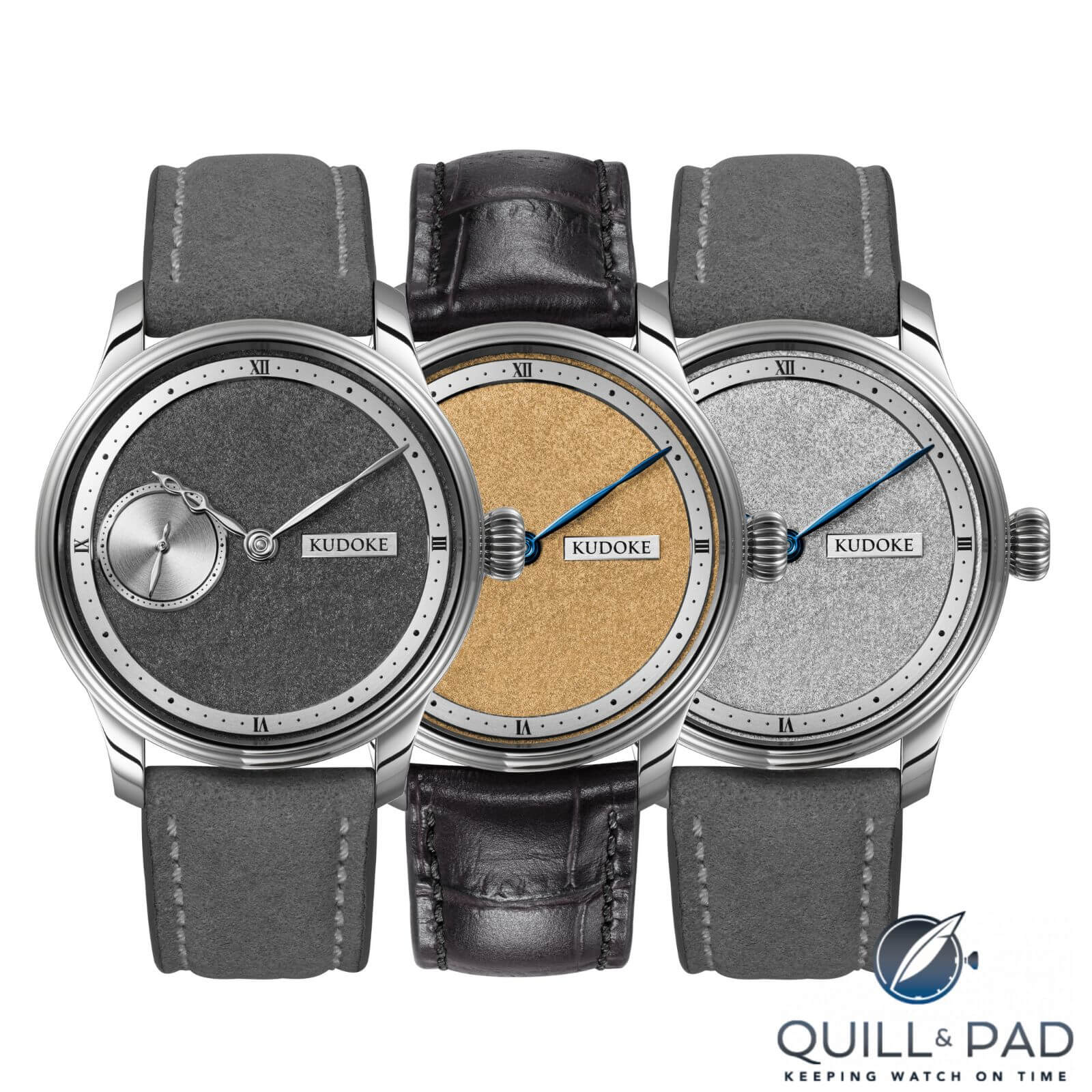
Все три версии Kudoke 1 Tremblage.
When you pick up a watch from a small, independent, creative brand, your first instinct is to flip it over and see what’s underneath the sapphire caseback. It’s always a pleasant surprise to discover a special movement you won’t find in other brands’ watches – an alternative to the SW200/300, Eta/Unitas 6497/6498, and other highly capable options that help watchmakers avoid the significant effort, time, and expense of equipping watches with fully specialized calibers. If you look at the current flagship Handwerk collection from the independent brand Kudoke, it’s built around exactly this kind of special caliber, simply named Kaliber 1, with nothing in common with industrial, mass-produced options.
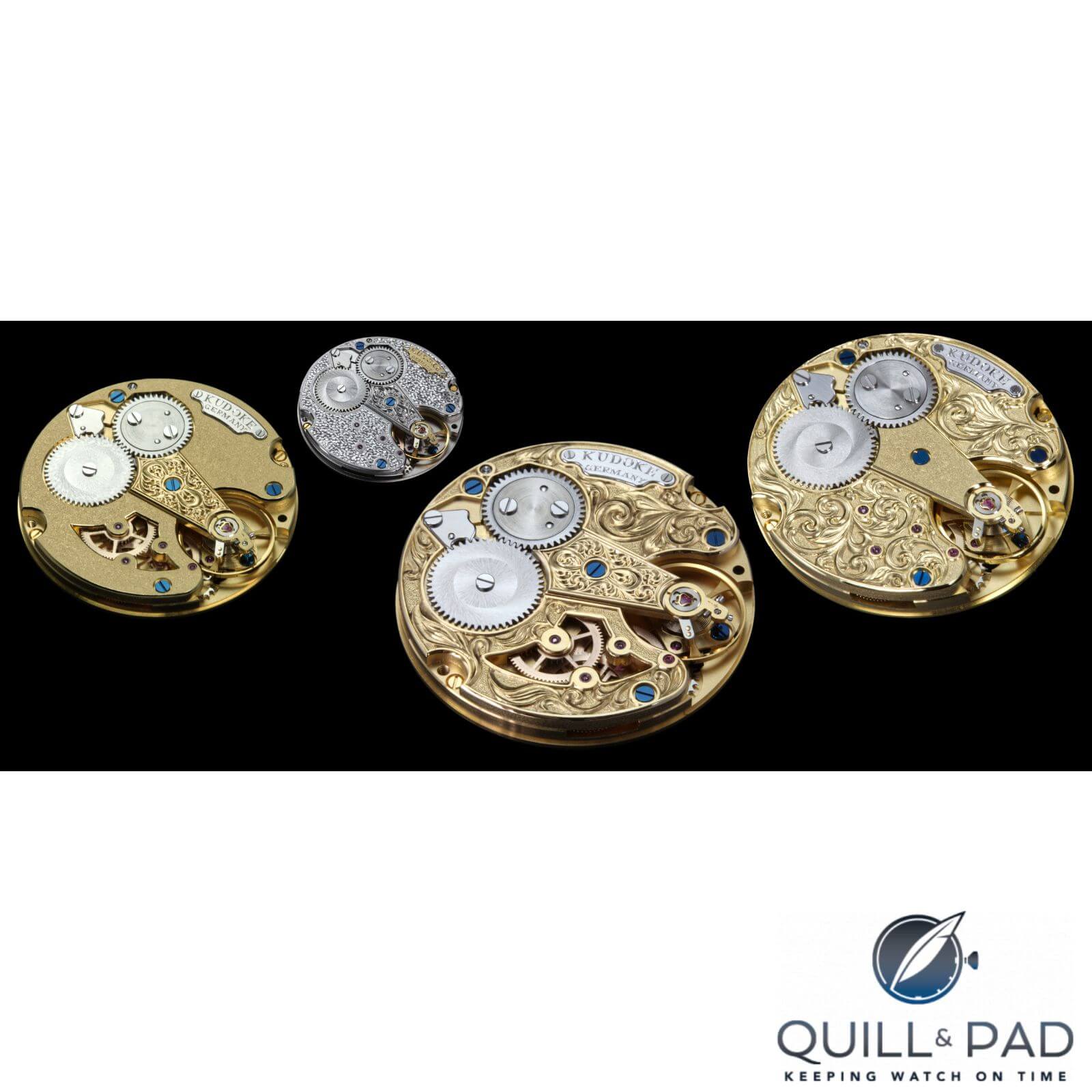
Four versions of Kudoke Kaliber 1.
Kaliber 1 is puzzling at first glance. Its design is clearly unique. Stefan Kudoke himself admits that its roots lie in an antique English pocket watch caliber from the 19th century that he once bought. The movement design of this type actually emerged in the final quarter of the 18th century. During that period, some English watchmakers, including the renowned John Arnold and Thomas Earnshaw, who still retained the innovative spirit characteristic of their country’s watchmakers in the 17th and 18th centuries, began to abandon the ornate Baroque balance cock in favor of the aesthetics of the Industrial Revolution, equipping movements with a symmetrically positioned, simply shaped, stepped trapezoidal balance cock.
The central balance cock of Stefan Kudoke’s Kaliber 1 movement, slightly elevated above the symmetrical backplate and flanked by the crown wheel and ratchet wheel, immediately captures your attention, making its origins difficult to discern without some guidance. Only by digging around on the internet can you uncover the unusual history of this unusual caliber.
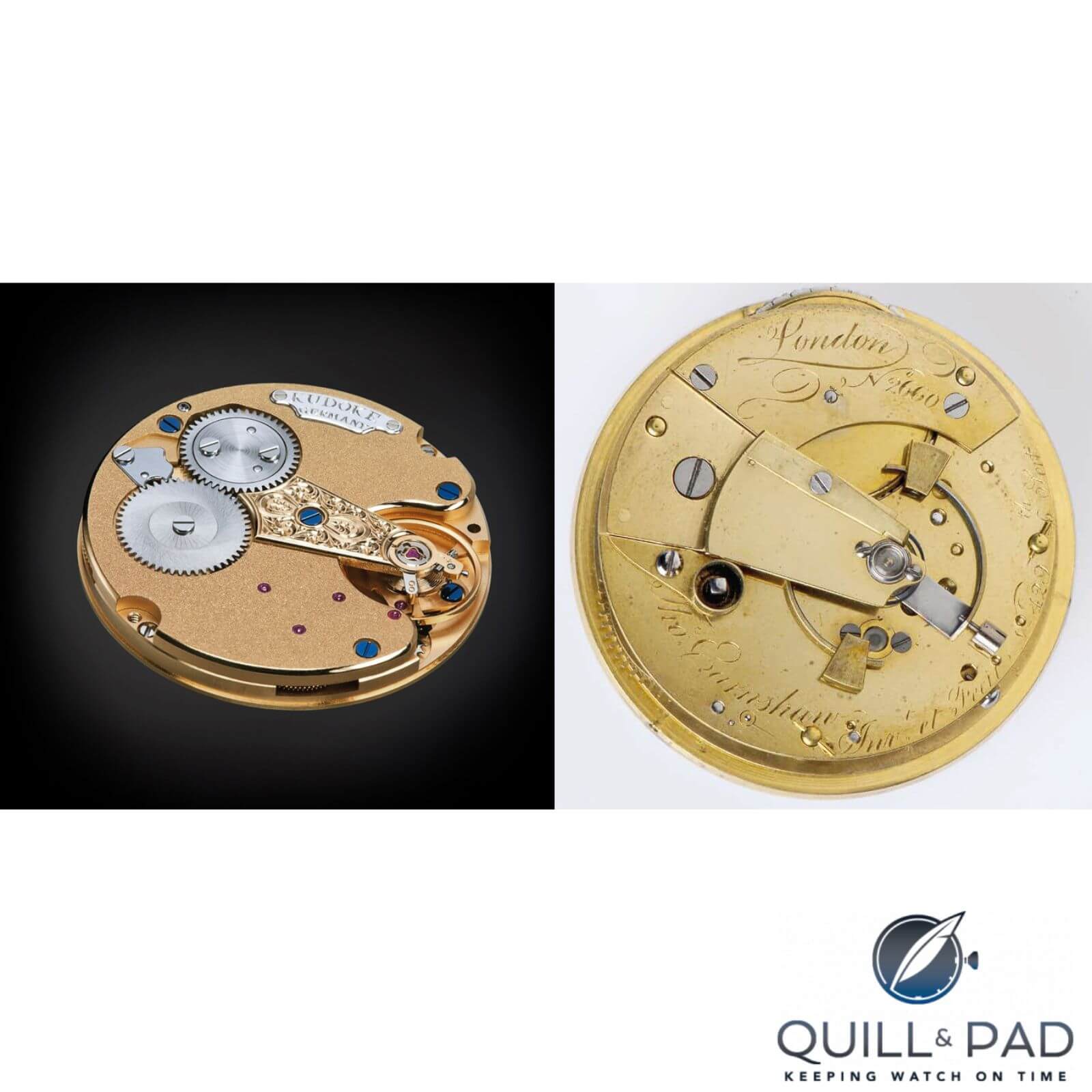
Kudoke Caliber 1 and a possible historical prototype: the movement of Thomas Earnshaw pocket watch No. 429-2660, circa 1799 (photo courtesy of Dr. Crott).
The origins of this story go back to a problem many independent watchmakers and brands faced in the 2000s. It was triggered by Nicolas Hayek Sr.’s announced 2002 strategy for Swatch Group: refusing to supply ébauches to companies outside his corporation. Austrian independent watchmaker Richard Habring, who had earned a reputation for adapting the Eta/Valjoux 7750 chronograph caliber to various complications, decided to play it safe and develop his own caliber, essentially a base movement derived from the 7750. He could do so safely, as the intellectual property rights to the 7750 had long since expired; it was developed in 1972.
Technically, it works like this: the watchmaker uses the kinematics of the base part of the movement – what’s left if the 7750 is stripped of everything it was designed for in the early 1970s, namely the chronograph and self-winding mechanisms. Thus, in 2011 Rachard Habring developed the A11 caliber, its own interpretation of basic part of the 7750 movement, as it could have been but wasn’t produced since the 1970s.
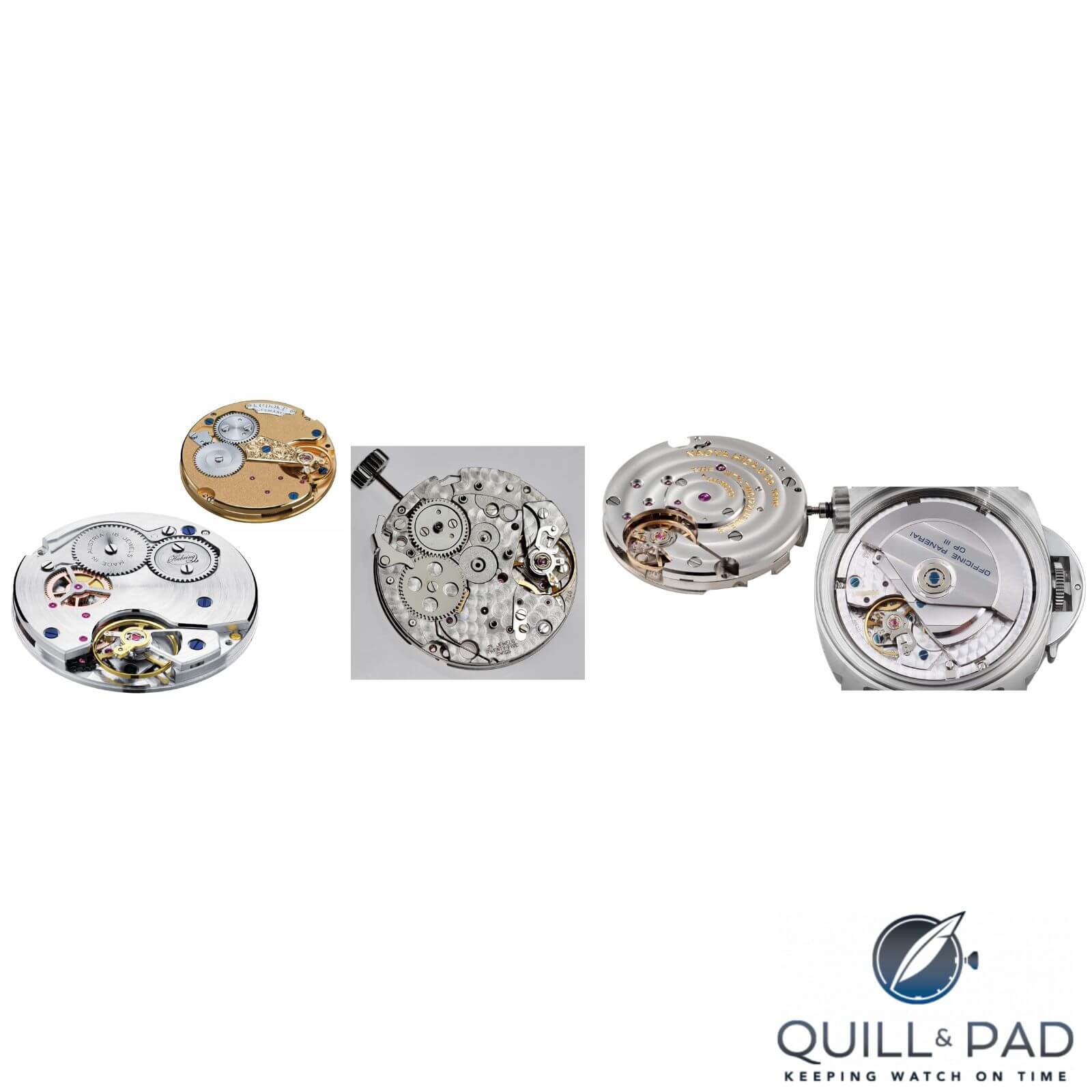
The Valjoux 7750 and its relatives: Habring A11, Kudoke Kaliber 1, Valjoux 7750 with the chronograph and self-winding mechanisms removed, Naoya Hida 3020CS, and Panerai OP III (from left to right; photos courtesy of Habring, Kudoke, thenakedwatchmaker.com, Naoya Hida, and Zeitauction, respectively).
Richard Habring wasn’t the only watchmaker to come up with this idea. Naoya Hida, a Japanese entrepreneur who founded his eponymous brand in 2018 and launched its first watch in early 2019, also relies on the stripped 7750 caliber as the base for the movements he produces for his collection. Around the same time, in 2018, Stefan Kudoke began collaborating with Richard Habring, adapting Habring’s A11 caliber to his own design, with a symmetrical layout and a central balance cock.

Mr. Habring, Mr. Hida, and Mr. Kudoke are absolutely right, by today’s standards, to rely on the “gold remnant” of the 7750. By the early 1970s, if Swiss watchmakers had perfected one thing, it was the simplest manual-winding calibers with minimal functionality – two or three hands, with the third hand being a small seconds, which adds nothing kinematically to the basic two-hand caliber. It should be noted, however, that contrary to modern views, in the early 1970s the automatic winding system was still considered an advanced feature, and when combined with a chronograph, it was seen as an avant-garde technical development. To understand the overall evolution of self-winding chronographs, it is also worth mentioning that the first automatic Rolex Daytona appeared in 1988, 16 years after the Valjoux 7750 was introduced.
Also worth mentioning in this context is Panerai, for which Soprod reportedly stripped the 7750 movement down to create its three-hand OP III self-winding caliber in the late 1990s. Why did Panerai use this in the early and mid-Richemont period? The answer is simple: the brand exploited this caliber’s inherent feature – small seconds at 9 o’clock (technically, we characterize it as a Lepine-type caliber)—which allowed Panerai to recreate a rugged version of the military style established, according to the official version of the brand’s history, back in 1956 with the Egiziano models featuring the 8-day Angelus cal. SF240 movement, which had exactly the same small-seconds position. What else, it would seem, would a modern Panerai collection need to support its rugged military image? As an off-topic aside, I’ll note that Panerai extensively used OP III in models of the not-at-all severe, but rather very decorative Sealand line (originally Black Seal), launched in 2002 and continued almost unnoticed by most of the public until about 2011.
Among the relatively small field of models with tremblage finishing, Kudoke watches stand out for their uniquely distinctive style – arguably one of their most important qualities. Stefan Kudoke offers his own vision of decorative watches that don’t overwhelm with excessive ornamentation, unlike many modern pieces in this genre.
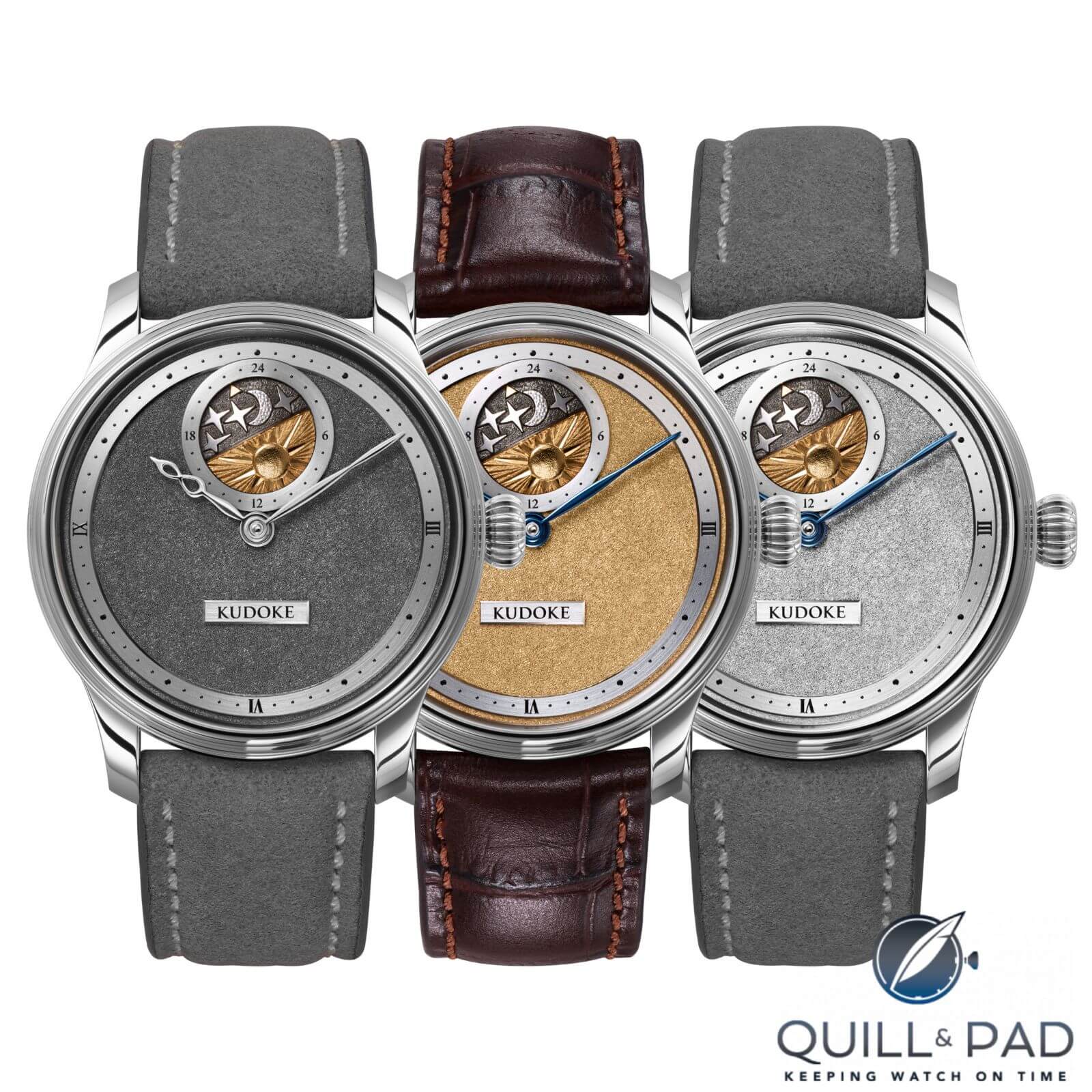
All three versions of the Kudoke 2 Tremblage. The subtle texture of the tremblage serves as a contrasting backdrop to the signature day/night indicator.
All photos, except where noted, courtesy of Kudoke.
Read more like this:

