
Why Accuracy Matters To Me, And Why It Should Matter To You Too
by Ian Skellern
To mark its 50th anniversary in 2009, the International Museum of Horology in Le Locle, Switzerland launched an international chronometry competition. This effectively broke a long drought of 37 years since the last timing trial, which was held by the Observatory of Neuchâtel back in 1972.

The demise of the trials − and there were quite a few of them − in the late 1960s and early 1970s was due to the seemingly unstoppable dominance of quartz regulators, over mechanical. Quartz blew away its mechanical competition in terms of price, reliability and, whisper it quietly, accuracy. As the Swiss mechanical watch industry could no longer hope to win even its own prestigious timing competitions, it did what was only natural to anyone familiar with young children: it stopped playing, took its toys out of the sandbox and went home.
Until the 1970s, the vast majority of watches were first and foremost timekeepers, i.e. bought for the express purpose of providing the time. As quartz watches were both cheaper and (generally) more accurate, there didn’t appear to be any way Swiss mechanical watches could compete.
And they couldn’t: two out of every three jobs in the Swiss watchmaking industry disappeared. But in the 1980s the Swiss fought back on two fronts:
1. Swatch took back the lower end of the market with a much simplified movement and great marketing.
2. High-end Swiss brands were reborn as objects exuding “luxury” and “exclusivity” rather than watches to tell the time.
Since then we have seen unparalleled growth in ever more complicated wristwatches, ever more artistic wristwatches and even ever more high-tech mechanical wristwatches.
Despite generally increasing numbers of C.O.S.C.-certified chronometers each year, what we haven’t seen (as yet) is unparalleled growth − or in fact, any growth at all − in more accurate mechanical wristwatches.
Naysayers don’t hesitate to tell us that that is simply how it should be. We can now find the precise time everywhere: in our cars, on our ovens and of course, on our ubiquitous mobile phones. So it’s only natural that wristwatches with mechanical movements have evolved away from being, or aspiring to be, highly accurate timekeepers and toward being pretty strap-on baubles of one-upmanship.
While I do not agree with that line of reasoning, I can at least understand it. However, an argument against accuracy mattering anymore that I find particularly inane is basically the same reason that the international timing trials stopped in the early 1970s, i.e. movements with mechanical regulators cannot compete against quartz regulators, so there is absolutely no point in them competing at all.
Taking that line of reasoning to its logical conclusion would mean that wristwatches will eventually become arm-borne kinetic (or even static) sculptures with no ability to tell the time. Why bother at all when more accurate time is available elsewhere?
And that would imply that the only competition at all worthwhile is that between the world’s fastest, strongest, most accurate, etc. rather than competition between similar classes of athletes or machines. If mechanical watches shouldn’t compete in accuracy trials because they cannot hope to beat quartz, then should all women’s sporting events be dismissed because they cannot hope to beat men? Are all sporting competitions useless unless between world champions that have a chance of being the absolute best? For that matter, should all sporting competitions based on speed be cancelled because running and swimming fast is now obsolete thanks to more velocious cars, bikes and boats?
Why accuracy matters
Accuracy matters, or to be more precise, matters to me in a mechanical wristwatch because telling the time as precisely as possible is what defines a mechanical wristwatch.
A mechanical wristwatch movement isn’t just a cleverly designed series of gears, springs and bridges going around and around to entertain or provoke the intellect like a miniature Tinguely sculpture: the whole raison d’être of a mechanical movement is to tell the time.
And these days the “time” is an extremely precise measurement known, thanks to atomic and quantum clocks, down to around 19 decimal places: 0.0000000000000000001 of a second. The NPL-CsF2 caesium fountain clock operated by the National Physical Laboratory, which is the U.K.’s primary time reference, is not expected to gain or lose a second in more than 138 million years.
For centuries, horologists have been on a quest for ever better accuracy, and this has led to advancements in materials, techniques, tools, machines and fantastic inventions like the lever escapement, chain-and-fusee constant force, tourbillon and Glucydur balance wheel to name but a few.
They searched for ways to make watches better timekeepers because that’s what a watch is, a keeper of time. Not a keeper of approximate time, but a keeper of time.
I am a big fan of contemporary watchmaking, and I applaud the creativity of many watch brands in terms of design and functionality, but if you are going to call yourself a watch brand, then your watches have to first and foremost tell the time.
For a mechanical watch, telling the precise time is what defines the rules or the playing field in watchmaking. Finish, complexity and design are all things that differentiate between various mechanical watches, but telling the time accurately is what makes them one.
And telling the time well is an endeavor that deserves our admiration and support.
A Ferrari might look fantastic when parked, but the name resonates around the world not because of its beauty, but because it wins races. Does anyone really think that Ferrari shouldn’t compete because planes and speed cameras have made fast cars obsolete?
I feel that it’s a shame that the world’s largest award ceremony for watches, the Grand Prix d’Horlogerie de Genève, offers a Revival Prize for the best contemporary reinterpretation or reissue of an iconic old model, which is basically an award for innovating the least, but nothing to highlight the importance of accuracy.
International Timing Competitions
So I tip my hat to the organizers of the new International Chronometry Competition for making ever better precision a worthwhile endeavor in its own right.
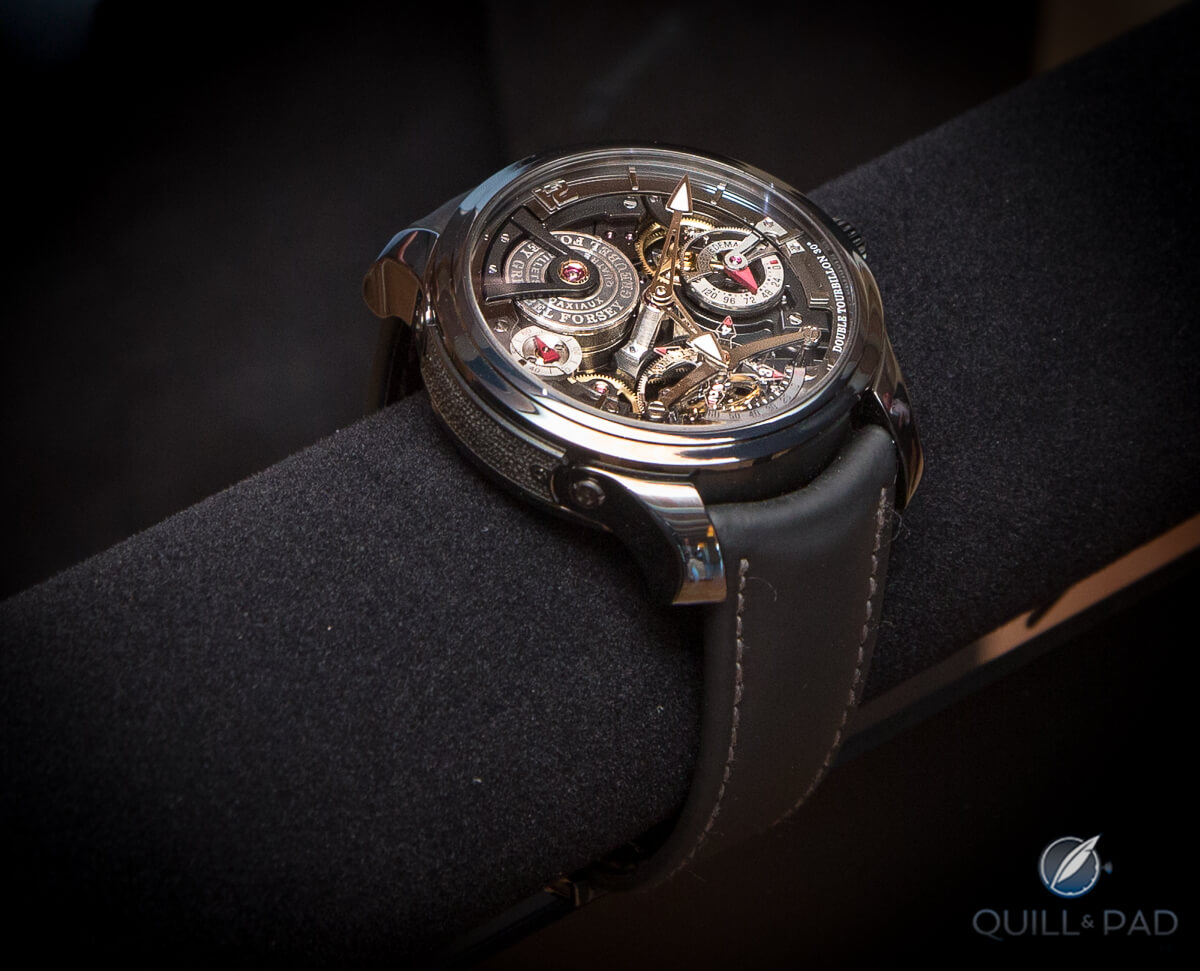
And I salute brands like Jaeger-LeCoultre, who won the first competition in 2009, Greubel Forsey, who won in 2011 (and still holds the record for the most accurate watch), and Tissot in 2013, as well as all of those who entered because competition is never easy: there are always many more also-rans than winners.
But for all of their best efforts, the organizers of the new International Chronometry Competition don’t make it easy to applaud too loudly. Calling it the European Chronometry Competition would be a lot more accurate a description because the competition appears to have been − and in fact has been − deliberately designed to deter non-European competition as much as possible.
But what really holds the competition back is that it is held in total obscurity. To protect the fragile reputations of the brands entering the competition, we are told what watches have entered each year and then a few months later the winners are revealed – nothing else.
What excites people is the competition itself, not the result. Imagine a Formula 1 race in which we see the cars line up on the grid, the starting gun fires, the screen goes blank for two hours and then the winner is announced. That wouldn’t make for good TV and the present format of the International Chronometry Competition doesn’t make for an interesting public event. And to really take off, the trials have to become an interesting public event and I can’t help but worry that they are more likely to become more of an industry platform for benchmarking rather than a true competition.
While both formats – a real international competition that the public cares about or a precision benchmarking service for the industry – are much better than nothing in terms of marking improvement of the precision of mechanical watches, unless the public finds a reason to care about better accuracy then it’s unlikely to amount to much.

What I’d like to see is a move to a more transparent timing competition that the public can follow. That doesn’t have to happen in one go (and scare off the brands from entering), but I would like to see that being the direction that the competition is headed. And I would like to see brands that have invested considerable time, energy and money into developing materials and mechanisms purportedly to improve accuracy, e.g. Girard-Perregaux’s Constant Escapement and Romain Gauthier’s Logical One, to put their watches to the test.
Aiming for better accuracy in a mechanical watch is something to be recognized and appreciated; however, aiming for something isn’t the same as hitting the target.
To break the rules you have to first master them. That applies to horology as much as it does to improvised jazz and abstract painting. And in terms of watchmaking, that means that a watchmaker should understand how to make an accurate watch before adding artistic embellishments or layers of complications. Precision isn’t just one of many attributes a watch might have, it is something all watches should have. Aiming for high precision is the noblest aim of all.
Trackbacks & Pingbacks
-
[…] For more about the International Chronometry Competition (and a little rant), please see Why Accuracy Matters To Me, And Why It Should Matter To You Too. […]
-
[…] To give you an idea of how strongly I feel about the subject, the very first article I published on Quill & Pad − in fact, the very first article ever published on Quill & Pad − was called, Why Accuracy Matters To Me, And Why It Should Matter To You Too. […]
-
[…] Time Trials…the importance of […]
-
[…] Performance: they have been willing to put their claims to the test; one noted success was the runaway victory of the Double Tourbillon Technique in the 2011 International Chronometry Competition. […]
-
[…] * The next edition of the International Chronometry Competition officially launches on May 26 during a press conference that will highlight regulation and organizational changes for the fourth edition, which is likely to include a new category for chronographs. Naturally, Quill & Pad will be following this exciting event as it unfolds. For more information on the competition, read Ian’s article on what accuracy means to him: Why-accuracy-matters-to-me-and-why-it-should-matter-to-you-too. […]
-
[…] pieces for a couple reasons, one of which deserves much more consideration after a certain friendly competition where it amassed a record score and eliminated all doubt about its […]
Leave a Reply
Want to join the discussion?Feel free to contribute!

accurate cheap wearable time information is a commodity since the 70s and the quartz revolution. it has recently moved out of the wrist to go to the pocket on the smartphone,and could well be back on the wrist with the connected wearble tech, or smartwatch or whatever we call it these days. This has very little to do with luxury. Owning and wearing a mono purpose device, that does not need to be hooked up to a mini usb for its daily dose of energy is real luxury. Wearing a mechanical time piece that is more accurate today than the fine chronometers that were produced and competing in the 60s is completly luxury, for me and this is where the current innovators in modern high end watchmaking sit and compete. In my humble opinion, luxury is not meant to be useful: the “useful” has to asnwer at best the fast good and cheap triangle, which nowhere near luxury.
in that context, is accuracy desirable: for sure it is and numbers prove it. the COSC certificates are produced in higher numbers each year, several high end poincon have been put in place by several brands or regionally (poincon de geneve). All of these include accuracy in their specs.Winning the revived chronometric competition is definitely an added value to the brands who dare to compete.
Is accuracy part of the elements defining high end watches: Yes is the answer. Is this the main element, or a very significant element: I think it very much depends on the profile of the wealthy customers, but all of them expect their high end watch making to be accurate enough to not require a daily adjustment of the time, I think
Thank you for your thoughts on accuracy, Jean-Philippe, and pointing out the popularity of COSC.
Too bad the European brands are still afraid of Seiko…and perhaps now the Chinese.
I agree that accuracy and its handmaiden, legibility, need to be a primary consideration in watchmaking for it to be legitimate. It’s rather like writing a sonnet; the art form is interesting insofar as you express yourself within certain constraints, and if you abandon the most basic functional attribute of a watch as a primary consideration, you’re not making watches anymore.
Thanks for your participation, Jack, and we do agree with you.
I love the art & science of accuracy in a mechanical time-piece. That’s what makes the mechanical time-piece so interesting to me… all those gears, wheels, springs, working together non-stop, all so delicate pieces experiencing the daily bumps and jerks of our daily life. It all simply amazes me. Each morning I love to check my current timepiece against the Atomic Clock… I’m thrilled when my deviation is just a few seconds fast and even more so if I see consistency within a +-range.
Precision quartz movements are also amazing in their own right. Amazing technological advancement in timekeeping.
But I have such a different feeling between the two forms. The Quartz seems robotic in nature, absolute correctness, flawless; whereas the mechanical movement to me is more human, flawed, problematic, and when it achieves accuracy it has proved itself in overcoming its humanity and has created that special moment (movement) in time. 🙂
To me a mechanical watch is just a complicated way to mistell time. To me there’s nothing human in all those levers, bridges and wheels. For me exact time telling out of Quartz is a likeable mysterie especially when the power is generated by movement ie kinetic.
But anyway, let’s agree to disagree😁👍