
A Collector’s View: Blancpain Introduces the Grande Double Sonnerie
by GaryG
“We choose to go to the Moon in this decade and do the other things, not because they are easy, but because they are hard.”
Pres. John F. Kennedy, September 12, 1962
Greetings to all! It has been a while since I’ve had the pleasure of publishing an article here at Quill & Pad, and it’s good to be back as a guest contributor – this time, to tell the tale of my recent trip to Le Brassus to learn about, and photograph, Blancpain’s new Grande Double Sonnerie.
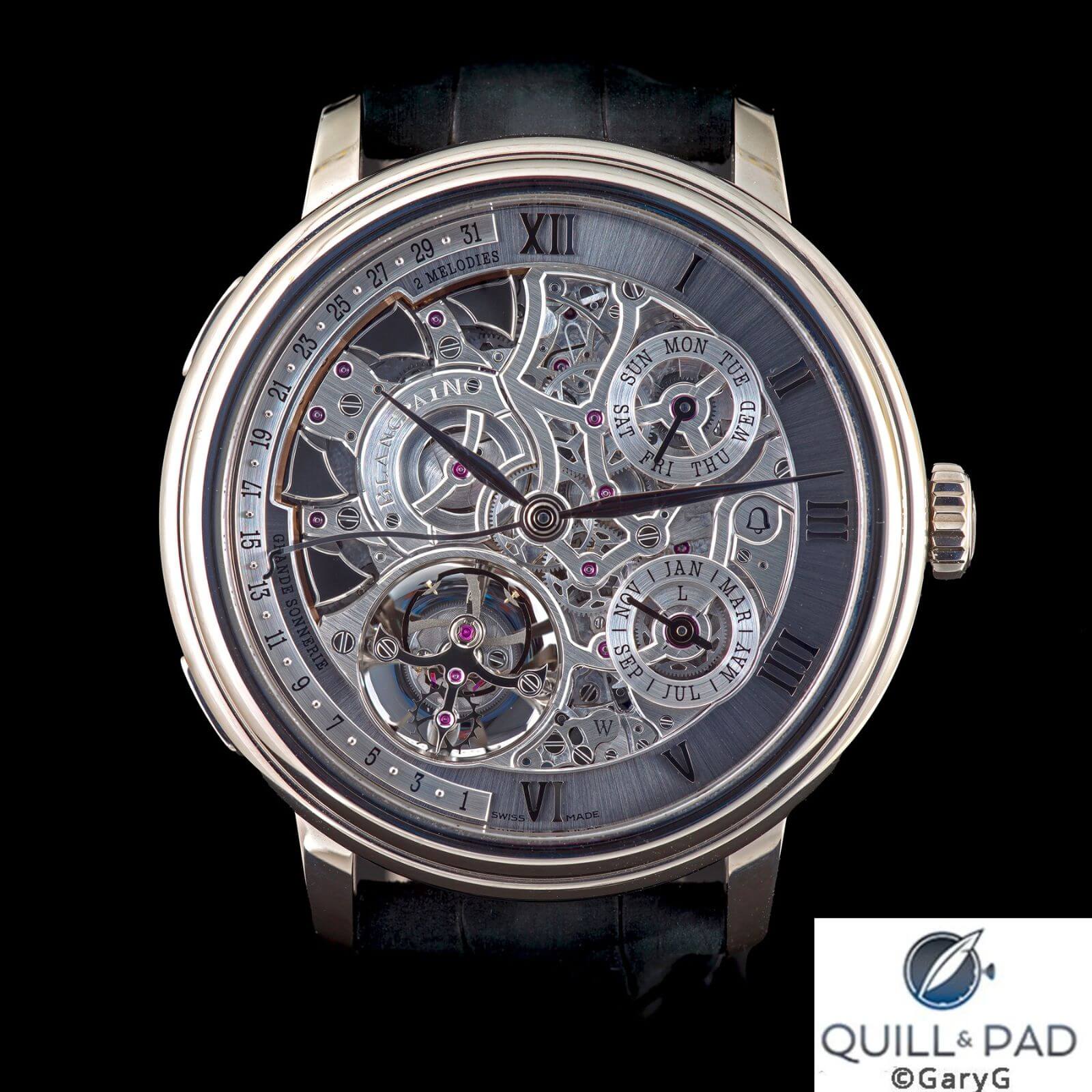
Blancpain Grande Double Sonnerie in white gold
Opening the doors
One of the most remarkable parts of the launch of this watch wasn’t the watch itself, but the transparency with which the Blancpain team treated us and the access they gave to sensitive information about the Sonnerie and its development and manufacture.
In a specially constructed “Laboratory” facility, the four lead watchmakers on the project took us through its phases, explained the motivations, challenges, and solutions contained in each, and patiently answered our questions.

The team behind the Blancpain Grande Double Sonnerie
Each stage in the eight-year process was represented by a prototype on display; first the base movement with flying tourbillon, then the retrograde perpetual calendar, and finally the chiming mechanism.

Multiple prototypes and models from the development of the Grande Double Sonnerie
One element of the fundamental architecture of this watch that I found particularly notable was the use of dedicated regions of the movement for each of the major features; as seen below, for instance, while the long retrograde hand that indicates the date reaches to a scale on the left side of the dial, the perpetual calendar mechanism itself sits to the right as seen from the front of the watch. The prominent, raised flying tourbillon occupies the space at 7 o’clock, and major elements of the sonnerie, including the four black-polished hammers, catch our eye at the upper left.
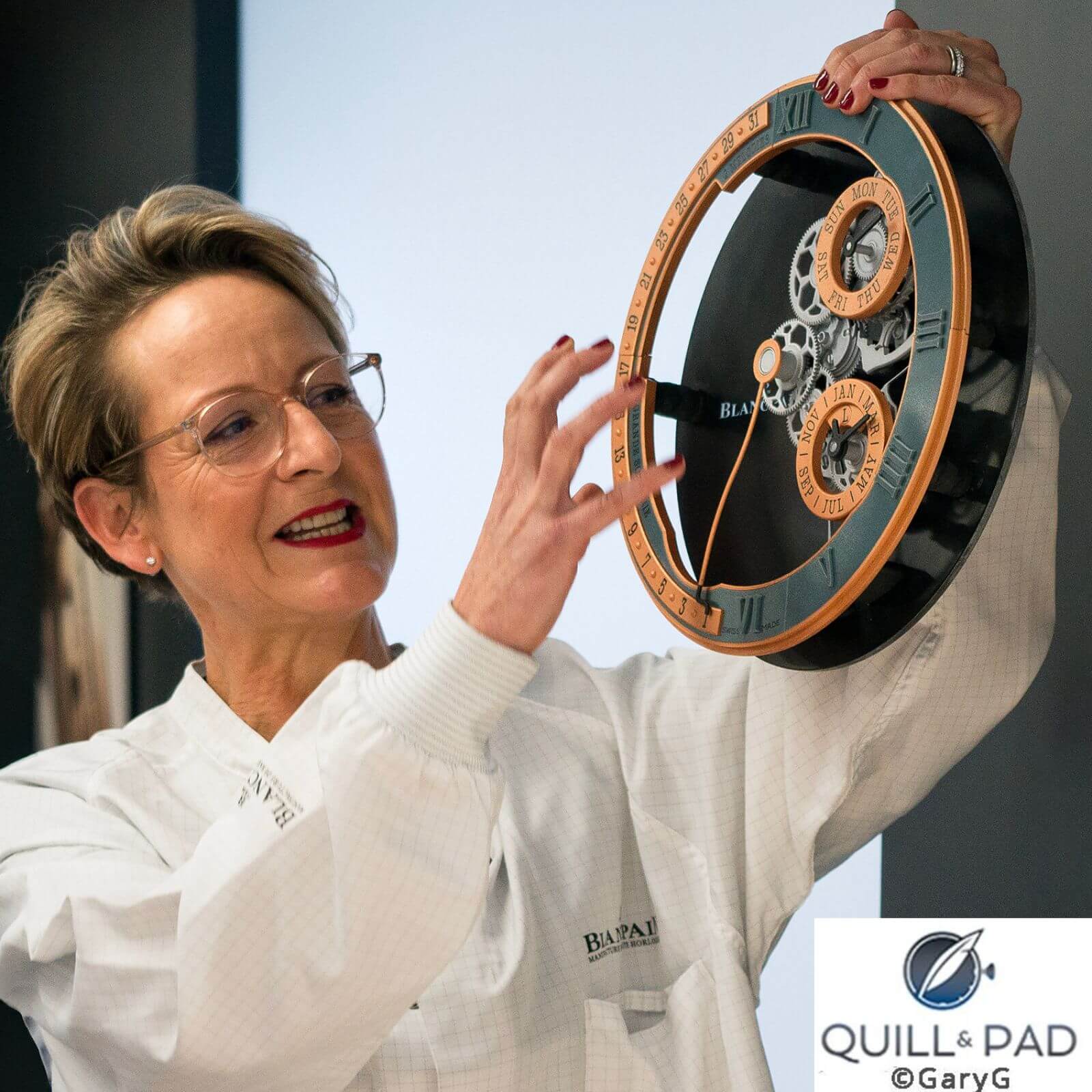
Our guide points out the position of the retrograde perpetual calendar works
At each station, we were able to see actual components through the microscope as their developers described them. Among the best: the vertically stacked racks that control the sounding of each of two different four-tone songs across the quarter-hours, chosen between by a column-wheel mechanism. It’s one thing to conceive of the idea of including not one, but two, Westminster-style chiming patterns in a watch; it’s quite another to develop the elegant technical solutions that allow it to work in a way that is mechanically robust and spatially economical.

Top and bottom racks controlling the two tunes of the Blancpain Grande Double Sonnerie
This thoughtfulness extended to every bit of the technical design; for instance, the use of a magnetic spinning regulator for the chimes (which in turn required that the tourbillon use a silicon escapement design). Some folks enjoy hearing the whizzing sound of a traditional centrifugal regulator in a chiming watch; I’m one of those who appreciates the blessed background silence that this magnetic solution provides.
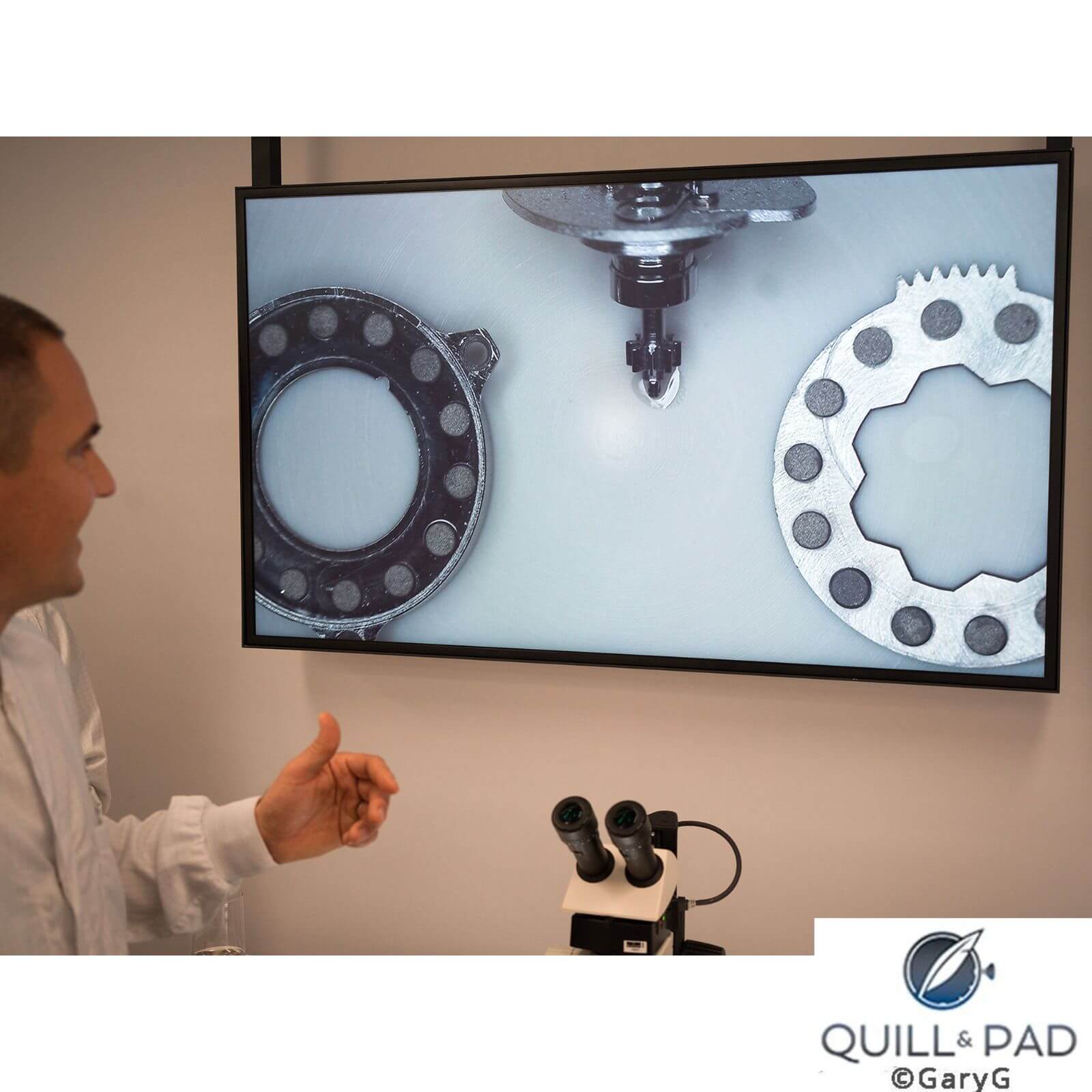
Components of the silent magnetic chiming regulation system for the Grande Double Sonnerie
All that silence is of little consequence, however, if the sound of the chimes isn’t great! I’ll confess that I began to worry just a bit as the next watchmaker took us through a matrix of prime frequencies and related resonant overtones associated with each of the watch’s notes; on a past occasion, I’d seen this type of rational-seeming engineering thinking result in less-than-beautiful sound in another repeating wristwatch prototype. As it turns out, however, I needn’t have worried – as you’ll hear in a bit.
The immediate follow-on to Blancpain’s understanding of the frequencies and overtones needed was the testing of multiple materials, and shapes, for the Sonnerie’s four gongs. The output was a set of gold gongs with a primarily square cross-section (better for precise contact with the hammers) but with the addition of specific bends and flattened sections near the attachment points to create those warm-sounding (if rationally derived) overtones that elevate the chiming performance of this watch from sound to music.
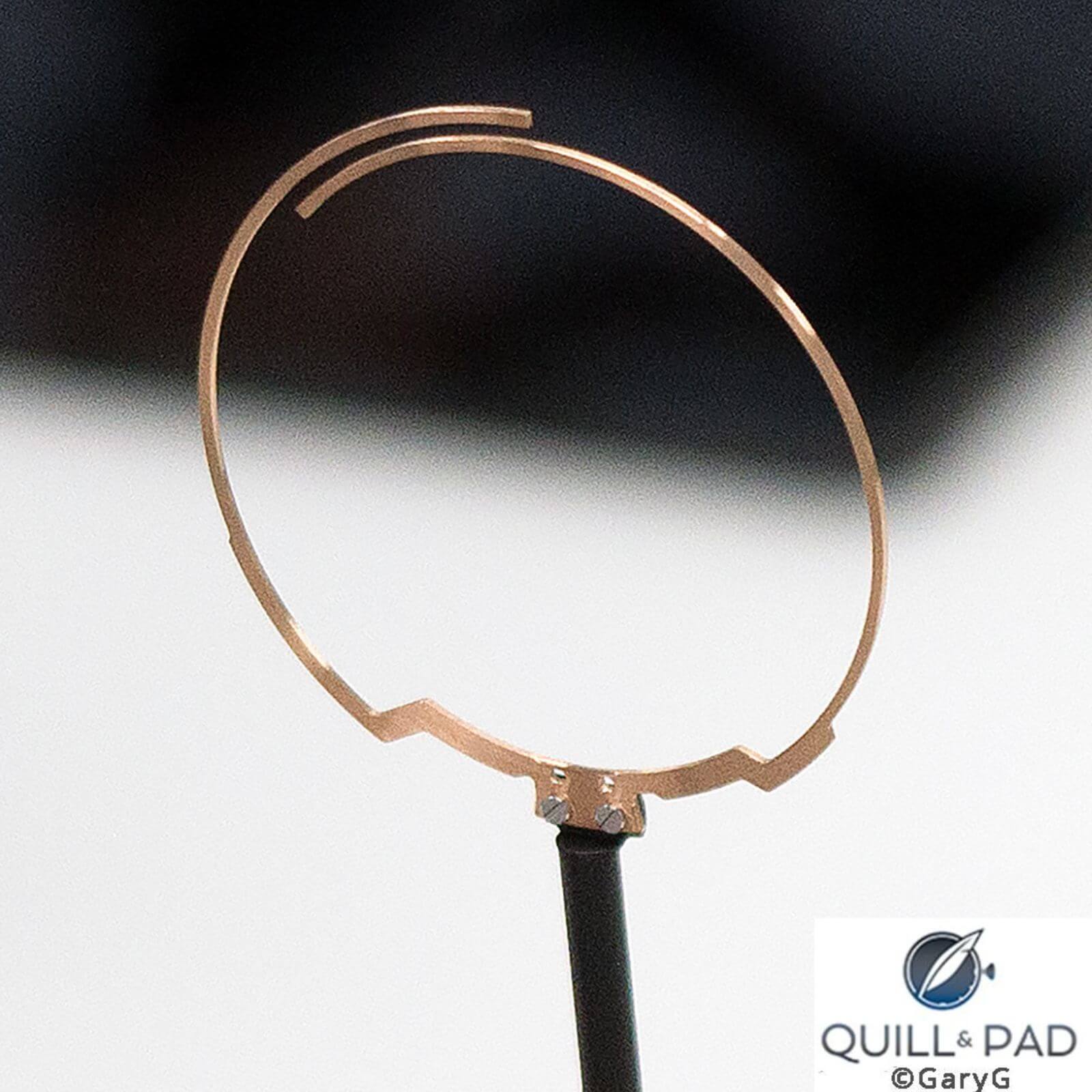
Detail view, shaped gongs of the Blancpain Grande Double Sonnerie
Once generated, the tones are transmitted to the case and crystal through a gold acoustic membrane as seen in the photo below.
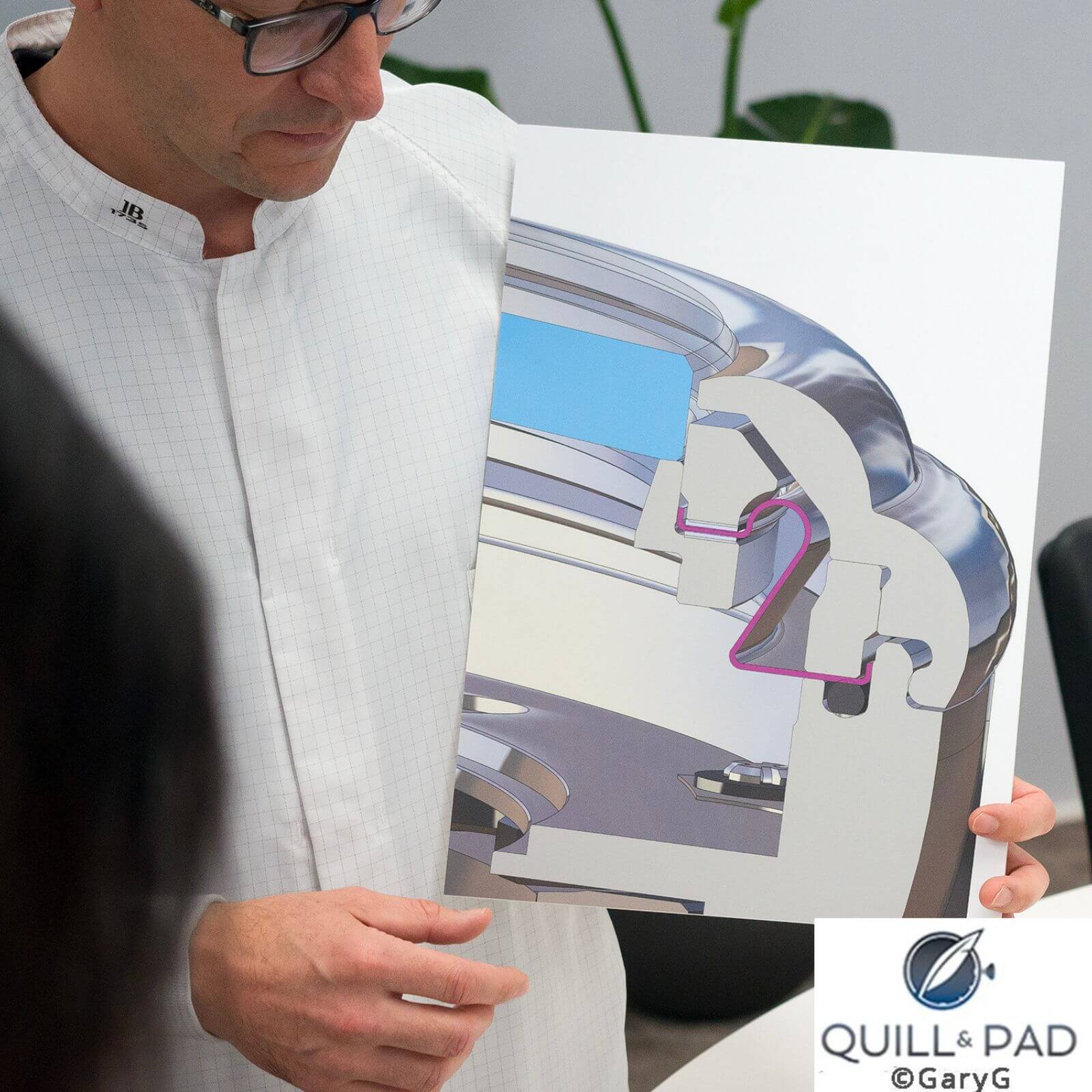
Gold acoustic membrane (shown in red in the rendering) for sound transmission
What about the music itself?
When it comes to chiming watches, I’m a stickler for proper intonation; in particular, when it comes to minute repeaters, I have a very strong preference for an interval of a major third between the tones of the minutes and quarters gongs. Apparently, lots of watch developers don’t share my quirk, however, as in the wild the intervals between tones vary substantially, even across different examples of the same reference.
For a Westminster-style chime that plays a tune, however, failure to sound the four notes we associate with Big Ben would be a disaster. And chiming the right notes, but with improper time intervals between the notes, would be equally jarring. Through painstaking adjustments to the lengths of the gongs, and micron-level filing of the tiny teeth on those stacked actuator racks I showed earlier, Blancpain has managed to address both challenges, allowing the watch to chime out the “Westminster” tune we expect.
But for Marc Hayek and his team, that wasn’t enough; so, they took on the challenge of adding a second “Melodie Blancpain” and engaged KISS drummer and watch nut Eric Singer to assist.
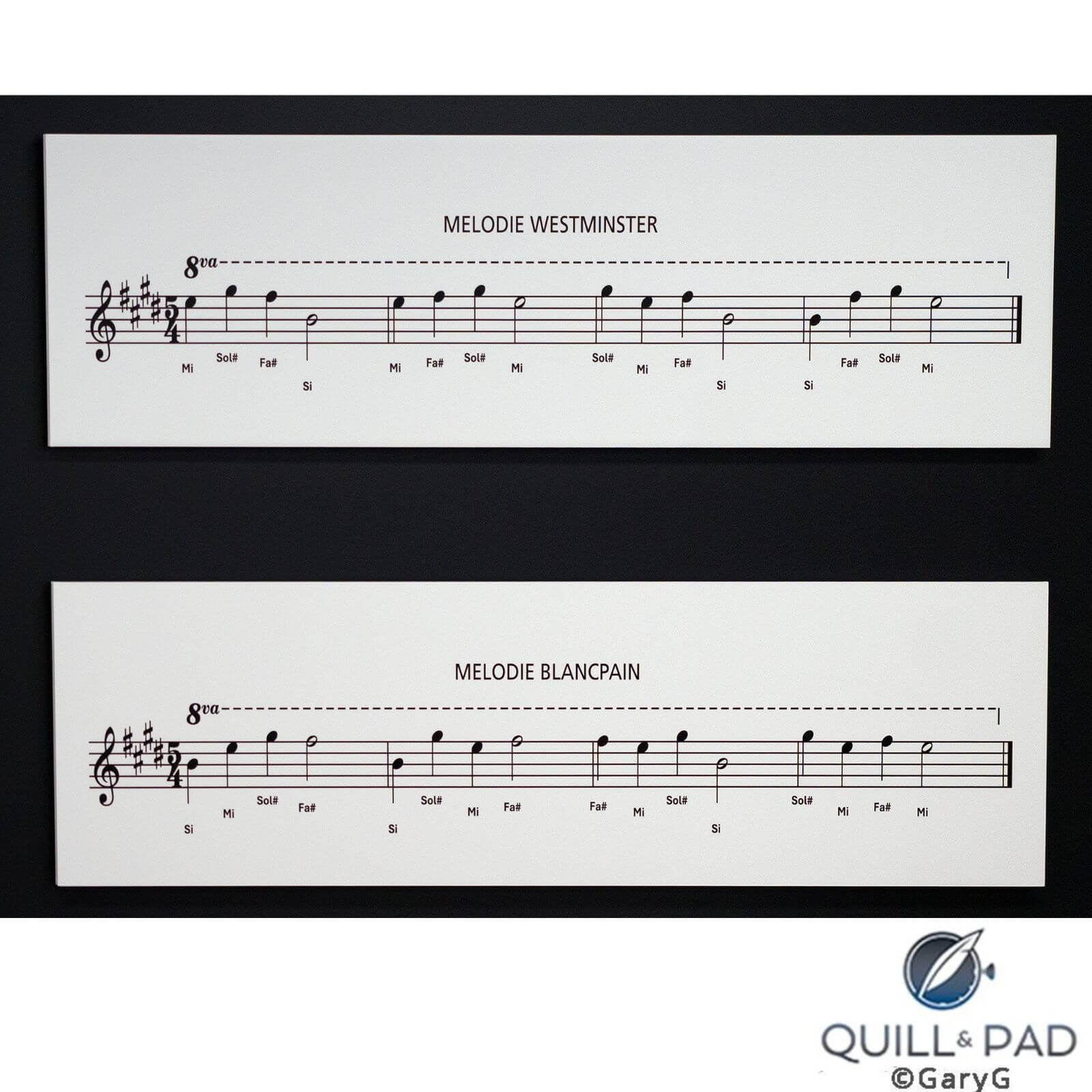
The Westminster and Blancpain melodies
While this might seem a dream assignment for a musician, Singer quickly learned that the request came with a raft of constraints. There were only four already-specified musical notes available; they had to be chimed in sets of four with fixed time intervals; the same note could not be sounded twice in a row; and the tune was limited to sixteen notes in total.
The Singer-Blancpain team ended up with nine alternatives, and selected one as the preferred version – although, upon request, buyers may have the option of substituting one of the others.
For me, the inclusion of the second melody, given all the inherent constraints, veers slightly in the direction of an incredibly difficult parlor trick; but it is so integral to the concept of this watch that I’m finding it hard to argue that it should have been omitted; and I do find the “Blancpain” melody a pleasant alternative to the traditional Westminster pattern.
Manufacturing and finishing
As the saying goes: collectors talk about watches, watchmakers talk about tools!
Suffice it to say that the creation of a watch with 1,116 components requires an extensive toolkit; we enjoyed having the chance to see a small subset of those tools before turning our attention to finishing.
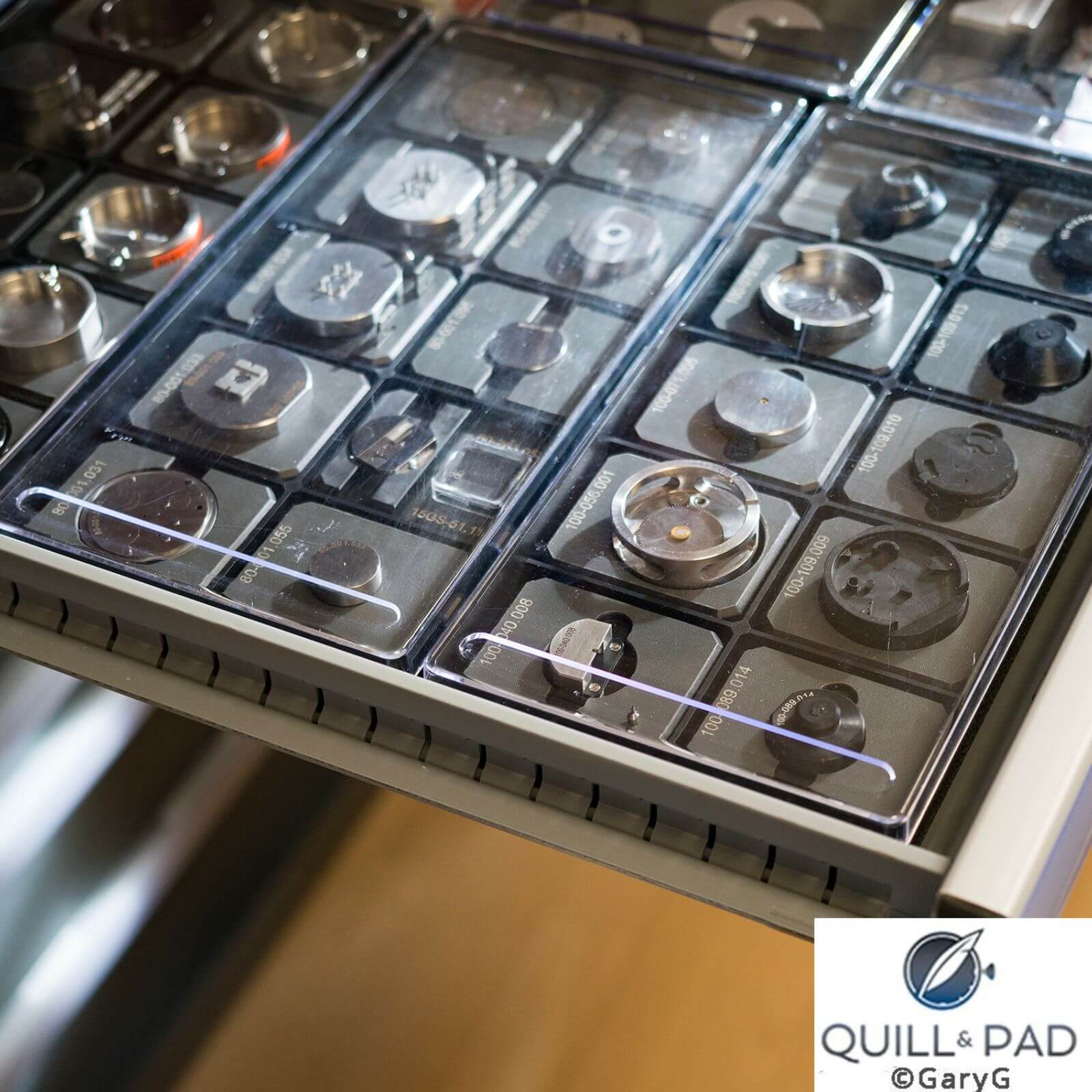
Some of the tools used to make the Blancpain Grande Double Sonnerie
Early on, Blancpain made a commitment that the finishing of the Grande Double Sonnerie would be of the same high level as its technical and sonic achievement; in the atelier, we watched the small group of artisans applying a broad range of finishes, including an astounding array of sharp interior angles created using, among other tools, an engraver’s burin.

Polishing work underway at the Blancpain workshop
The precise instructions set out for each step, such as the application of perlage, are carefully followed and yield (to my eye) excellent and refined-looking results.
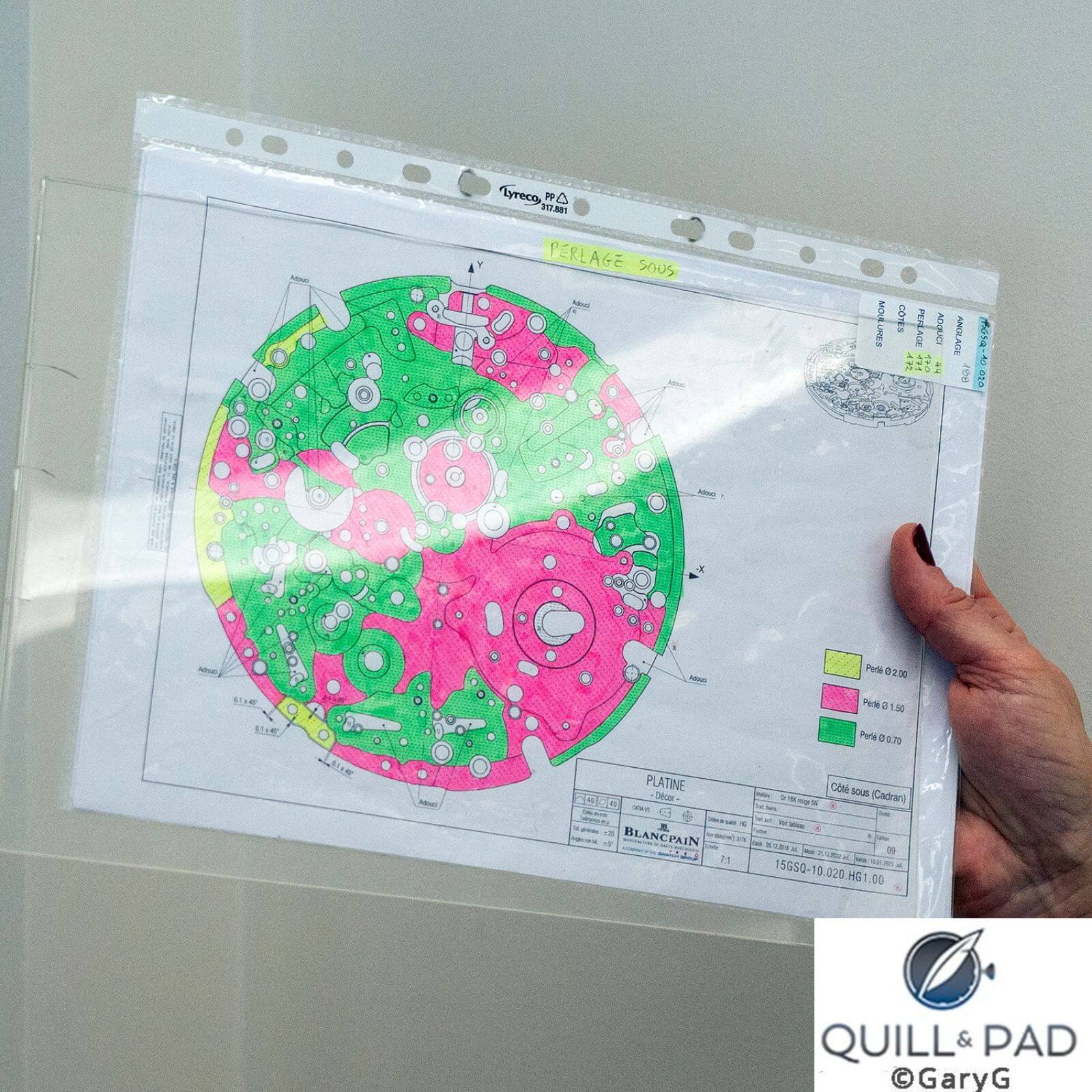
Perlage application diagram for the Blancpain Grande Double Sonnerie
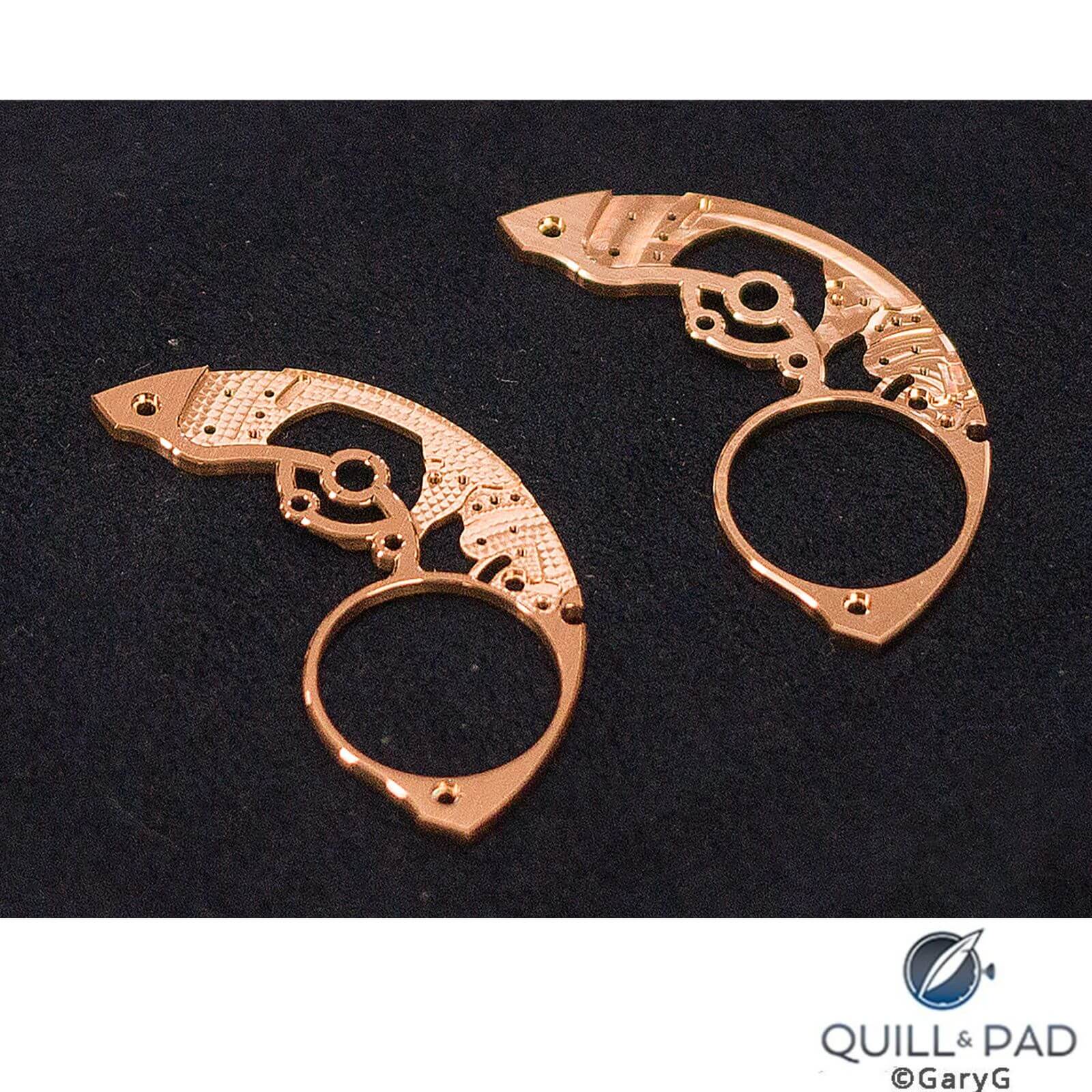
After (left) and before (right); perlage application to a movement bridge
To my eye, the finishing was of a high overall standard, with some of the elements such as black polishing among the best I have seen. If I have a quibble, it is that I would have preferred that many bevels be more fully rounded rather than primarily angled with the burin; for me, the resulting ability to reflect light at every angle of view, and the requirement to make two curved surfaces meet in a perfectly straight line at each interior angle, are the hallmarks of truly superlative finishing.
Seeing and hearing
The technical tour was fascinating, but of course we all wanted to see and hear the completed watch! We gathered eagerly around as our host Marc Hayek opened the presentation box, which incorporates a sounding board of Risoud spruce from the Vallée de Joux, to reveal a finished Sonnerie in red gold.
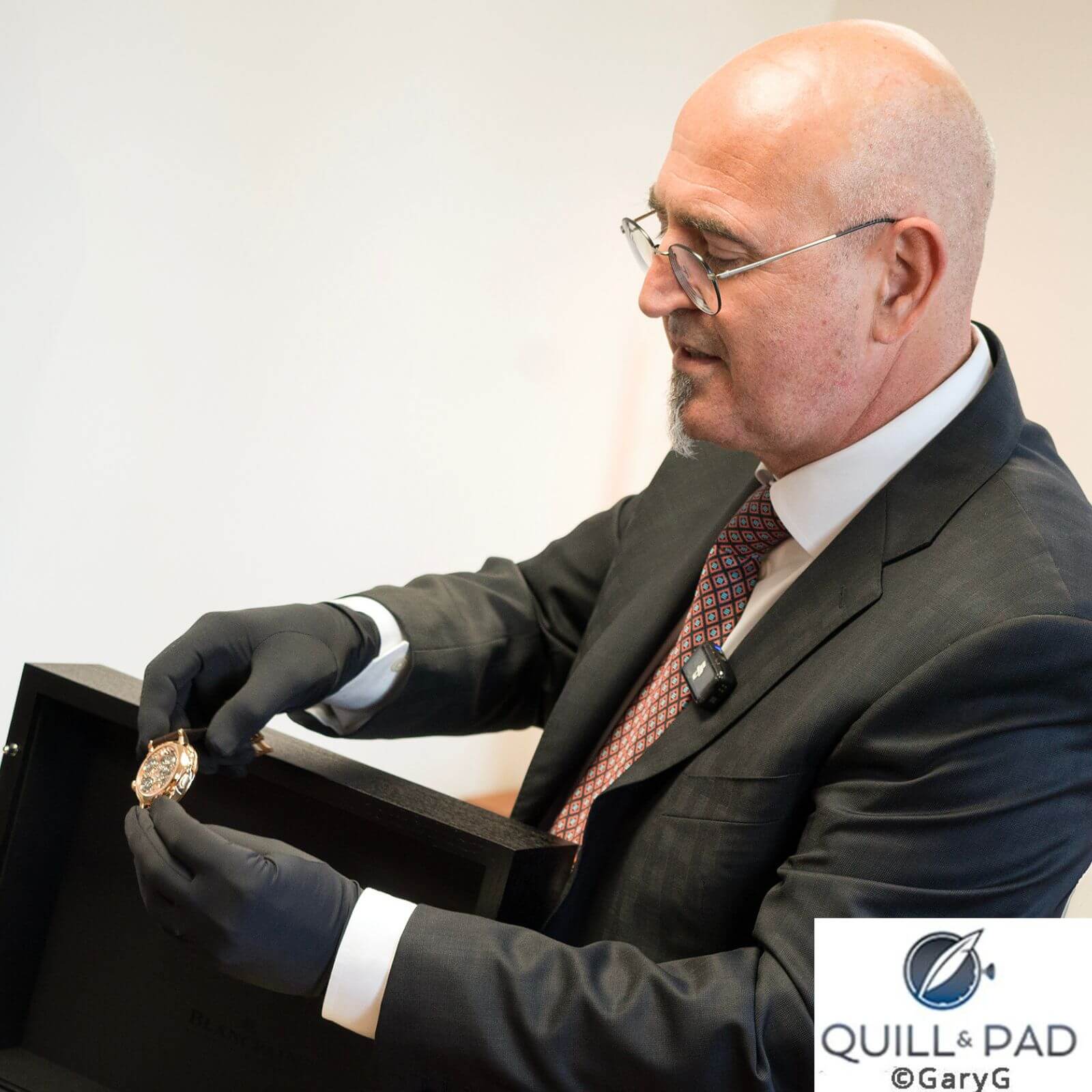
Proud papa: Marc Hayek displays the Blancpain Grande Double Sonnerie
Following the initial presentation, we gathered in small groups to hear the watch chime; and I must say that I was quite impressed. The tuning of the gongs to sound exactly the right pitches was bang-on, as was the setting of the time intervals between the strikes. I was standing a good six feet away from the watch and recording with my phone, and the sound of the Blancpain melody I captured in the recording below was still both highly audible and pleasingly musical.
The “Melodie Blancpain” (with apologies for the shaky phone video)
You can make your own judgment, but for me while the sound of this watch is not quite as big as that of the Chopard repeaters and sonnerie, nor perhaps quite as sweet as heard from a Patek Ref. 5078, its combination of volume and sonority, and its ability to meet the added demands of the sonnerie mechanism and Westminster-style melody, make it one of the few most appealing chiming watches I’ve heard.
Behind the lens with the Grande Double Sonnerie
I didn’t have a great deal of time to shoot the Grande Double Sonnerie with my travel light tent and Hasselblad setup, but did manage to capture a few images. Perhaps my only critique on the shooting accommodations: the watch provided was fully wound, and the movement does not hack, so my usual practice of creating multi-image focus stacks was not possible and I had to utilize straight-on views to get everything in focus.
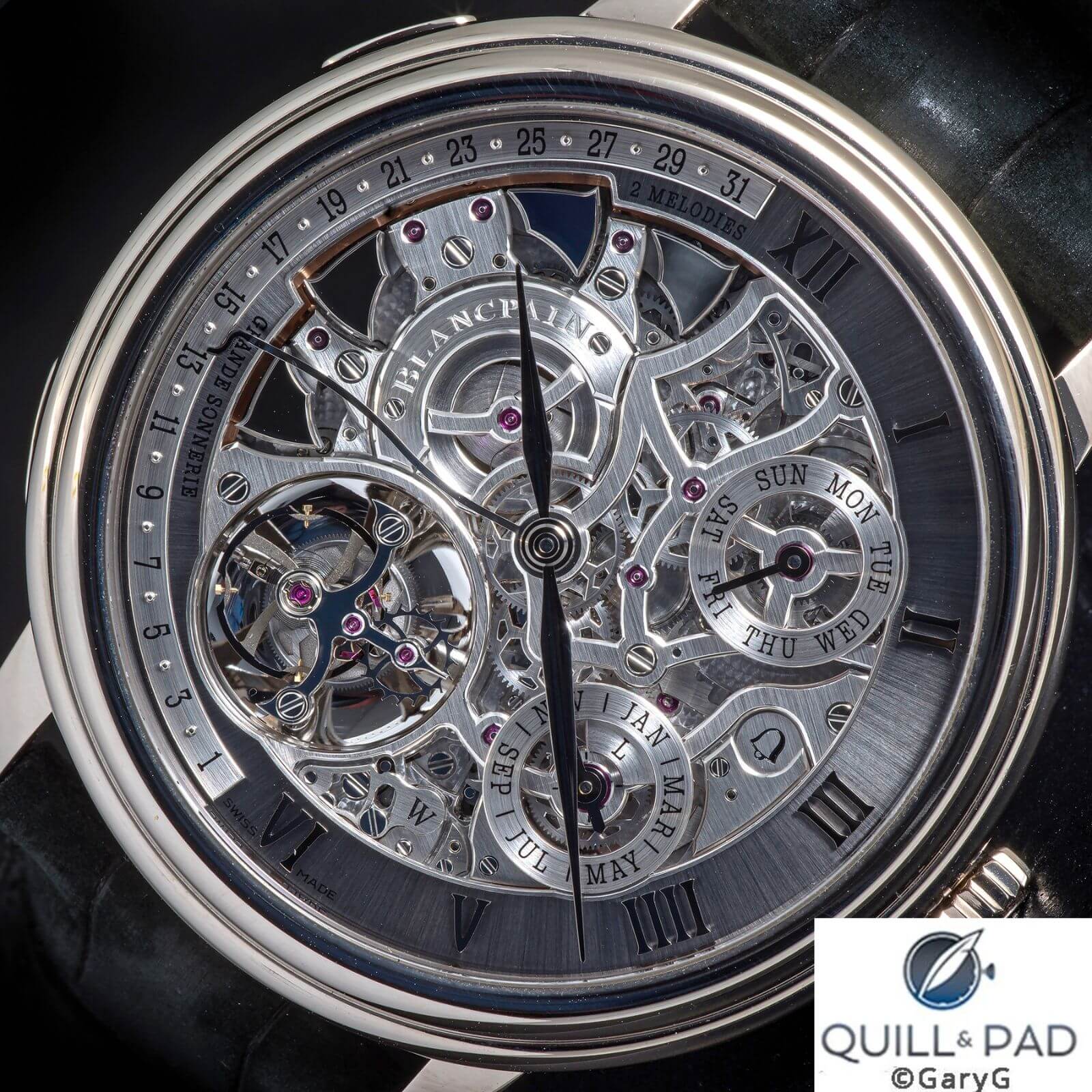
Dial side, Blancpain Grande Double Sonnerie in white gold
As you can see, the visual appeal of the white gold version (in addition to the appealing shapes of the openworked movement) is a matter of tone-on-tone variety, with the mix of radial, axial, and straight brushing working well to catch and reflect differing levels of brightness and contrast.
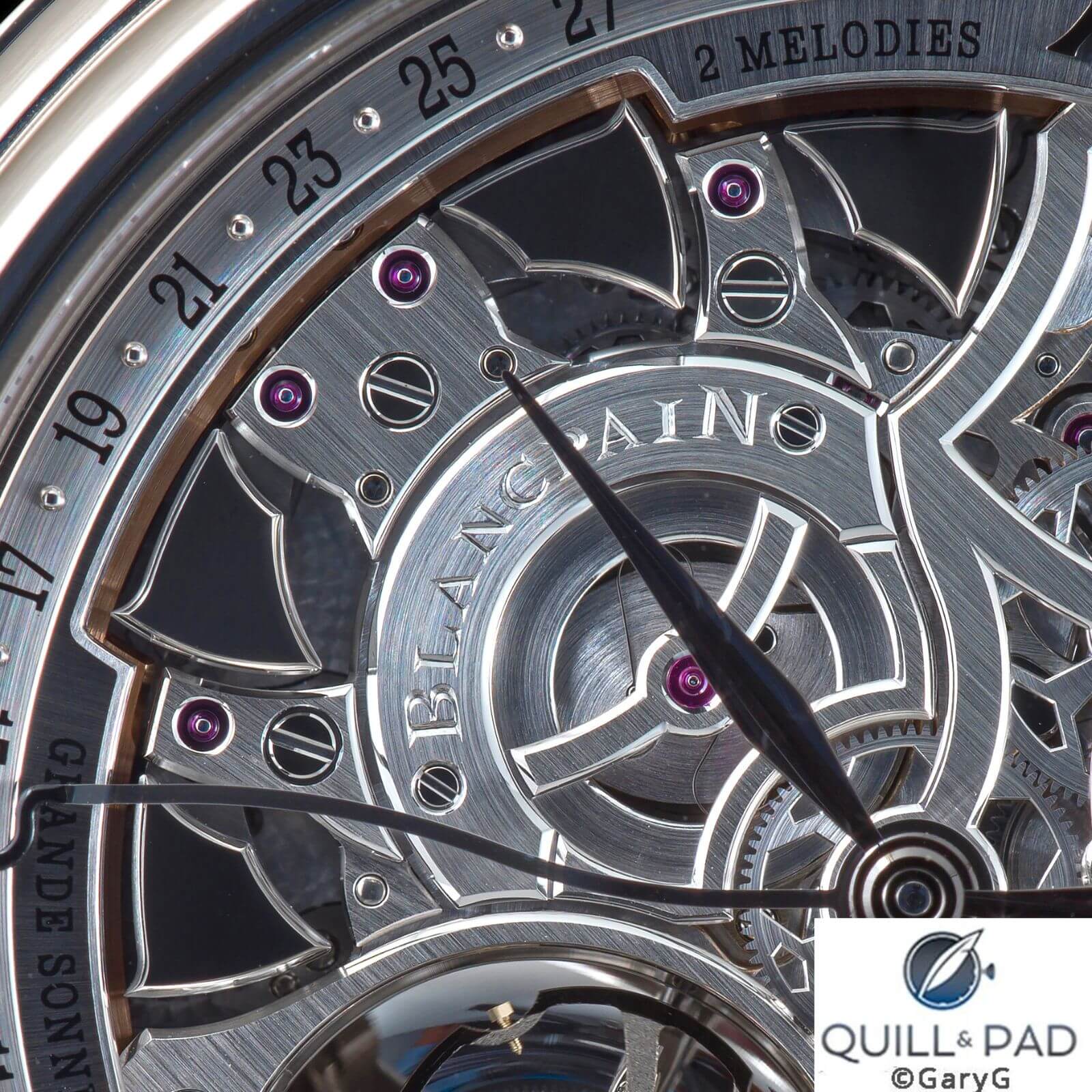
The four hammers of the Grande Double Sonnerie
As I mentioned earlier, the black polishing is a highlight of this watch; above, you can see the mirror-smooth surfaces of the four striking hammers poised above the 5N gold gongs.
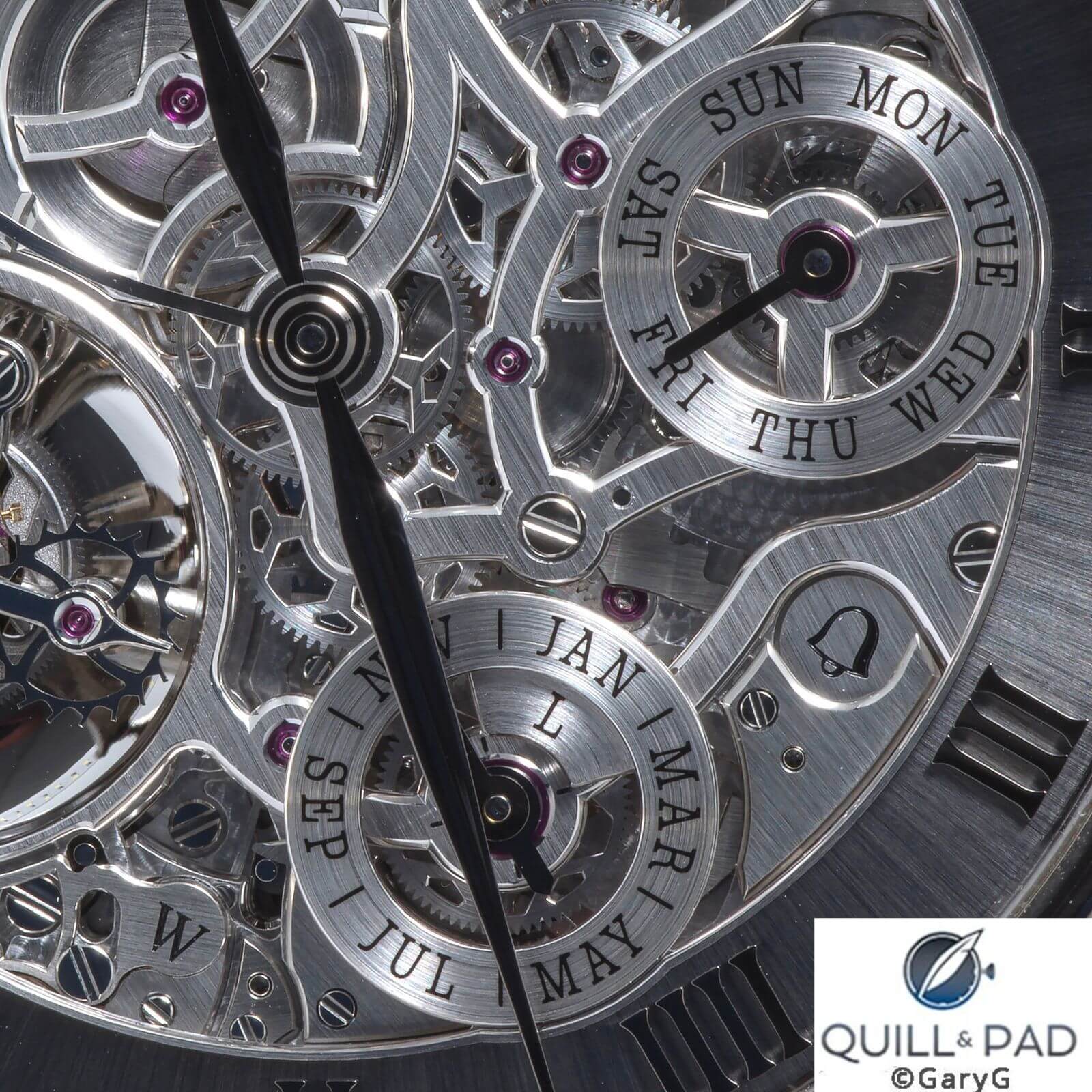
Day and month displays of the perpetual calendar
Elsewhere on the front of the watch, we are treated to views of the secondary calendar indications and the prominent, raised frame of the flying tourbillon with its silicon balance spring.
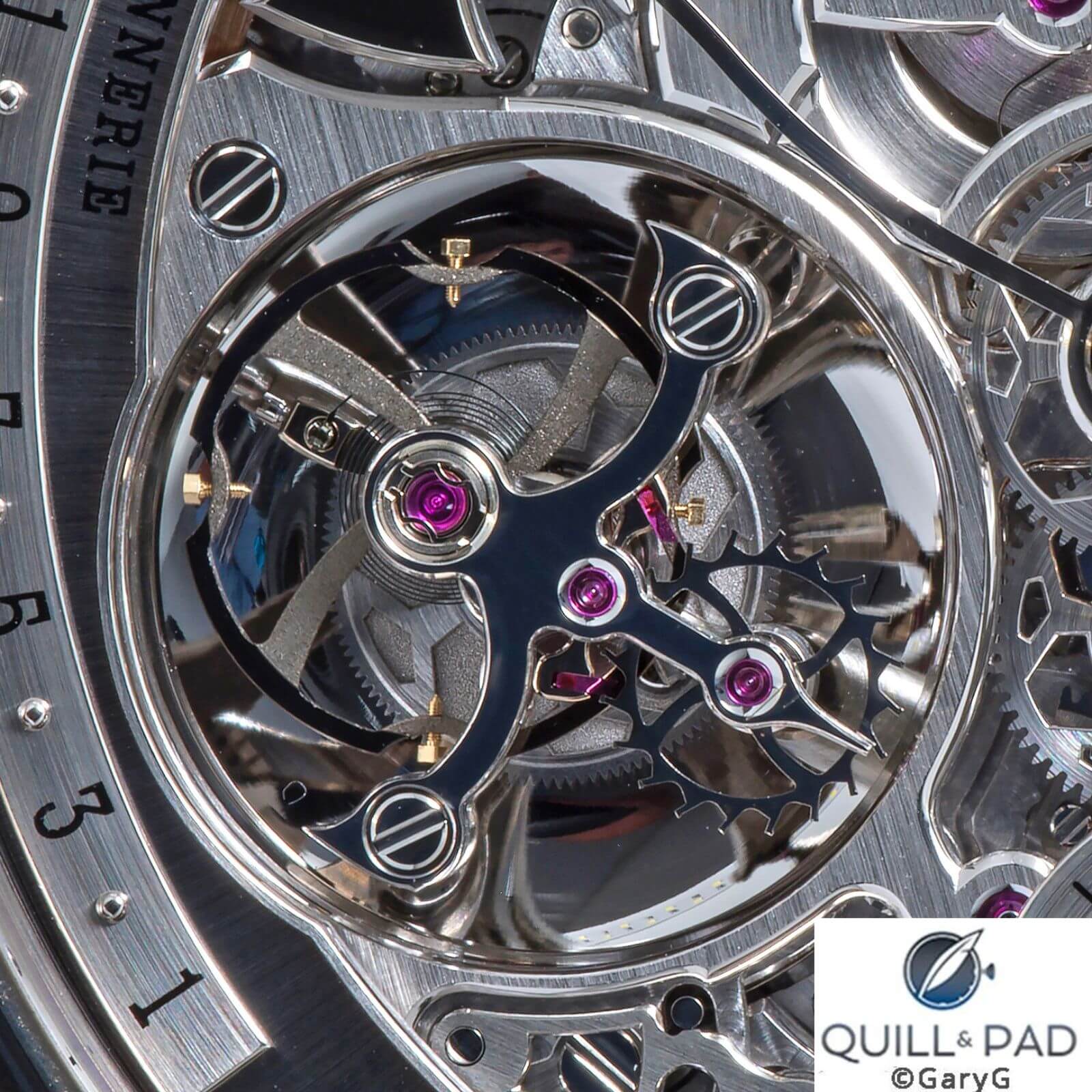
Raised flying tourbillon, Blancpain Grande Double Sonnerie
If I were buying this watch, I’d make a polite inquiry into adding seconds dots on the tourbillon frame, but that’s a small objection to what is otherwise an impressive dial-side presentation.
On the reverse of the watch, we see more of the repeater and sonnerie mechanisms and the two barrels and related power reserves for the main movement and striking train.
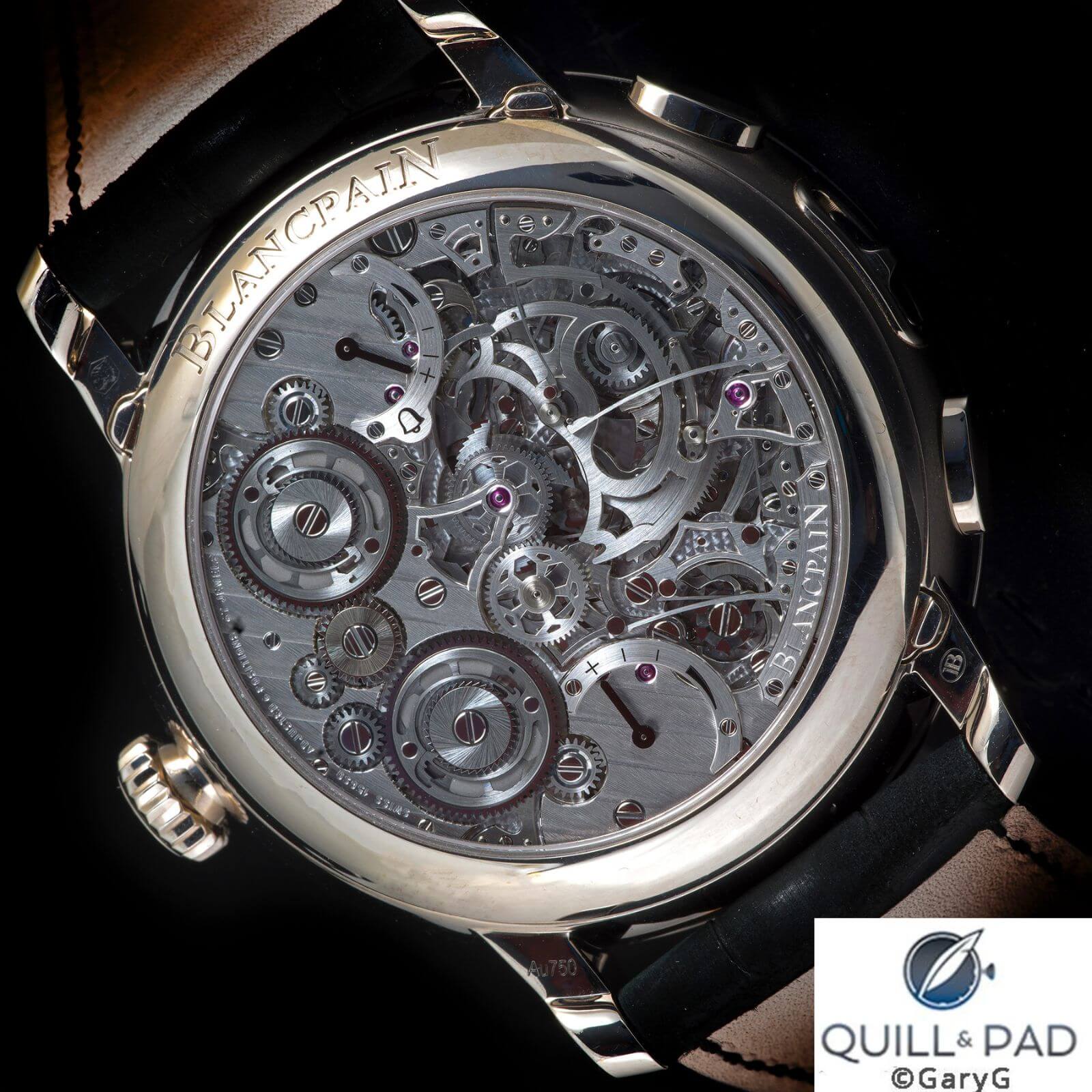
Rear view of the Blancpain Grande Double Sonnerie
The Grande Double Sonnerie on the wrist
I did have the chance to try on the red gold version of this watch, and while Blancpain was at pains to stress that it “remains highly wearable,” at 47mm in diameter and 14.5mm in thickness it is quite substantial, even on my broad wrist.

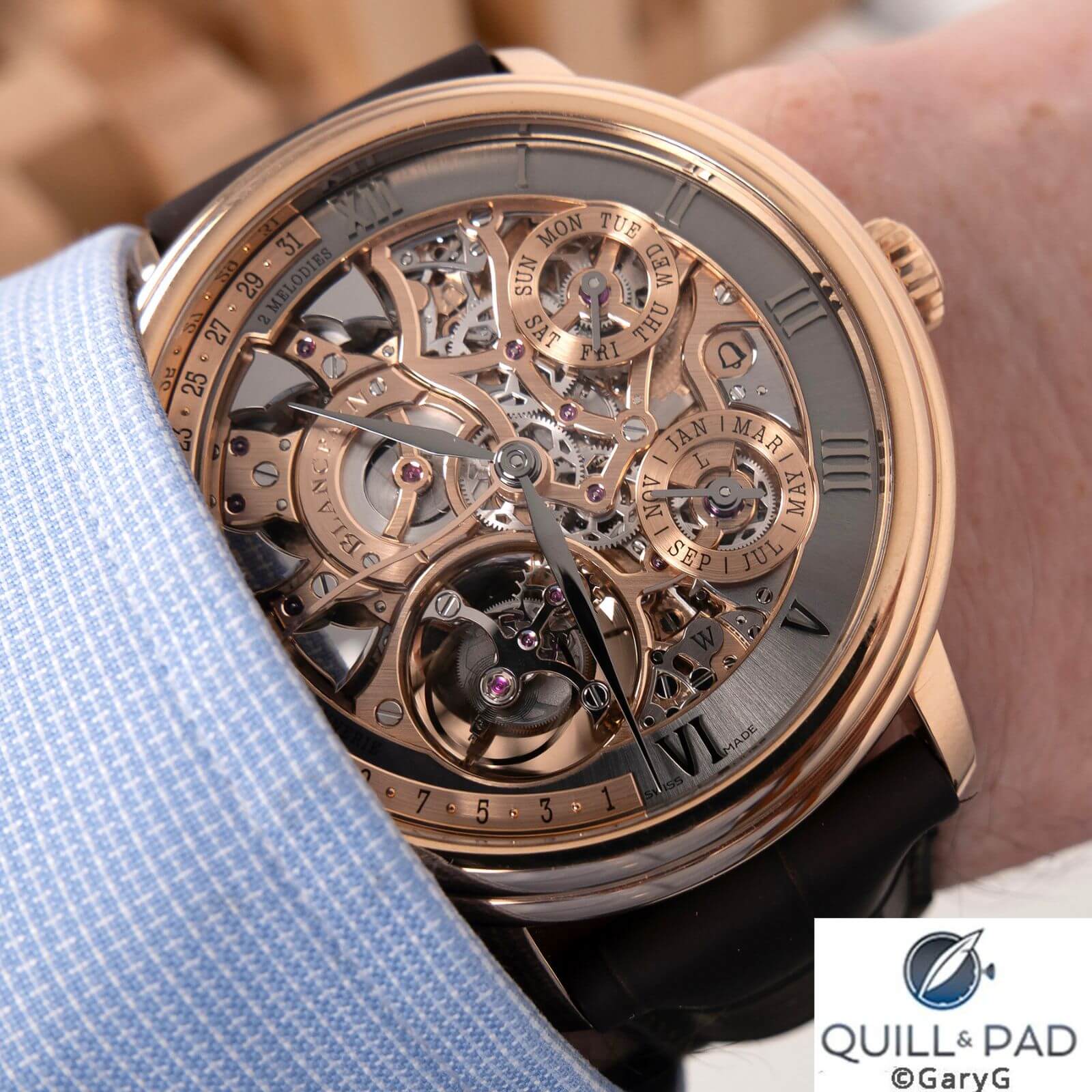
On the wrist: red gold version of the Grande Double Sonnerie
The downturned lugs and a caseband that tapers from front to back do help quite a bit with wearability, but in terms of comparisons we’re still talking about Greubel Forsey Double Tourbillon Technique dimensions here; this is a meaty watch!
Team Sound vs. Team Complications
One of the most interesting aspects of my discussions with other participants in this event was a clear bifurcation between two groups: those who, like me, valued this watch for its sonic achievements, and others, who to quote one, “liked that the sound was great but found the combination of complications much more amazing.”
I was definitely Team Sound! In fact, had I been in the design room eight years ago, I might well have argued for a watch limited solely to the chiming complications, omitting the tourbillon and perpetual calendar, aiming for even more sonic perfection and, with any luck, a smaller package.
Perhaps in future we’ll see that sort of watch from Blancpain! We got no indication that such a piece is forthcoming, and it would not be a simple matter of modifying this reference, as that would leave gaping holes where the tourbillon and perpetual works sit now, but I for one would be a “yes.”
Any quibbles?
There is no such thing as a perfect watch! I’ve already stated a few points above; my final question has to do with the chiming sequence on the hours.
Blancpain has taken the remarkable step of chiming both all four quarterly sequences and the number of hours at the top of each hour; I can’t imagine how much time it took to figure that out and then to implement it.
That said, the sequence of chiming (you can go back and listen to the recording earlier in this article) is hours first, then the four quarterly melodies. For those of us used to the striking of tower clocks like Big Ben https://www.youtube.com/watch?v=juT1zsim6es , it’s a bit jarring to hear the sequence of quarters and hours in reverse order from the “normal” arrangement. I suppose I could learn to live with it, though!
Closing thoughts
So much to say! As you can tell I was quite impressed indeed with the Grande Double Sonnerie, as well as with the transparency with which Blancpain welcomed enthusiasts and writers.
My hope is that we see more of both from Blancpain and from Swatch Group more generally. I was very pleased that in private discussions, Marc Hayek seemed resolved to finding the right ways to renew Swatch Group’s presence at exhibitions and expand direct contacts with enthusiasts, and I hope that we hear more about both soon.
There’s another whole line of inquiry and discussion that I’ll tease here and then leave for another time: what does the Grande Double Sonnerie say about the direction and market positioning of Blancpain, and was it in fact best for Swatch Group to introduce it as a Blancpain watch? Introducing one remarkable halo watch is a significant accomplishment; building a coherent strategy that incorporates that watch, and the capabilities required to create it, into a broader brand tapestry is another matter entirely, and one that I will follow with interest.
I’ll look forward to your thoughts on both the Grande Double Sonnerie and on Blancpain in the comments section. In the meantime, happy wearing!
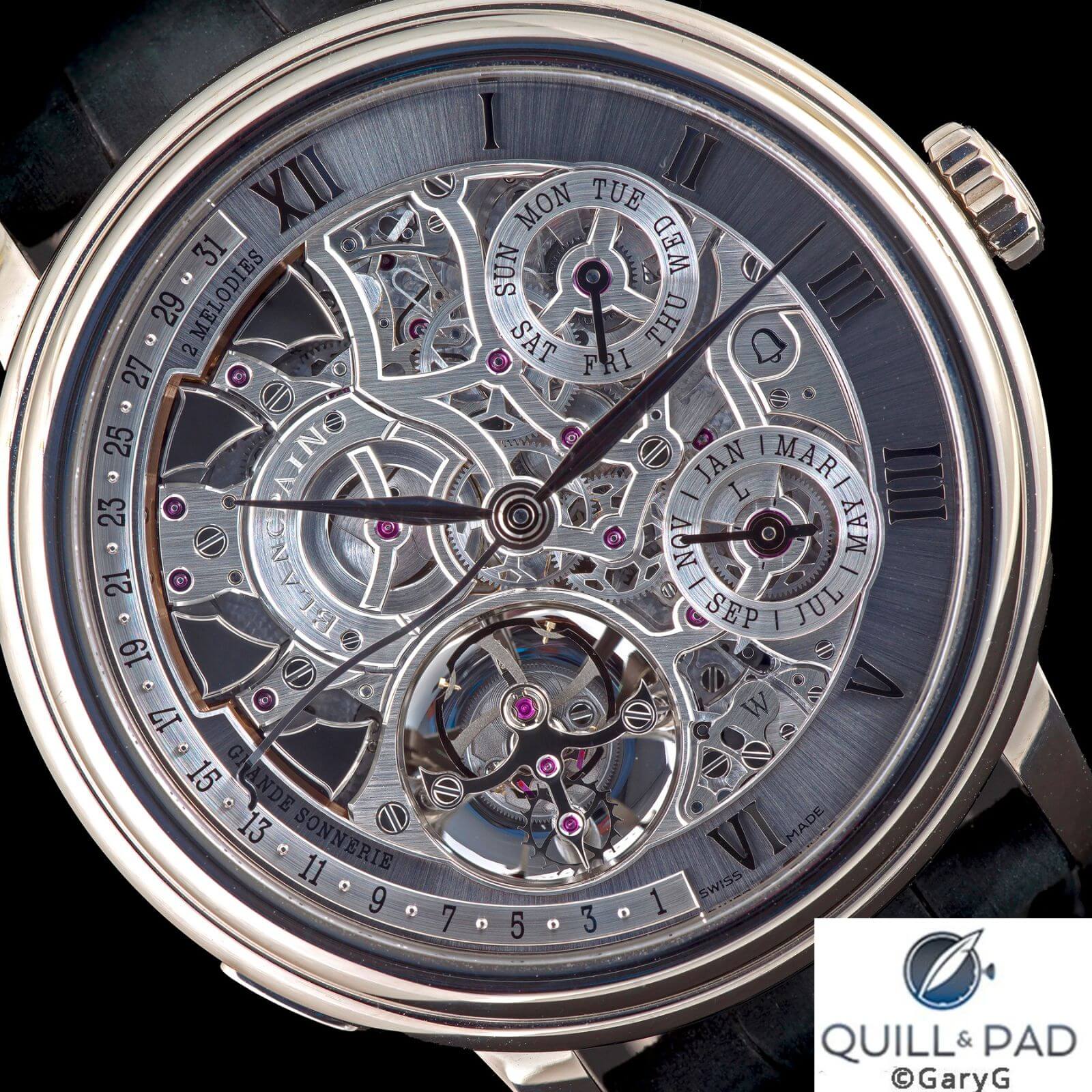
Parting shot: Blancpain Grande Double Sonnerie
Quick Facts: Blancpain Grande Double Sonnerie
Case: 47mm x 14.5mm in red or white gold; sapphire front and rear crystals; water resistance 1 ATM/10m
Dial and hands: Main material 5N gold; openworked with sector displays for hours and retrograde perpetual calendar; blackened gold hands
Movement: Manually wound Cal. 15GSQ; manual winding in both directions; power reserve 96 hours; striking power reserve 12 hours in Grande Sonnerie mode; flying tourbillon with silicon balance spring, frequency 4 Hz
Functions: Hours, minutes, grande sonnerie with two melodies, petite sonnerie, minute repeater, perpetual calendar with retrograde date, power reserve indicators for movement and chiming mechanism
Announced Price: CHF 1,700,000
Limitation: 2 examples produced per year
Production Years: Beginning 2025
You Might Also Enjoy:
Laurent Ferrier’s Auto Sport 79 in Rose Gold
The Pattern of Perfection: Sartorial Billard and Exquisite Timepieces Collaborate on the SB04-E
Shades of Substance: The Squale Sub-39 GMT U.S. Limited Edition Watches

