
Clash of the Titans: A Comprehensive Guide to Blancpain vs. Jaeger-LeCoultre
By Nina Scally
When you reach a certain echelon in your watch-collecting journey, you inevitably face a crossroads. You’ve moved beyond the entry-point luxury timepieces and are now seeking a true horological pedigree. On one path stands Blancpain, a brand wrapped in the romance of antiquity and contemporary defiance. On the other path stands Jaeger-LeCoultre, the intellectual powerhouse frequently revered as the watchmaker of watchmakers. Which do you choose? Both of these extraordinary manufacturers reside in the Vallée de Joux, the historical cradle of Swiss high watchmaking, yet they occupy profoundly different emotional and technical spaces in the minds of enthusiasts.
The Influence of History and Heritage
Choosing between two luxury watch brands is never simple. It requires some level of exploration into what you really value most in mechanical art. Do you gravitate toward engineering firsts and architectural accuracy, or does your heart pull you toward stealth wealth and a strong defiance of modern trends? This guide will lead you through the defining characteristics, historical importance, and iconic timepieces of both Blancpain and Jaeger-LeCoultre, helping you understand exactly what beats beneath the dials of each brand.
To truly appreciate these brands, you must first understand the basis upon which they are built. The history and heritage of a watchmaker form the institutional memory that dictates how its movements are finished or how a case is sculpted. Understandably, some brand histories hold more weight than others and become the backbone of their very existence. Such can be said for these two brands.
Blancpain claims the title of the world’s oldest registered watchmaking brand, following its roots all the way back to 1735 in the village of Villeret. When you explore this brand’s history, you’re exploring a narrative centered around survival and fierce traditionalism. Nothing illustrates this better than the company’s stance during the quartz crisis of the 1970s and 1980s. While the rest of the Swiss industry was scrambling to produce battery-powered watches to compete with Japan, Blancpain famously declared that since 1735, there had never been a quartz Blancpain, and there never would be. The brand stayed true to its word, leveraging this philosophy with the release of the 1735 Grande Complication in 1991. At the time of its release, it was the most complicated automatic wristwatch in the world, combining a tourbillon, a minute repeater, a perpetual calendar, a split-seconds chronograph, and a moon phase. It took a full year for a single master watchmaker to assemble its many elements, proving that high mechanical art was still vibrantly alive.
Jaeger-LeCoultre, founded in 1833 by Antoine LeCoultre, approaches its heritage from a slightly different angle, becoming a key architect of the modern Swiss watch industry. For decades, Jaeger-LeCoultre operated as the ultimate movement manufacturer, supplying blank movements, known as ebauches, to the fabled Holy Trinity of watchmaking: Patek Philippe, Audemars Piguet, and Vacheron Constantin. When you wear a vintage piece from one of those three giants, there is a very good chance a Jaeger-LeCoultre heart is beating inside. The brand’s heritage is defined by an unrelenting pursuit of physics and micro-engineering and you can see this brilliance in the Calibre 101, introduced in 1929. It still reigns today as the world’s smallest mechanical movement and was famously worn by Queen Elizabeth II on her coronation day. You can also see it in the legendary Atmos Clock, a desk clock that requires no manual winding and no batteries. Instead, it is powered by a capsule containing a blend of temperature-sensitive gases that expand and contract with the slightest changes in ambient room temperature.
The Defining Icons: Fifty Fathoms vs. Reverso

You cannot discuss these two heavyweights without confronting the iconic models that define their modern catalogs. For Blancpain, that icon is undoubtedly the Fifty Fathoms watch. Born in 1953, the Fifty Fathoms is arguably the absolute blueprint for the modern dive watch, arriving on the scene before the Rolex Submariner. Designed in collaboration with Captain Bob Maloubier of the French combat swimmers, it introduced the unidirectional rotating bezel alongside unparalleled water resistance and a highly legible dial, making it perfect for tactical military use. When you look at the Blancpain Fifty Fathoms “No Rad” (No Radiation) model, you’re looking at a piece of pure mid-century military history. This specific model, incredibly sought after by collectors, famously featured a prominent crossed-out radioactive symbol painted directly on the dial. This was to reassure civilian and military divers alike that the manufacturer had made the crucial switch from dangerous radium luminous material to the much safer tritium. Today, the Fifty Fathoms still represents Blancpain’s rugged, tactical, and historical side.
Conversely, Jaeger-LeCoultre’s most recognisable silhouette was born not in the depths of the ocean, but on the arid, sun-drenched polo fields of 1930s India. The Reverso is one of the most famous and recognisable watches ever created and aimed to serve a very practical purpose on the wrist. British army officers were frequently shattering the glass crystals of their watches during aggressive polo matches, leading Jaeger-LeCoultre to design an ingenious rectangular case that could be smoothly flipped over on its chassis to expose a solid metal caseback, protecting the delicate surface of the dial and its glass. Today, while the Reverso Classic functions as the ultimate Art Deco dress watch, Jaeger-LeCoultre uses this pivoting canvas to show off its most extreme capabilities. Take, for example, the Reverso Tribute Gyrotourbillon. This masterpiece takes the 1930s polo watch concept and completely upends it by scaling the proportions to house a multi-axis, spherical flying tourbillon. Watching the gyrotourbillon dance within the confines of a reversible rectangular case is a visual experience that perfectly demonstrates how Jaeger-LeCoultre can stretch its extraordinary horological range within a single, historical case shape.
Movement Mastery and Innovation
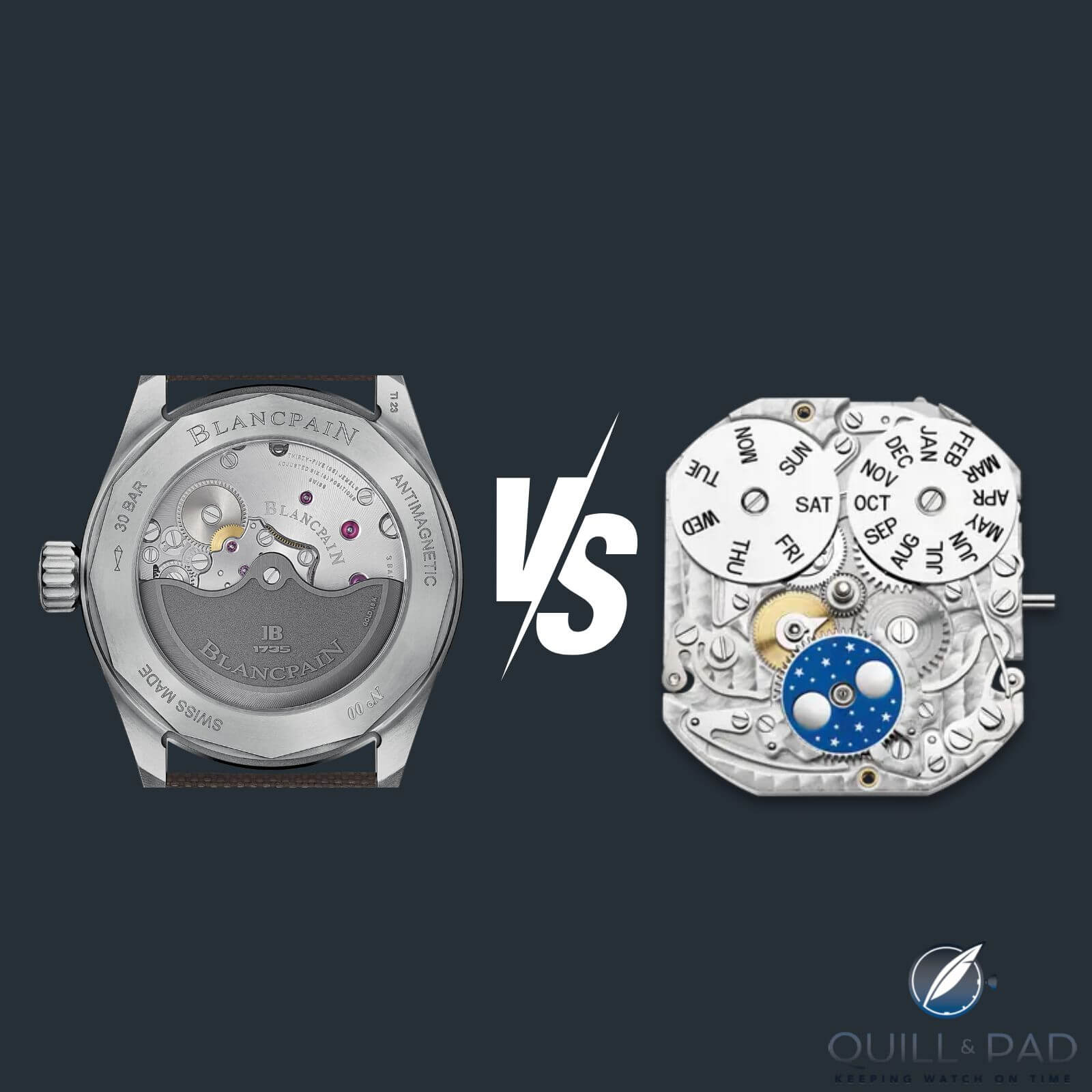
When you turn these watches over and look through their sapphire exhibition casebacks, you are greeted with two very different philosophies of movement manufacture. Jaeger-LeCoultre remains defined by sheer volume, relentless testing, and groundbreaking architecture. The manufacturer has created over 1,200 different calibres and holds over 400 patents, all of which are subjected to its famous 1000 Hours Control, a punishing internal testing protocol that tests the fully cased watch, not just the bare movement, for six continuous weeks. This makes certain that the watch on your wrist provides strong, daily reliability. The brand’s mechanical ingenuity shines vividly in the Memovox alarm watches, specifically the vintage-inspired Memovox Polaris. It is a serious technical challenge to create a mechanical alarm that chimes beautifully, but to design one in 1968 that rang loudly enough underwater to remind divers to begin their ascent was pure brilliance. Furthermore, the company’s Duomètre collection presents the incredible “Dual-Wing” concept. These watches feature two separate power reserves and gear trains. One is dedicated solely to keeping the time, and the other to powering the complications, both of which are linked by a single regulating organ. This assures that activating a complication never drains power from the timekeeping mechanism, resulting in perfect chronometry.
Blancpain, on the other hand, approaches movement manufacture with a focus on exceptionally long power reserves, refined complications, and clever, user-friendly engineering that removes the friction associated with wearing a highly complicated piece. Even the brand’s base movements routinely offer upwards of 100 hours of power reserve. When you examine a highly complicated piece like the Villeret Quantième Perpétuel (Perpetual Calendar), you observe something unusual: the sides of the case are completely smooth. Traditional perpetual calendars require the user to poke tiny recessed pushers on the side of the case with a wooden or metal stylus to adjust the date, month, and moon phase, but Blancpain revolutionised this with its patented under-lug correctors. They ingeniously hid the adjustment pushers out of sight, tucking them beneath the lugs on the back of the watch. This allows you to adjust the complex calendar functions using only your fingernail, keeping the case profile immaculately clean and making the watch far more enjoyable to interact with. Blancpain also continues to expand limits in the dive watch space, evidenced by the Fifty Fathoms Tech Gombessa. Released in 2023, this specialised instrument features a world-first three-hour rotating bezel, specifically engineered for the unique timing necessities of modern closed-circuit rebreather diving, proving that its tactical use remains as sharp today as it was in 1953.
Aesthetic Language and Finishing
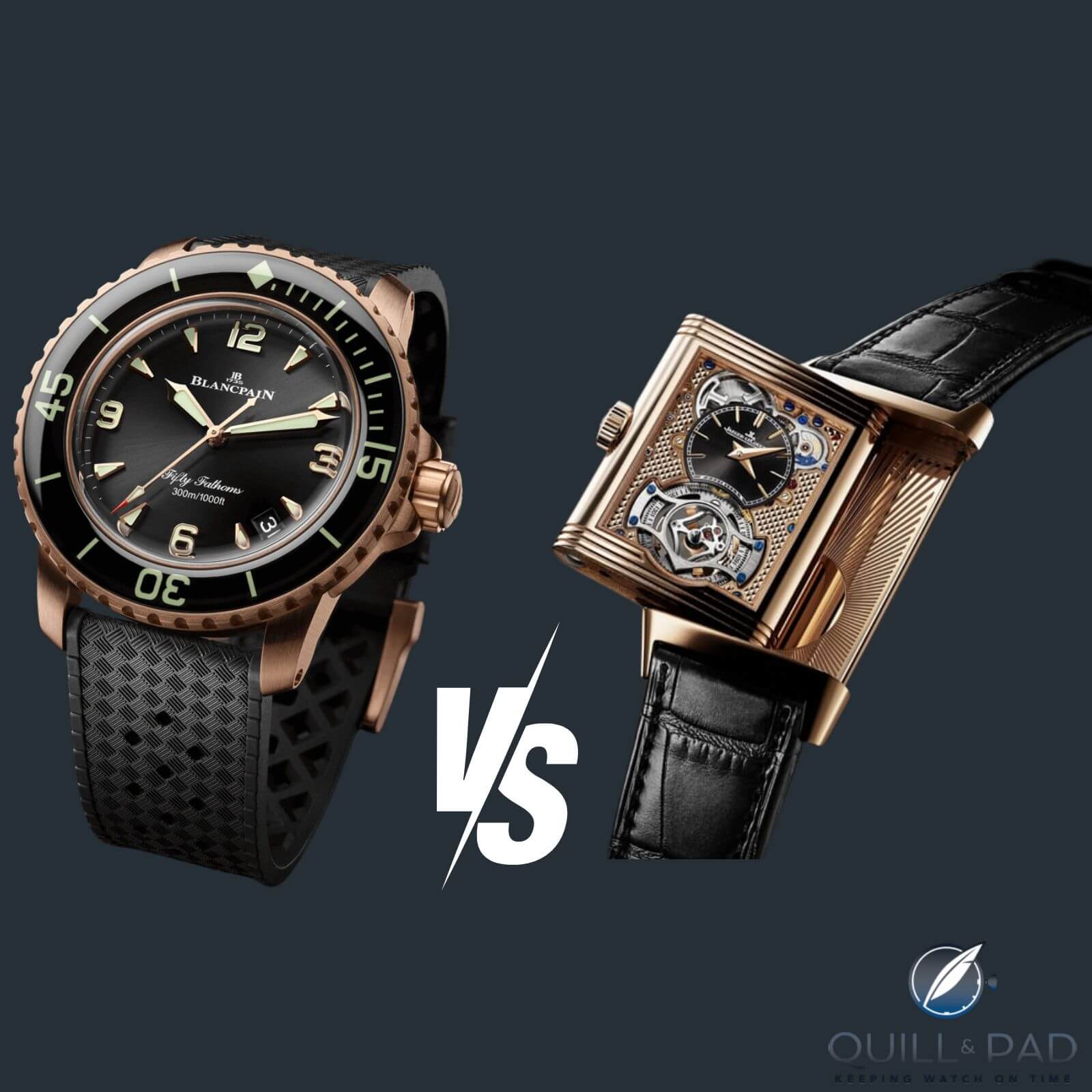
The aesthetic language of a watch is what speaks to you across the room, and here, the divergence between the two manufacturers becomes highly pronounced. Jaeger-LeCoultre operates as the precise, restrained architect. Its design language leans heavily into sharp lines, striking geometry, and an understated elegance. When you strap a Master Ultra Thin Moon to your wrist, you are wearing the gold standard of the modern dress watch. The dauphine hands are razor-sharp, the faceted dart indices catching the light with exacting precision, and the dial layout is mathematically balanced. Suffice it to say, Jaeger-LeCoultre dials are incredibly clean, delivering a sophisticated look that is confident, elegant and never overly ornate.
Blancpain’s aesthetic is significantly softer, more curvilinear, and more artisanal. The Villeret line perfectly captures this ethos. When you look at a Villeret Tourbillon Volant Une Minute 12 Jours or even a simpler time-and-date Villeret Ultraplate, your eyes are immediately drawn to the signature double-stepped bezel that mimics classical architecture. The dials feature exquisitely hollowed sage-leaf hands that sweep gracefully over stylised, applied Roman numerals in a playful, poetic design language.
This brings us to the passionate debate among collectors regarding finishing. In enthusiast circles, it is widely agreed that while both manufacturers produce excellent movements, Blancpain’s movement finishing on its entry-level and mid-tier watches is often a notch above Jaeger-LeCoultre’s. When you inspect a Blancpain calibre under a loupe, you will frequently find deeper, more pronounced beveling, richer anglage on the bridges, and far more elaborate, hand-engraved decoration on its solid gold rotors. Jaeger-LeCoultre’s finishing is undeniably beautiful, but it may occasionally feel slightly more industrial and uniform at the entry-level price points, which makes sense when you consider its historic role in supplying movements to other manufacturers, many of whom chose to modify them with their own hallmarks.
Brand Positioning and Exclusivity
Understanding how Jaeger-LeCoultre and Blancpain fit into the modern market is important for collectors considering how a timepiece fits inside their broader portfolio. Corporately, both brands sit within competing luxury empires. Blancpain is the prestige crown jewel of the Swatch Group, operating at the very pinnacle of the conglomerate’s hierarchy alongside Breguet. Jaeger-LeCoultre, on the other hand, is a core pillar of the Richemont Group.
A major point of differentiation is production volume and exclusivity. Blancpain produces significantly fewer watches per year than Jaeger-LeCoultre, appealing deeply to the collector who desires stealth wealth and selectiveness. When you wear an Air Command flyback chronograph, a watch with a fascinating, murky mid-century military aviation history, you are wearing something that only the most dedicated horological scholars will recognise. Blancpain prices its timepieces accordingly, frequently positioning its entry-level steel pieces noticeably higher than its competition, rubbing shoulders with the pricing of Patek Philippe or Vacheron Constantin in certain categories.
Jaeger-LeCoultre, conversely, is universally viewed as the ultimate value proposition in high horology. It’s the gateway into the truly elite tier of watchmaking. The steel Master Control Calendar or the Master Control Chronograph Calendar offer prestige-to-price ratios that are virtually unmatched in the Swiss industry at that level. When you buy a JLC watch, you’re acquiring a fully in-house, highly complicated timepiece from one of the most important names in watchmaking history, often for significantly less than what you would pay for a base model from a more hyped, heavily marketed brand like Patek Philippe or Audemars Piguet.

The “Everyday Wear” Contenders
Beyond the pure dress watches and the hardcore dive instruments, you will inevitably want a watch that can serve as a luxurious daily driver. The good news is that both brands feature compelling options that combine legacy with contemporary wearability. For Jaeger-LeCoultre, the modern Polaris Automatic and Polaris Chronograph lines are great examples of everyday luxury, paired with vintage-inspired dial textures. Look closely at a Polaris dial, for example, and you will see an intricate mix of sunray brushing in the center, granular graining on the hour track, and an opaline finish on the inner rotating bezel. The combination provides a sporty, highly dynamic everyday profile without losing the brand’s signature elegance.
Blancpain answers this call with the Fifty Fathoms Bathyscaphe. While the standard Fifty Fathoms can be quite large and bulbous on the wrist, often measuring a commanding 45mm with its heavily domed sapphire bezel, the Bathyscaphe takes a different route. It strips the dive watch design down to its bare, utilitarian essentials, resulting in a sharp, highly technical aesthetic. Available in highly wearable case sizes and utilising state-of-the-art materials like lightweight titanium or perfectly brushed black ceramic, the Bathyscaphe is Blancpain’s ultimate answer to the modern high-end sports watch, offering immense durability wrapped in a sophisticated package that you can wear all day, every day.
Conclusion
In the end, choosing between Blancpain and Jaeger-LeCoultre remains a decision that pits the heart against the head. To understand these two brands is to understand the two fundamental pillars that keep mechanical watchmaking alive in the twenty-first century: human intellect and human spirit. From an educational standpoint, both of these historic houses represent the absolute pinnacle of what it means to be a true manufacturer. Many famous names rely entirely on third-party suppliers for their gears, springs, and escapements, but Jaeger-LeCoultre and Blancpain stand apart as absolute purists. They conceptualise, design, machine, decorate, and assemble their calibres entirely under their own roofs in the Vallée de Joux. When you acquire a timepiece from either of these brands, you’re rejecting the disposable nature of modern technology in favour of something designed to outlive you. If you are fascinated by industrial innovation and the history of the Swiss watch industry, Jaeger-LeCoultre will forever be your North Star. Wearing a Jaeger-LeCoultre represents an acknowledgement of the brilliant engineers and mathematical minds who built the very engine room of high horology. However, if your passions lean heavily toward craftsmanship, artistry, exclusivity, and elaborate mechanical purity, Blancpain will undoubtedly capture your soul.
Both are indisputable titans, offering masterpieces of mechanical art that represent the very best of human inventiveness. Whichever path you ultimately choose, you are securing a work of mechanical art that represents the absolute pinnacle of human brilliance and traditional craftsmanship.
Read more like this
The Dancing Cage: 10 Best Tourbillon Watches
Aurum Awakened: Armin Strom Unveils the New Tribute 2 Aurum Edition
Inflection: Atelier Wen’s Groundbreaking Full-Tantalum Flagship

