
Old-World Guilloché vs. The Geneva Tradition: Breguet and Patek Philippe Compared
By Nina Scally
Torn between Breguet and Patek Philippe? We compare their royal histories, iconic movements, and market value to help you choose your masterpiece.
The past twelve years of my life can be measured in a series of personal milestones, all the while deepening my passion for luxury timepieces. I’ve spent countless hours in stuffy, dimly lit showrooms on press trips or on Zoom calls, waiting in anticipation for some of the decade’s most hotly anticipated releases. Navigating the high-end watch industry in this way has given me a rather unique lens. I might not be the one raising a paddle at the Christie’s or Phillips auction blocks, but I’m the journalist researching and immersing myself in the brilliant engineering behind some of the world’s most prestigious watch manufacturers. Over my career, I have seen brands rise from relative obscurity to global dominance and some that have rested a little too heavily on their laurels. Yet, whenever the conversation among purists turns to the absolute apex of traditional mechanical watchmaking, two names inevitably swallow the oxygen in the room: Breguet and Patek Philippe.
Choosing between these two maisons is akin to choosing your horological religion. You can’t just simply pull up the spec sheets of both brands and make a decision based on which sounds more appealing. You have to compare the very foundation of each watchmaker against modern standards. This is a comparison between one brilliant inventor and one obsessive perfectionist. Both command immense respect, both have produced breathtaking timepieces, and frankly, both demand a significant portion of your net worth to acquire. But they appeal to very different corners of a collector’s soul. So let’s take a deep dive into their histories, review their sprawling catalogues, and examine their most iconic creations in this Breguet vs Patek Philippe guide.
Exploring Breguet and Patek Philippe’s Client Lists
To understand both brands better, we need to understand who they built watches for. Abraham-Louis Breguet is, without a shadow of a doubt, the single most important figure in the history of watchmaking, having established his business in Paris in 1775 and practically inventing the modern mechanical watch as we know it today. His client list reads like a roll call of the people who literally conquered and ruled the eighteenth and nineteenth centuries. We’re talking Napoleon Bonaparte, who purchased several Breguet carriage clocks for his military campaigns, and Winston Churchill, who carried a Breguet pocket watch his entire life, not to mention Tsar Alexander I of Russia. Most famously, there was the French Queen Marie Antoinette, who commissioned Breguet to create the most spectacular watch possible, containing every known complication of the era.
Patek Philippe, on the other hand, entered the scene a bit later. It was founded in Geneva in 1839 by Antoni Patek and later joined by the brilliant French watchmaker Jean Adrien Philippe, the man who invented the keyless winding mechanism. Patek Philippe also boasts an incredibly royal history. Queen Victoria famously acquired a keyless Patek Philippe pendant watch at the Great Exhibition in London in 1851, which catapulted the brand to international fame. However, where Breguet’s dominance is anchored firmly in the past, Patek Philippe successfully transitioned that royal pedigree into the modern era, becoming the undisputed watchmaker of choice for twentieth and 21st-century leaders. From scientific geniuses like Albert Einstein and artistic legends like Pablo Picasso to modern captains of industry, Patek Philippe has become a universally recognised status symbol.
A Journey Through the Catalogues: Icons and Aesthetics
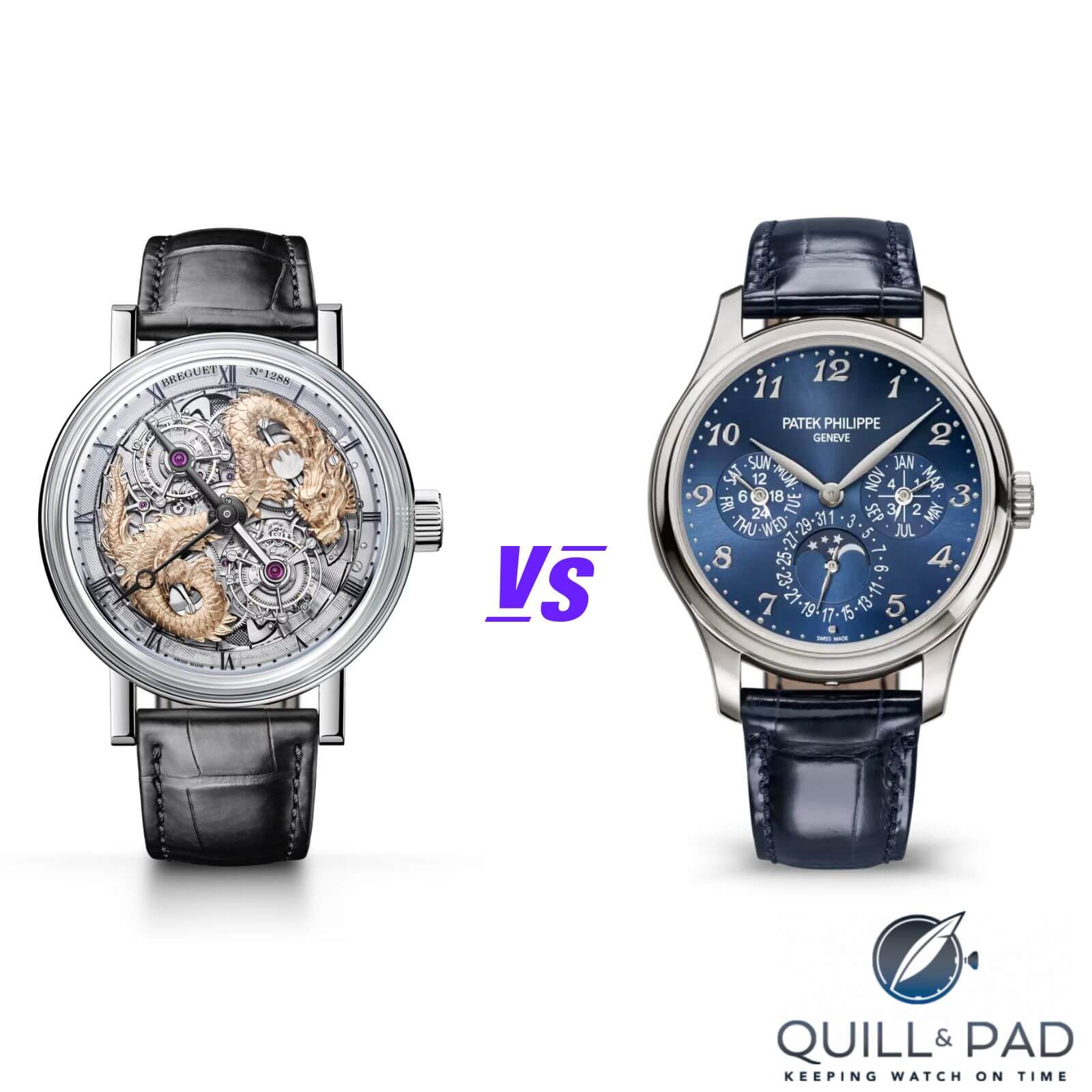
As any experienced collector will tell you, a brand is only as good as its current catalogue, and both of these manufacturers approach their collections with very different philosophies.
Breguet’s catalogue is fiercely dedicated to preserving the aesthetic codes established by its founder over two centuries ago. Put simply, not much has changed throughout its archives, and that’s not a bad thing. The cornerstone of the brand is the Classique collection. These are the purest expressions of the Breguet DNA. They feature beautifully coin-edged cases, cold-rolled welded lugs, and the iconic, eccentric moon-tipped hands that the entire industry recognises as the famous Breguet hands. Then there is the Tradition collection, which is arguably the company’s most fascinating modern line. Inspired by the simple subscription watches Abraham-Louis made to rebuild his business after the French Revolution, the Tradition line completely exposes the movement on the dial side. These symmetrical masterpieces feature bridges and gears that feel both deeply antique and incredibly futuristic all at the same time. For those wanting something sportier, Breguet offers the Marine collection, drawing on the company’s history as the official chronometer maker to the French Royal Navy. Let’s not forget the Type XX line either, a series of rugged flyback chronographs originally designed for the French naval air army in the 1950s.
Conversely, Patek Philippe’s catalogue captures the zeitgeist of multiple different eras. Its foundational pillar is the Calatrava, introduced in 1932 – a textbook definition of the dress watch, heavily inspired by the minimalist principles of the Bauhaus movement. But Patek’s modern reputation is heavily carried by its luxury sports watches. The iconic Nautilus, designed by the legendary Gérald Genta in 1976, with its porthole-inspired case and integrated bracelet, is perhaps the most heavily desired watch on the planet right now. What’s more, its younger sibling, the Aquanaut, introduced in 1997 with a composite rubber strap, has become the ultimate casual flex for the billionaire class. Finally, we have the Grand Complications line, which offers everything from deeply complex celestial charts to minute repeaters, and split-seconds chronographs, all housed in perfectly proportioned precious metal cases.
The Battle of the Dress Watch
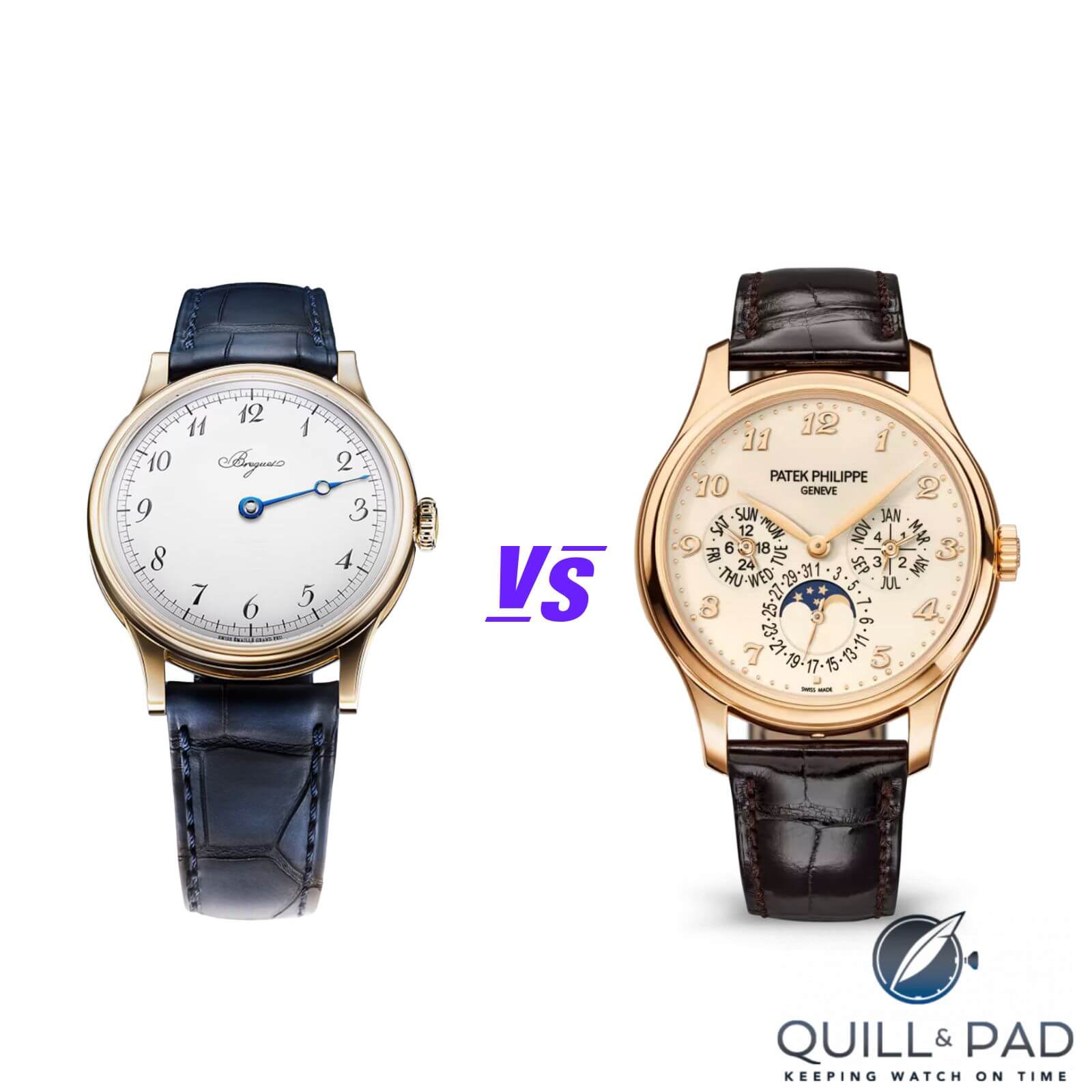
When exploring the Breguet vs Patek Philippe debate, it pays to put their purest creations head-to-head. In my years of advising collectors, the choice between a Breguet Classique and a Patek Philippe Calatrava – the brands’ respective dress watches – is often the most agonising decision a collector has to make, especially since both models demand a hefty premium.
The dials on a true Breguet Classique, for example, are made of solid gold and are engine-turned by hand on antique rose engine lathes. This process, known as guillochage, creates mesmerising, textural patterns such as clous de Paris, barleycorn, or cross-weave. Each catches the light in a way that standard stamped dials simply can’t. Furthermore, it takes years for an artisan to master the pressure required to guide the cutting tool across the dial. The result is a watch that feels incredibly ornate and steeped in old-world charm.
The Patek Philippe Calatrava, on the other hand, takes quite the exact opposite approach. It’s bold and beautifully reductive. After all, Patek believes that perfection is achieved not when there is nothing left to add, but when there is nothing left to take away. A classic Calatrava, like the modern reference 6119, features a crisp, highly legible dial, razor-sharp dauphine hands, and perhaps a subtle hobnail bezel for a touch of texture. It’s perhaps one of the few watches out there whose dial relies purely on the absolute perfection of its proportions and mirror-like polish of its case.
The Heavyweights of High Complications
When we leave the realm of simple three-hand dress watches and enter the field of high complications, the gloves truly come off. This is where the engineering limits of micro-mechanics are pushed further than many other prestigious brands are prepared to go.
Breguet’s absolute trump card is the tourbillon – a feature that traces its lineage right back through the brand’s very origins. Abraham-Louis Breguet patented the tourbillon in 1801, realising that gravity was wreaking havoc on the delicate escapements of pocket watches as they sat vertically in gentlemen’s waistcoats. His solution was to place the entire escapement inside a rotating cage, averaging out the gravitational errors over a full minute. Today, almost every high-end watch brand makes a tourbillon to prove its mettle, but when you buy a Breguet tourbillon, you’re buying it from the house that invented the concept. The company’s modern double tourbillons, where the entire movement rotates around the dial over twelve hours, are mechanical theatres of the highest order.
Patek Philippe, on the other hand, did not invent the minute repeater or the perpetual calendar, but it certainly perfected them. Patek was the first brand to successfully miniaturise the perpetual calendar, putting the mechanism capable of automatically adjusting to the varying lengths of months and leap years inside a wristwatch in 1925. Above all, however, it is Patek Philippe that produces the finest sounding minute repeaters in the world. Collectors simply adore the chime of a Patek repeater, perfectly paced, rich, and resonant. In fact, it’s a known fact that Thierry Stern, the President of Patek Philippe, personally listens to and approves every single minute repeater before it leaves the Geneva manufacture. Furthermore, Patek’s obsession with finishing is legendary; every component, even those hidden deep within the movement, is remarkable. Every meticulously hand-bevelled, polished, and decorated component meets the incredibly strict criteria of the Patek Philippe Seal, offering an exclusive level of perfection.
Value, Market Reality, and the Hype
You can appreciate the history and the finishing of a Breguet or Patek Philippe watch all day long, but when it comes to parting with funds, the economic realities of these two brands could not possibly be more different. This is where my years of industry experience really colour my perspective, because the market can be incredibly cruel, and is rarely entirely rational.
Patek Philippe has successfully cultivated an aura of extreme exclusivity that drives collectors absolutely mad. If you walk into a Patek Philippe authorised dealer today and ask to buy a stainless steel Nautilus or Aquanaut, they’d politely laugh you out of the boutique. To even get on the waitlist for these steel sports models, you must have an extensive, six-figure purchase history of their precious metal dress watches. Because of this artificial scarcity and massive global demand, Patek Philippe commands staggering premiums on the secondary market. A watch that retails for £30,000 might trade for £80,000 the moment it leaves the boutique. Even the brand’s standard Calatravas holds its value exceptionally well. Buying a Patek Philippe is often viewed by modern collectors not just as an acquisition of horological art, but as a solid life investment. It is the ultimate flex, instantly recognised by anyone who knows anything about wealth.
Despite having a history that dwarfs almost every other brand, and offering hand-finished, solid gold, engine-turned masterpieces, Breguet suffers from an element of depreciation on the secondary market. A stunning, brand new Breguet Classique that costs £35,000 at retail can frequently be found on the pre-owned market for less than £15,000. Many collectors consider it entirely criminal that a watch of such immense pedigree and artisanal craftsmanship can command roughly the same price as a mass-produced stainless steel sports watch.
However, it is this market reality that makes Breguet the ultimate stealth-wealth option. Those chasing Instagram recognition with disposable income rarely gravitate toward Breguet. It demands a deeper appreciation of history and a willingness to accept that its value isn’t measured in immediate resale returns. Therefore, when you see a collector wearing a Breguet, you immediately know you’re looking at a true purist. You buy a Breguet purely for the brand’s unadulterated love of watchmaking. You buy it because staring at a hand-guilloché dial brings you joy, not because you are trying to impress the waiter or flip the watch for a profit.
Turning the Watch Over: In-House Movements and Micro-Mechanics
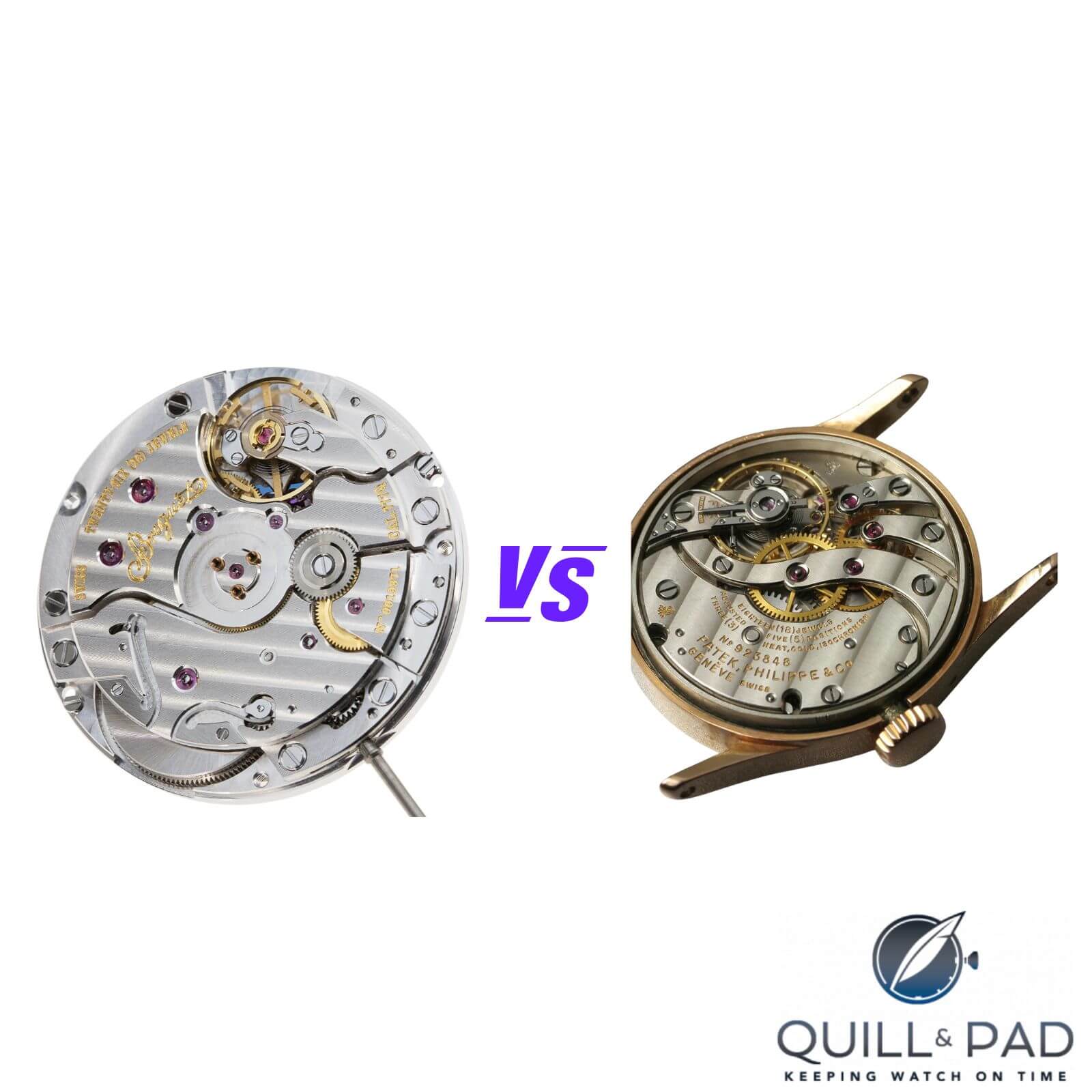

For the true purist, the dial is merely the invitation. Indeed, the real romance happens the moment you turn the watch over, where both houses put their in-house movements on show. Still, there are differences worth noting. Patek Philippe specialises in traditional micro-mechanics. The brand is so confident in its execution that it famously abandoned the prestigious Geneva Seal to create its own, even stricter Patek Philippe Seal. The sweeping architecture of its bridges and mirror-polished anglage, applied to the edges of every single component, are just some of the brand’s signature touches. It is a well-known industry joke (though entirely factual) that Patek watchmakers spend more hours hand-polishing a microscopic gear that you’ll never actually see than some luxury brands spend assembling an entire watch.
Breguet produces its own calibres, a capability significantly strengthened by its acquisition of the legendary Lémania movement manufacture decades ago. Visually, these movements often mimic a nineteenth-century pocket watch, featuring frosted baseplates and deeply intricate, hand-engraved balance cocks that look antique. Armed with the Swatch Group’s infinite research budget, however, Breguet has been able to fully embrace anti-magnetic silicon hairsprings, silicon escape wheels, and even revolutionary magnetic pivots that float the balance staff in mid-air. It’s a little like hiding a highly advanced engine inside a vintage, velvet-lined carriage, and it works beautifully.
The Final Verdict: Independence vs The Conglomerate
Ultimately, the divergent paths of these two legendary houses can be traced back to their modern corporate structures. Patek Philippe is the last great, fiercely independent, family-owned watch manufacturer in Geneva. The Stern family has owned the company since 1932, and its independence is a massive part of its romantic appeal. It doesn’t have to answer to the impatient demands of shareholders. Instead, it can afford to play the long game, strictly controlling production numbers and maintaining the exclusivity factor that fiercely protects the prestige of the Patek Philippe name.
A quick glance through Breguet’s story and it becomes clear that this brand had a much more turbulent history, having been dormant for many years before changing hands several times throughout the twentieth century and finally being revived. Today, Breguet sits as the crown jewel at the very top of the massive Swatch Group conglomerate. Being owned by the Swatch Group gives Breguet vast resources, financial security, and access to top-tier technology, but some purists feel it lacks the intimate, family-run charm of Patek Philippe. It produces masterpieces, but they have to fight much harder for mindshare in a crowded, noisy market obsessed with steel sports watches rather than classical elegance.
In conclusion, choosing between Breguet and Patek Philippe is a reflection of what you value most as a collector. If you’re captivated by the romance of absolute perfection, the security of immense market demand, and the flawless execution of high complications, your path leads directly to Patek Philippe. It’s a brand that demands a high price of entry, but rewards you with unmatched global prestige. But if you value raw historical significance and prefer the beauty of a hand-turned dial, then Breguet is your calling. Even so, whichever path you choose, you’re putting a true piece of human ingenuity on your wrist. So enjoy the journey.
Read more like these
Unlocking the Mechanical Secrets of the New Felipe Pikullik Sternenhimmel FPA1
Clash of the Titans: A Comprehensive Guide to Blancpain vs. Jaeger-LeCoultre

