
A good way to make a watch last forever. Well, almost.
Part of the appeal of watchmaking is that watchmakers often set themselves seemingly impossible goals: an ultra-thin movement, a highly complex movement, a highly skeletonized movement, a transparent movement, a movement with a power reserve that far exceeds practical requirements. Beyond focusing on the mechanics, watchmakers also transform watches into miniature works of decorative art. One such approach is stone dials, and watches with dials of this kind have always been rare.
Italian decorative masters during the Renaissance invented the technique of the Florentine mosaic, reproducing multicolored paintings using plates of various stones. The technique of pietra dura – as they called it – most likely made its way into watchmaking in the 19th century. French firms Breguet, Leroy, and a few other now almost forgotten names are usually mentioned in this context. In the late 19th and early 20th centuries, Vacheron & Constantin produced pocket watches with pietra dura dials in collaboration with the Parisian jeweler Ferdinand Verger. In 1966, Piaget essentially reinvented this technique in a simplified form, typically decorating the dial entirely with a single thin slab of decorative stone or, more rarely, a combination of two slabs of different stones for the central and peripheral parts of the dial.
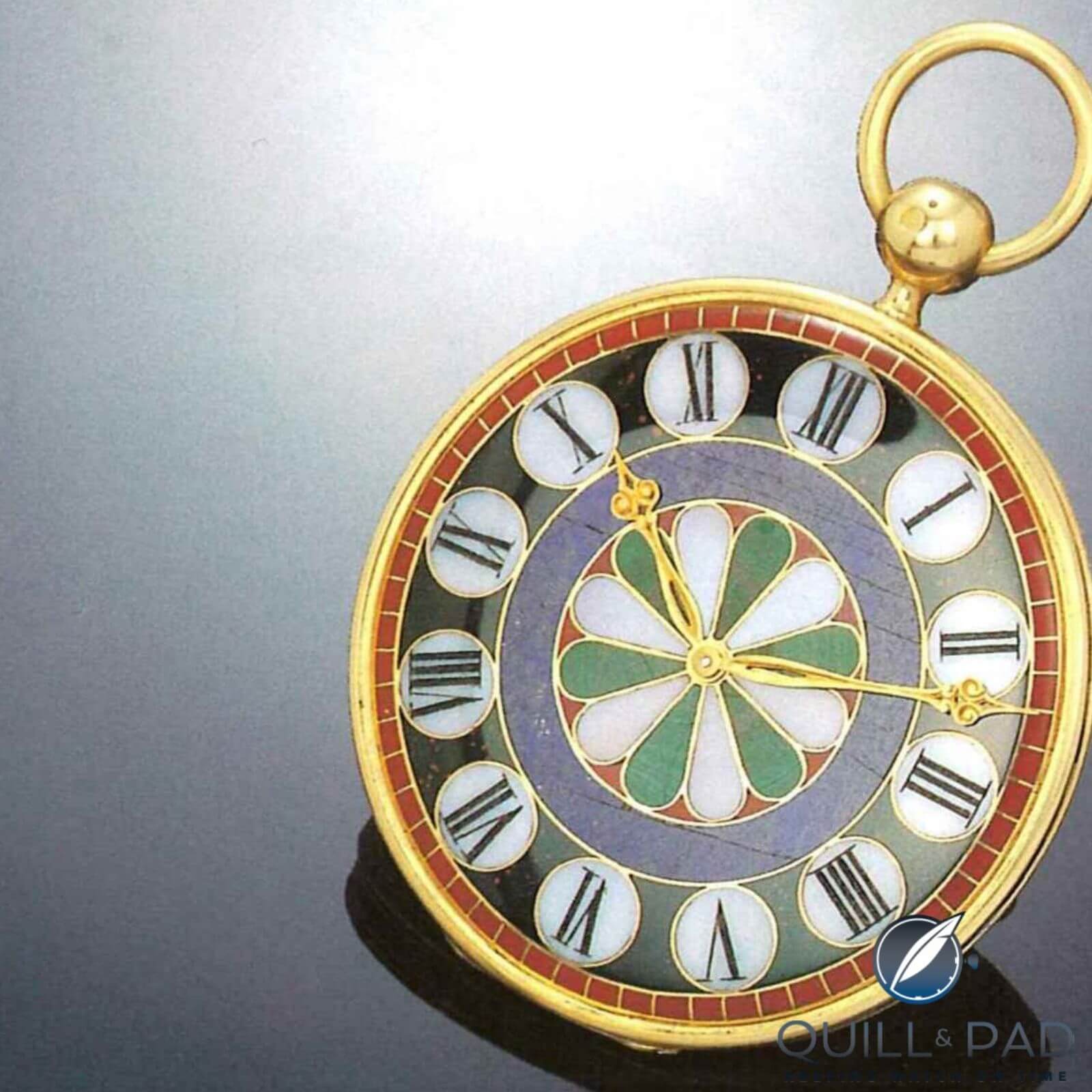
Lepaute & Fils pocket watch with hardstone mosaic dial and case, circa 1835. Image credit: Antiquorum.
Stone dials on wristwatches reached peak popularity in the 1970s and 1980s. These dials were primarily used on gold dress watches, taking advantage of the fact that by then the production of thin movements – both mechanical and quartz – was well established, allowing for more elegant decorative models. Watchmakers most frequently used agate, jasper, jadeite, lapis lazuli, malachite, onyx, opal, tiger’s eye, hawk’s eye, and turquoise for dials. Aventurine, coral, mother-of-pearl, and meteorite are also commonly included, although, strictly speaking, these materials are not minerals. Watch market leaders including Rolex, Patek Philippe, Vacheron Constantin, Audemars Piguet, several others, and, of course, Piaget, the pioneer of this technique in the modern era, have all been active in this genre.
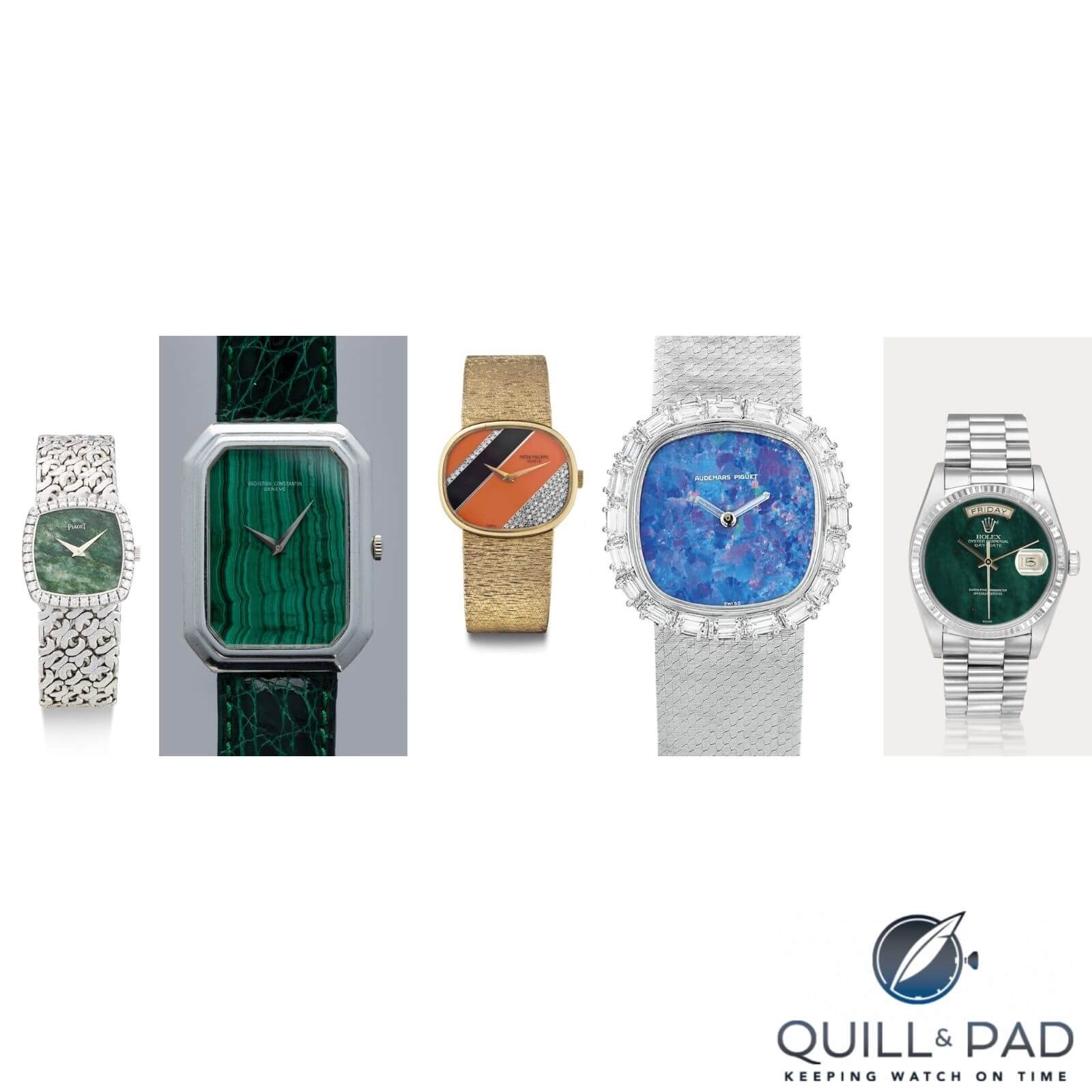
Vintage watches with stone dials (from left to right): Piaget Ref. 9236 N66 with jade dial (circa 1970; image credit: Sotheby’s); Vacheron Constantin Ref. 2077 with malachite dial (circa 1970s; image credit: loupethis.com); Patek Philippe Ref. 3845/909 with coral, onyx, and diamond-set dial (1977; image credit: Christie’s); Audemars Piguet watch with opal dial (circa 1985; image credit: Sotheby’s); Rolex Day-Date Ref. 18039 with bloodstone dial (circa 1979; image credit: Sotheby’s).
The technical difficulties of working with fragile, often imperfectly monolithic raw materials led to a high rate of defects, both when sawing the original material and when polishing and drilling holes for the hand pinions and applied markings (if any). As a result, the already considerable cost of producing a stone dial – and a watch as a whole – increased significantly. Hardstone dial production has always been, and remains, highly limited, and the inherent fragility of stone further reduces the number of surviving examples as time goes by.
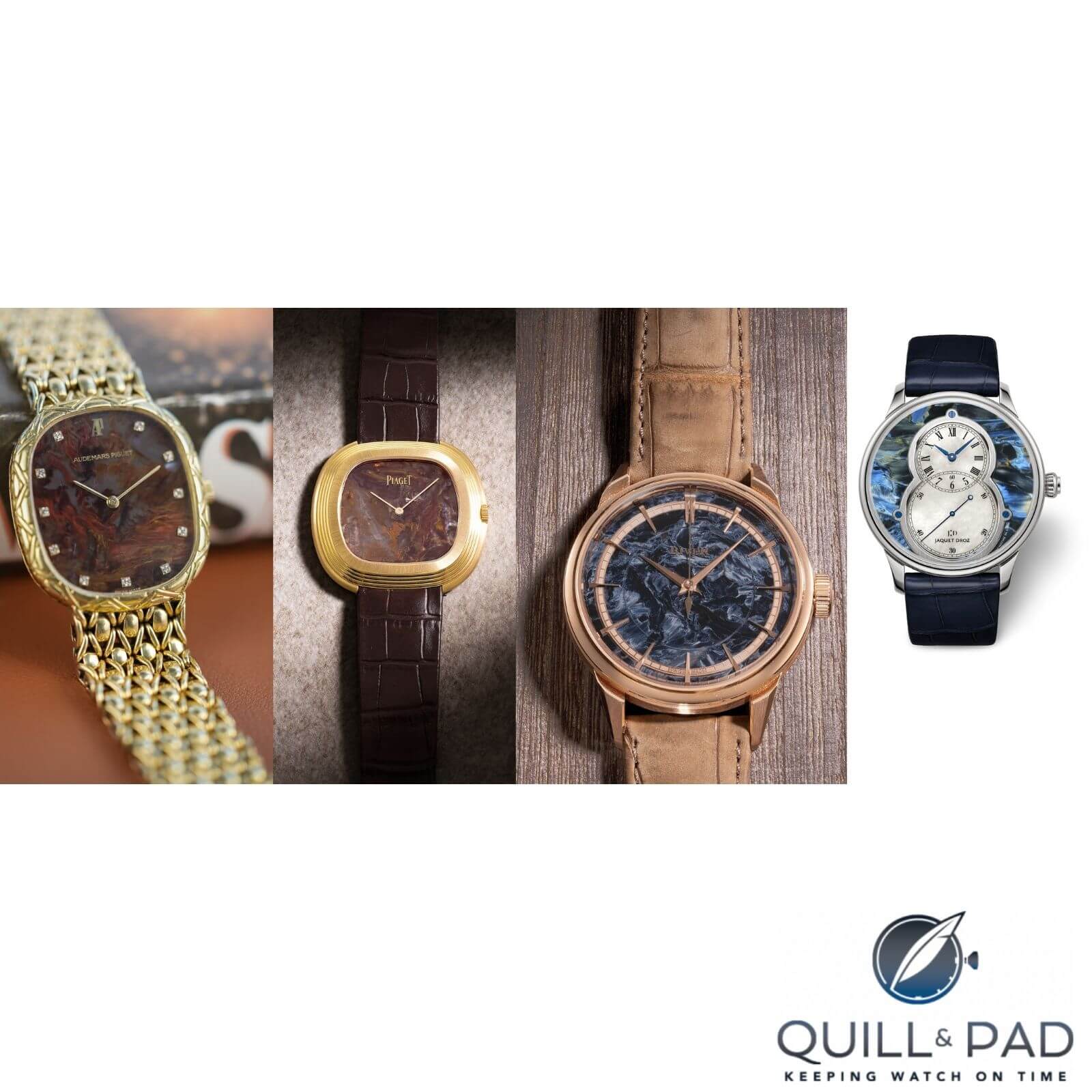
Some rare watches with pietersite stone dials (from left to right): Audemars Piguet oval-shaped watch (circa late 1980s; image credit: discreetpeacock.com); Piaget Black Tie Vintage for Only Watch 2017 (image credit: Phillips); Biver Automatique Atelier Series Pietersite Ref. PRF-12154 (2025; image credit: Phillips); Jaquet Droz Grande Seconde Pietersite Ref. J003034423 (2016; image credit: Jaquet Droz).
Among rare stone-dial watches, some are exceptionally scarce, and that group definitely includes pietersite – a special type of chalcedony with chaotic coloring and structure, plus an unpredictable fibrous texture that makes the polished stone, once in hand, seem almost alive as you change your viewing angle or the lighting. Pietersite can be described as a wildly intertwined blend of hawk’s eye and tiger’s eye. Its texture and predominant gray-blue hue evoke storm clouds or a turbulent sea, which is why it’s sometimes called “Storm Stone” – and the name fits. Pietersite dials shimmer with a range of hues, from light gray to deep, dark gray-blue and red-brown tones. The interplay includes red, brown, gold, and silver-blue accents that don’t sit frozen beneath the polished surface of the translucent stone, but instead seem to live and shimmer.
This is only the second time Quill & Pad has featured this stone. Pietersite isn’t just rare on watch dials; its use in vintage watches can be counted on one hand. It’s relatively new to the ornamental mineral world, having been discovered in 1962 in Namibia by mineral dealer Sidney Pieters. Watches with dials made from it reportedly appeared in the 1970s, most likely in the Piaget collection, specifically Ref. 9791. Such dials subsequently appeared on Audemars Piguet Ref. 4647 (late 1980s) and Royal Oak Ref. 14587 (1994). It appears that a new source of specimens well suited to watch dials emerged in the 2010s, offering watchmakers especially dramatic pietersite dials, as pietersite watches have resurfaced on the market. Piaget cemented its reputation in this genre in 2017 by offering a unique Black Tie Vintage watch with a pietersite dial for the Only Watch 2017 charity auction. Jaquet Droz beat them to the punch, introducing the Grande Seconde Pietersite a year earlier, later adding two tourbillons with dials made from two different types of pietersite: the Grande Seconde Tourbillon Blue Pietersite and the Grande Seconde Tourbillon Red Pietersite.
A fresh wave of interest in watches with dials made from this exotic mineral emerged in 2025, when several brands joined the pietersite club. Among them were Biver with the Automatique Atelier Series Pietersite, Baltic with the Prismic Stone Dial Pietersite (the “eternal” dial material is complemented by an “eternal” design – Prismic dials like those of the 1930s Patek Philippe Calatrava Ref. 96), Atelier Wen with the Millésime 2025 Perception, and Sartory-Billard with the SB04-E Pietersite Platinum.
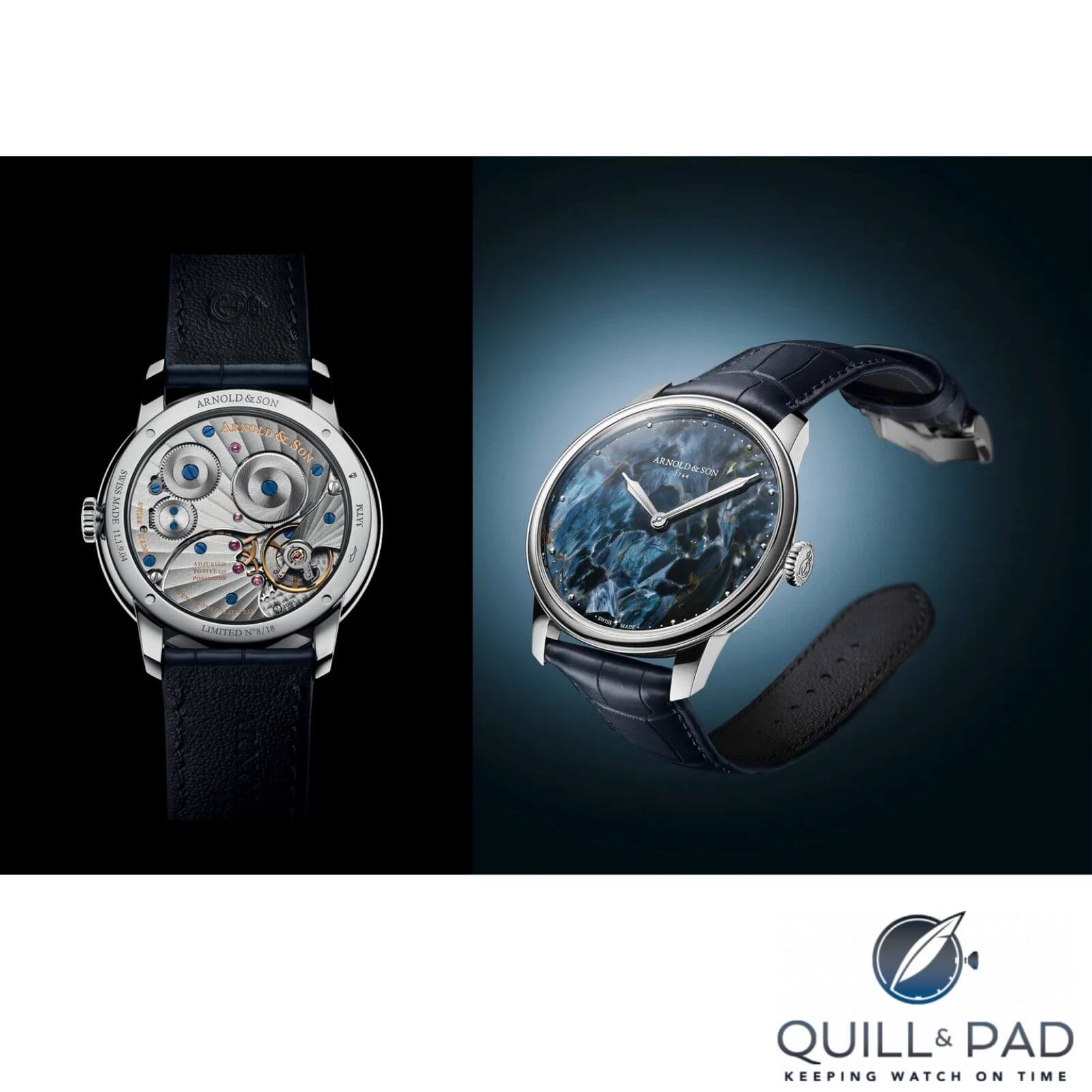
Arnold & Son HM Steel Pietersite. Limited edition of 28 pieces, although this official image still shows the 18-piece limitation engraved on the caseback.
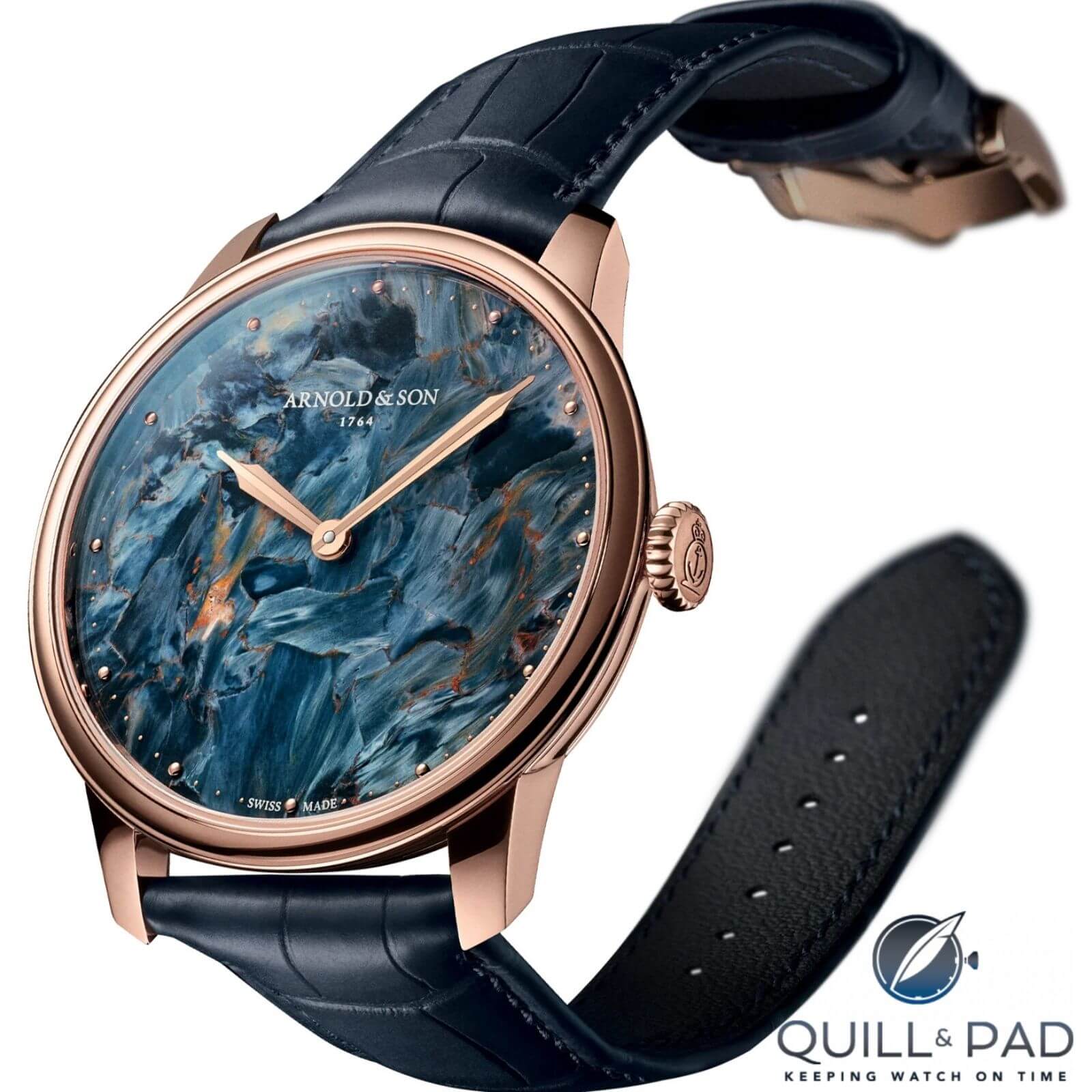
At Watches and Wonders 2026, this story took a remarkable turn – Arnold & Son unveiled not one but two HM Pietersite models, in stainless steel and red gold. It’s worth noting that when planning the exposition, Arnold & Son apparently underestimated the demand for watches with exotic stone dials. At Watches and Wonders, the editions were initially announced as limited to 18 steel and 8 gold pieces, but by summer they had increased to 28 and 18 pieces, respectively. Interestingly, at the time of writing, the caseback images on the brand’s website still show the original limitation. To me, this situation is telling – perhaps the demand for watches with stone dials isn’t so marginal that releases of such models should be treated merely as PR activities to attract attention to the brand without generating significant sales.
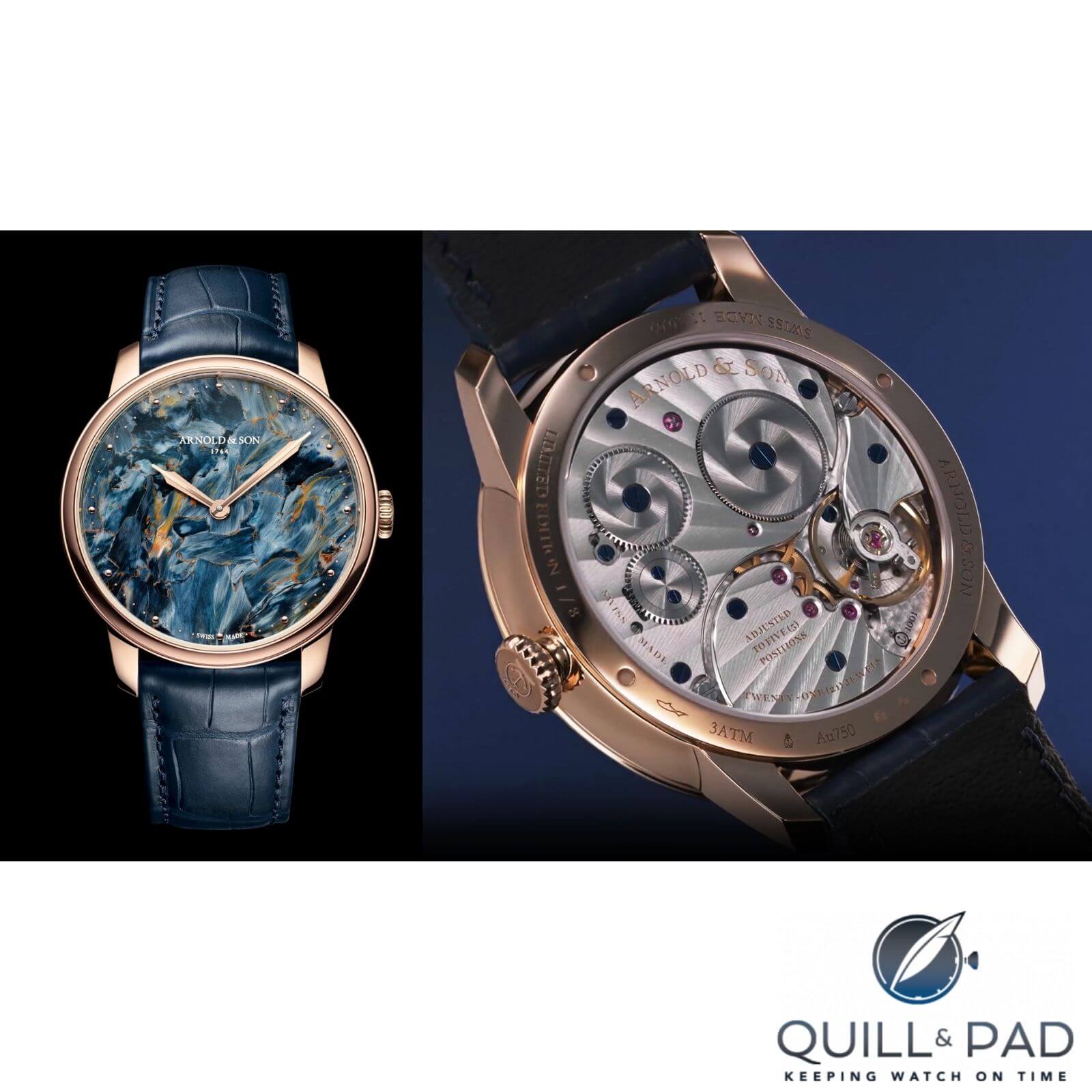
Arnold & Son HM Red Gold Pietersite. Limited edition of 18 pieces (this image shows the 8-piece limitation engraved on the caseback).
Let’s take a closer look at this watch. The Arnold & Son HM Pietersite is designed in a classic dress-watch style and, in line with modern trends, has a diameter under 40 mm – specifically 39.5 mm. Its elegant character, crucial for a dress watch, comes not only from its round shape and meticulous full polishing without brushing, but also from its slim thickness – no more than 8 mm for a modern mechanical watch (7.82 mm, to be precise). This gives the watch an aspect ratio slightly better than 5:1, an excellent figure for a modern watch, considering that a watch with an aspect ratio of 4:1 already feels very comfortable on the wrist. The Arnold & Son HM Pietersite takes this a step further. I especially like how the brand achieves such pleasing proportions in watches with stone dials, which technically should add thickness. Arnold & Son excels in this area, particularly with their thin tourbillons. Another important point, in my opinion, concerns the crystal. It’s domed, whereas you’d typically expect a flat crystal in thin watches – that’s usually the norm in this genre. Combined with its domed shape, the crystal has anti-reflective coating on both sides, which enhances the impression when looking at the pietersite dial – the crystal seems to disappear.
No two dials made from natural materials ever share the same pattern, which is perfectly natural for pietersite, a mineral characterized by swirling structures formed by nature in a completely random way. What does this mean for the watch owner? A dial with a chaotic texture is essentially a natural object, one you never get tired of looking at, like watching a flame, flowing water, or clouds drifting across the sky – fully in line with the classic formula. A final mineralogical note: Arnold & Son sources the mineral from Namibia, the very place where Sidney Pieters discovered it in the early 1960s.
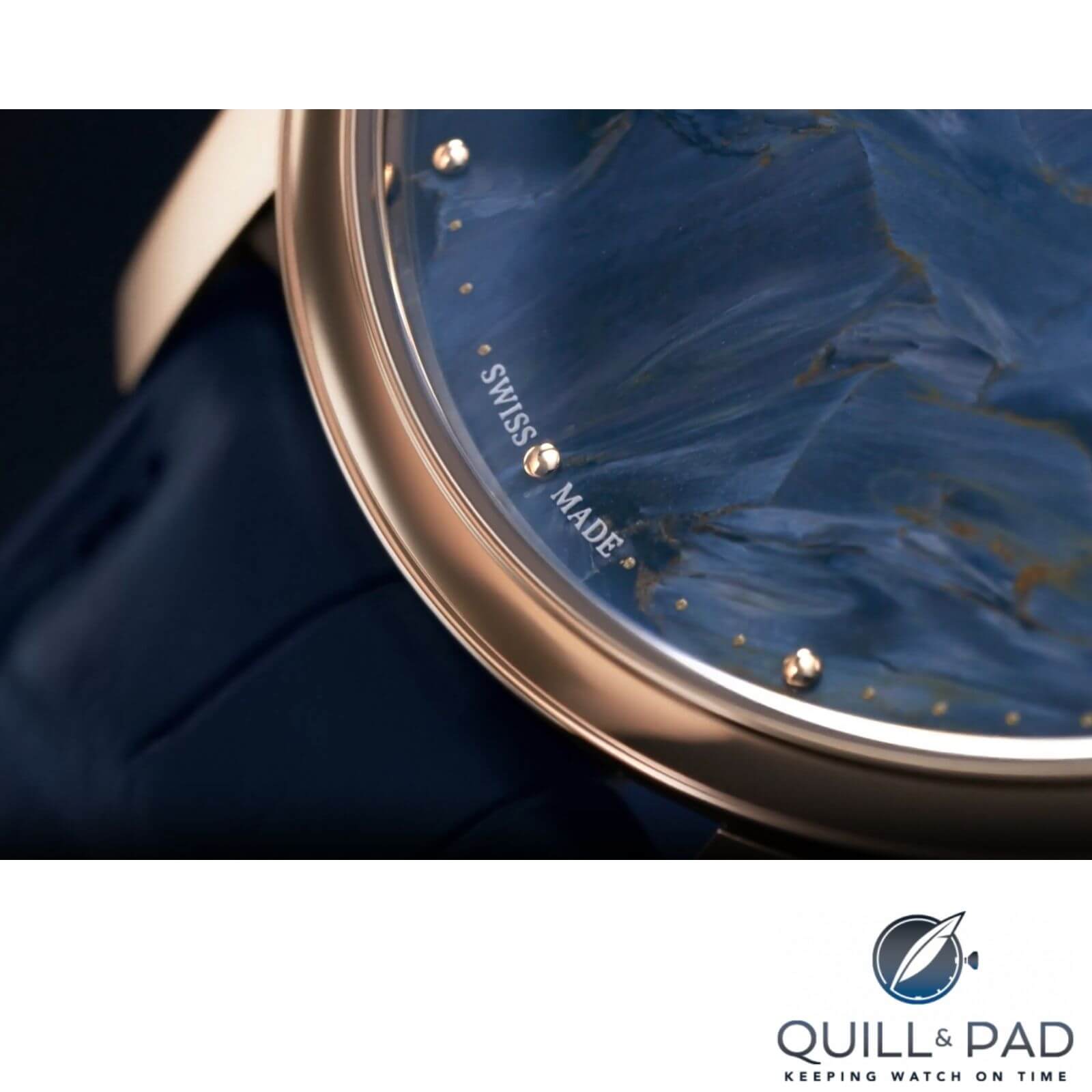
Arnold & Son HM Red Gold Pietersite. Detailed view of the dial.
To maximize the mineral’s presence on the dial, Arnold & Son chose a minimalist design with applied “pearl” indices. These are small, polished, hemispherical metal elements, with larger ones marking the hours and smaller ones marking the minutes – a nod to pocket watch styling from the first half of the 20th century. Rather than detracting from the pietersite, the “pearl” indices act as design accents, adding a touch of technical flair to the dial. This suits a brand with distinguished technical roots like Arnold & Son, even though the modern company has no direct historical connection to John Arnold’s original firm. Naturally, the applied indices match the case color, which always signals good taste.
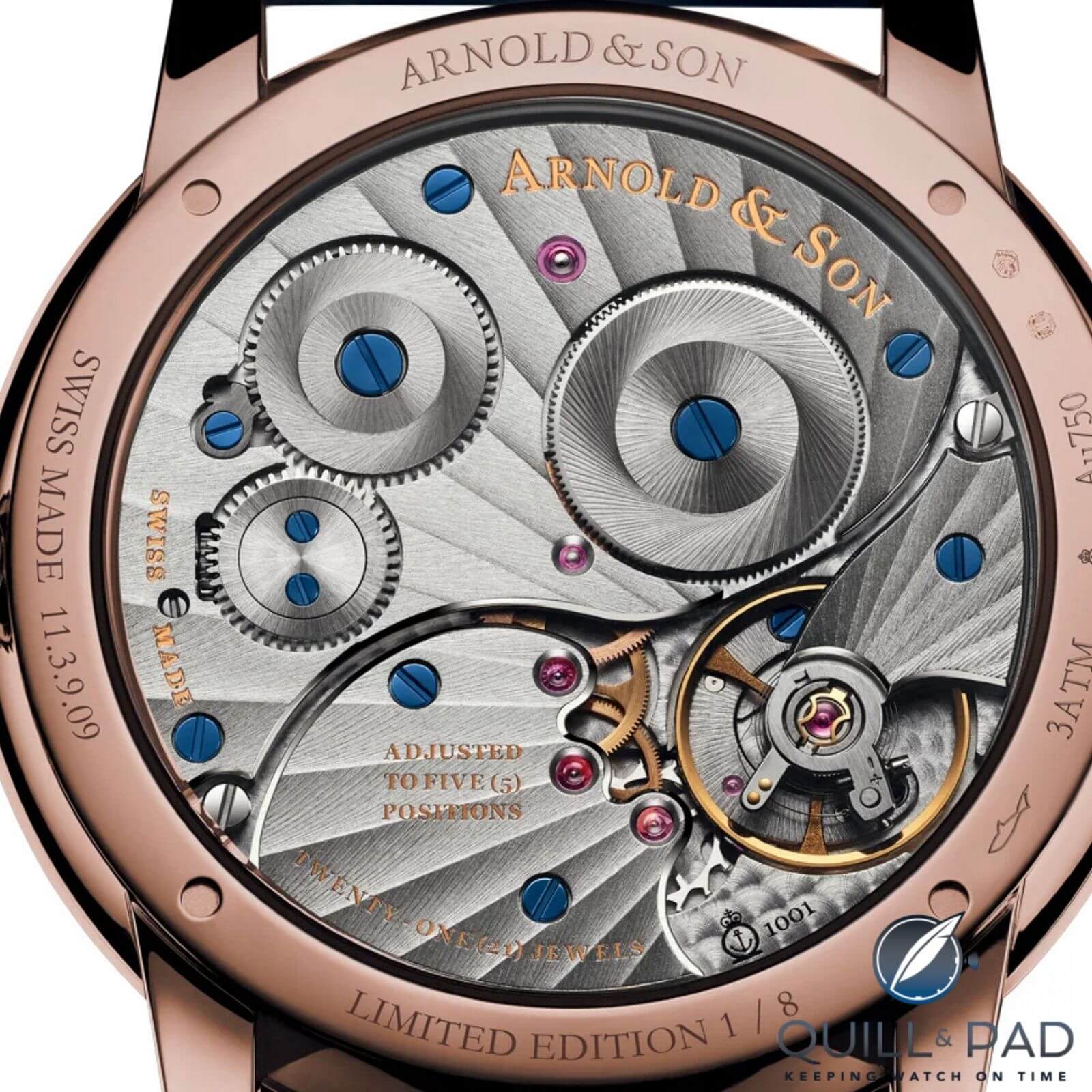
Caliber A&S1001, a 2.7 mm-thick ultra-thin movement in the Arnold & Son HM Red Gold Pietersite.
Unlike the classic stone-dial timepieces of the 1970s and 1980s, Arnold & Son offers a genuine opportunity to enjoy watchmaking at its finest. The HM Pietersite caseback is sapphire, revealing a truly captivating movement: the exclusive Caliber A&S1001, produced by Arnold & Son’s sister company La Joux-Perret, the Swiss movement maker. Twin barrels, which provide a 90-day power reserve, are a rare advantage for an ultra-thin, hand-wound movement measuring just 2.7 mm thick.
This movement architecture allowed Arnold & Son to create a superb 5:1 ratio for the watch, and it offers something else too: a notably large 30 mm diameter for the movement itself. First, this is technically necessary, as it allows space for the two barrels. Second, it gives the movement a very strong presence when viewed from the back. Arnold & Son and La Joux-Perret made the most of this geometry. They gave the movement bridges contours reminiscent of fine, slim pocket calibers from the first half of the 20th century, accentuating this with snail-brushed winding wheels, an abundance of blued screws, and gilded engravings. The traditional perlage on the mainplate is complemented by radial Côtes de Genève on the bridges, centered on the balance shaft, giving the watch an intriguing blend of tradition and calm avant-garde, perfectly suited to a modern dress watch.
Quick Facts — What to Know About
Models and maker: HM Steel Pietersite, Ref. 1LCDS.Z02A.C1506S, and HM Red Gold Pietersite, Ref. 1LCDR.Z01A.C1506A, by Arnold & Son.
Edition: Limited to 28 pieces in stainless steel and 18 pieces in 18k red gold.
Case: Stainless steel or 18k red gold, polished; domed sapphire crystal with anti-reflective coating on both sides; sapphire case back with anti-reflective coating; winding crown at 3 o’clock; water-resistant to 30 m.

Case dimensions: Diameter 39.5 mm; thickness 7.82 mm.
Dial: Pietra dura dial with Namibian pietersite; semi-spherical applied indexes; polished and brushed plume-style hour and minute hands.
Movement: Manufacture hand-wound caliber A&S1001, running at 3 Hz (21,600 vph), with a 90-hour power reserve; 21 jewels; diameter 30 mm; thickness 2.70 mm.
Strap and buckle: Dark blue alligator leather strap with pin buckle in stainless steel or 18k red gold.
All images, except where otherwise noted, courtesy of Arnold & Son.
Read more like this:
A World in Platinum: The Andersen Genève Communication 45 and the Art of the Worldtimer
Hong Kong: Watch-World’s Other Hub
League of severe decorative style, thanks to the preserved gold part of the 7750

