
Party on the Wrist: Reviewing the Sartory Billard SB10 Jumping Hour ‘Disco Ball’
By Nina Scally
The Sartory-Billard SB10 Jumping Hour ‘Disco Ball’ strips away a traditional dial and hands. Instead, it features floating sapphire discs, a massive jumping-hour aperture, and an exposed, engine-turned centerpiece. It’s pure mechanical theatre, delivering bespoke, independent horology for the price of a mass-produced diver.
If you’ve ever found yourself absentmindedly rolling a cabochon gemstone between your fingers, you already know there’s something cathartic about its smooth, domed surface. The term actually comes from the old French word for “head,” but in our world, it means a stone that’s been shaped and polished rather than sliced into sharp little facets. It’s an ancient technique, way older than modern diamond cutting, and it’s used for one very specific reason: it makes a stone look like liquid. You don’t facet an opaque stone like turquoise, or something as glassy as tiger’s eye. Faceting is for chasing that blinding sparkle.
Cabochons are all about lustre, surface tension, and rich, intensified color. But honestly, there’s a much more human reason we love them, especially in jewelry and on winding crowns. They just feel good. A brilliant-cut diamond is sharp. A cabochon is warm and inviting, begging you to run your thumb over it when you’re lost in thought. It is art designed for your fingertips just as much as your eyes.
In watchmaking, the dial is where all the magic and artisanship happen. It’s forever locked away in a tiny vault behind a sliver of AR-coated sapphire crystal. We can stare at the guilloché, drool over the enamel, and appreciate the polished indices, but we can’t physically connect with any of it. It is, for want of a better word, a long-distance relationship.
The Void Where a Dial Used to Live
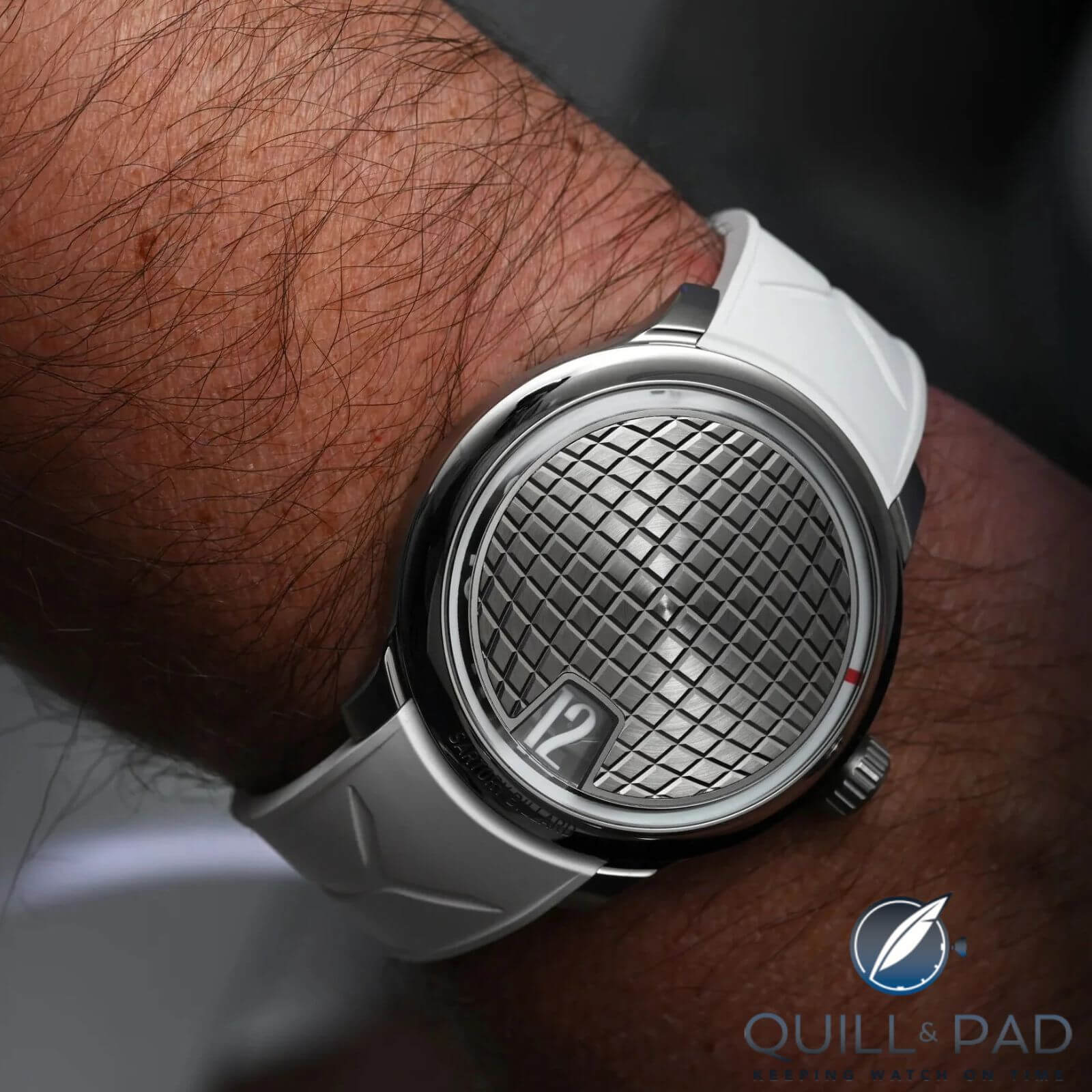
The SB10 by Sartory Billard is named the “Disco Ball” for good reason. It has no dial. It has no hands. No central pinion drives a sweeping seconds indicator, either. And if you were expecting to find a minute track painted on a brass baseplate, you’ve come to the wrong party, because Armand Billard has stripped the traditional architecture right down to the studs, leaving a gaping void where the dial should conventionally sit. Into this empty space, he dropped a massive, fixed central element that he and the brand call a cabochon.
But in this “Disco Ball” edition, we aren’t looking at a smooth, polished piece of onyx. We’re looking at a globe of steel that has been subjected to an intense engine-turned process. It is built from hundreds of sharp, perfectly machined micro-facets that catch, shatter, and scatter the ambient light from every possible angle. And here’s the best part: it sits on the outside.
With the timekeeping bits pushed out of the way, the center of the watch gets to be the star of the show. No giant sapphire crystal locks everything away behind glass. That steel Disco Ball cabochon sits totally exposed. You can physically run your thumb across it. You can feel the crisp edges of the guilloché and the cold metal, creating an interactive experience: when you move your wrist and the light dances across the steel, you can reach out and touch it. You’re instantly connected to the core of the watch.
Ghostly Numerals in the Night
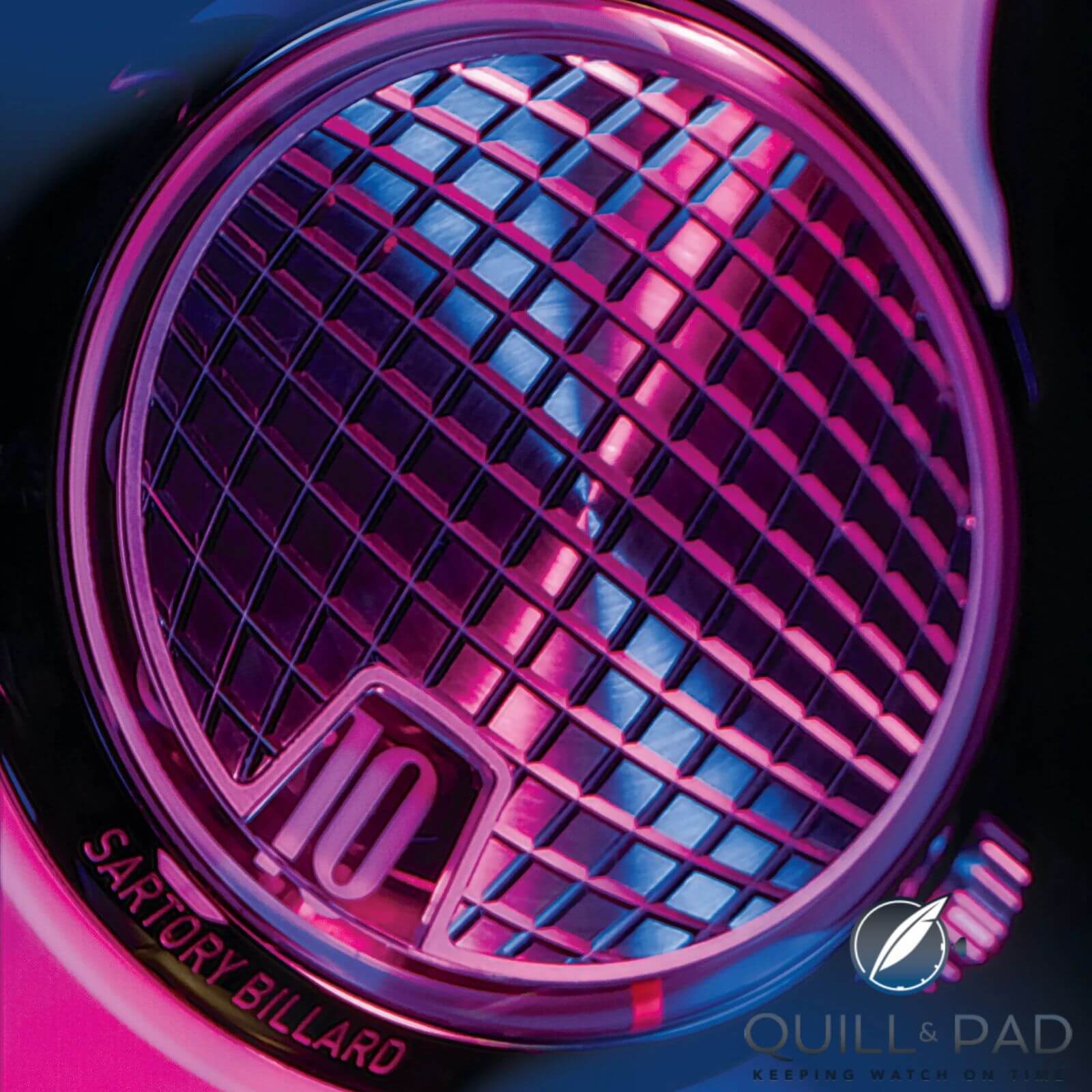
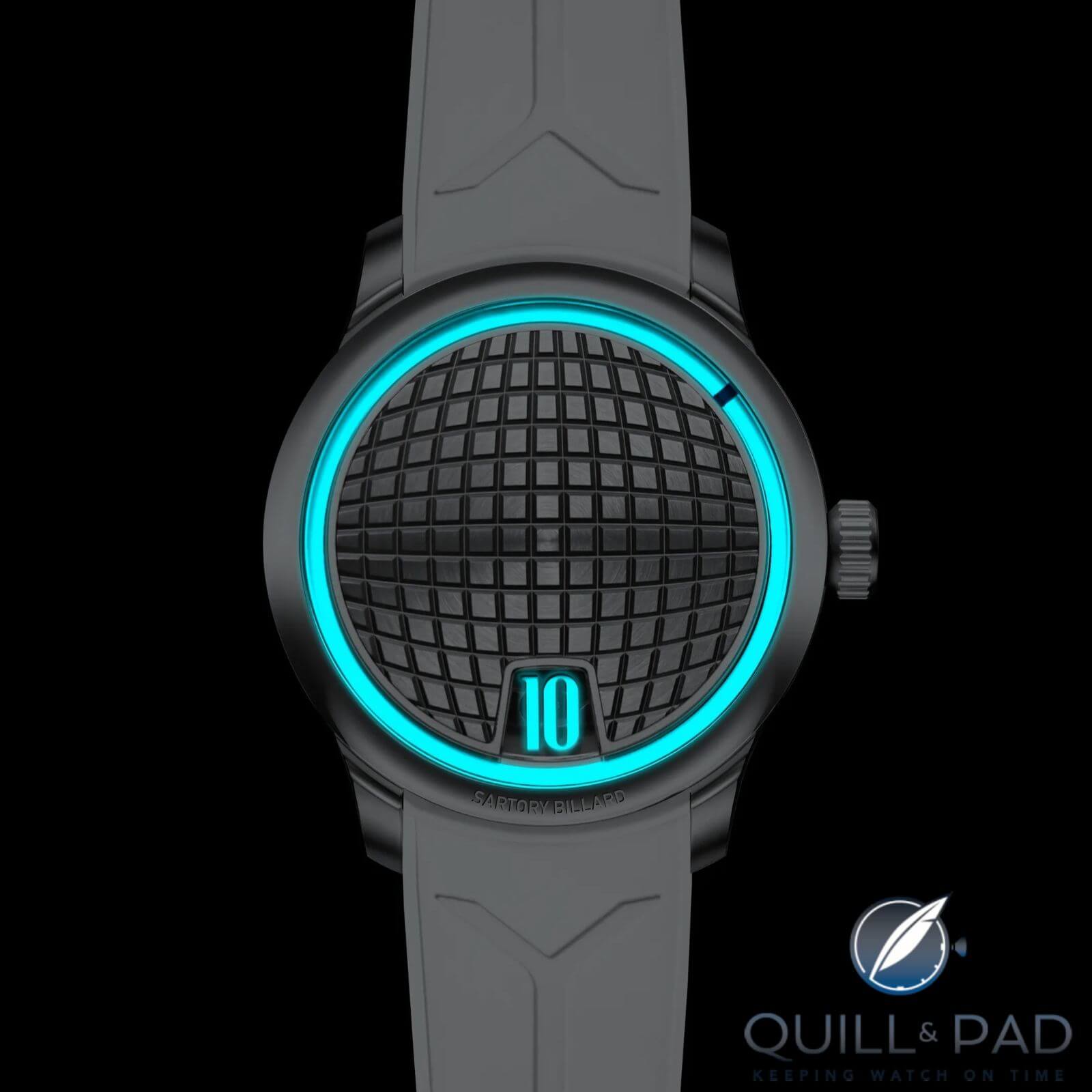
So, if there are no hands and no dial, how do you actually tell the time on the SB10 Jumping Hour ‘Disco Ball’? It all comes down to two incredibly thin sapphire discs, measuring just 0.2mm thick. They rotate around the central cabochon, virtually invisible, making the numerals look suspended in mid-air, with a little red marker floating around the edge to track the minutes.
In daylight, it looks sleek and modern, but the second you turn the lights off, the outer ring of the Sartory Billard SB10 Jumping Hour ‘Disco Ball’ floods with BGW9 Super-LumiNova. In the dark, it lights up, throwing a vivid turquoise halo around the cabochon’s dark silhouette in the middle. Time hovers. It feels like you’ve got a tiny, glowing orbit floating above your wrist.
The Mechanical Snare Drum
Down at six o’clock sits the main event: a massive jumping hour window – a feature that dates all the way back to 1883 with Austrian engineer Josef Pallweber’s pocket watches. Heavyweights like IWC and Cortébert ran with it, Gérald Genta revived it for his crazy Disney watches, and brands like A. Lange & Söhne eventually turned it into high art.
But why do purists lose their minds over it? Well, because jumping hours replace the standard sweeping hand. The jumping hour is all about tension. For 59 minutes and 59 seconds, a ridiculous array of cams and springs slowly winds up, holding back a physical wall of energy. Then, right at the top of the hour, all that stored power violently releases, and the disc snaps 30 degrees like a snare drum.
On the Sartory Billard SB10, that sudden snap of energy plays perfectly against the smooth, silent orbit of the floating minute ring, so you’ve actually got fluid time and fractured time sitting in the exact same space. It looks incredible.
Plus, Armand designed this thing to be used. Jumping hours are notorious for having tiny windows, but Armand, in his usual blunt fashion, pointed out that at 50, he wants to be able to read his own watch. So, the aperture here is huge, and the bespoke numerals by typographer Simon Schmidt are bold and aggressive.
The Movement
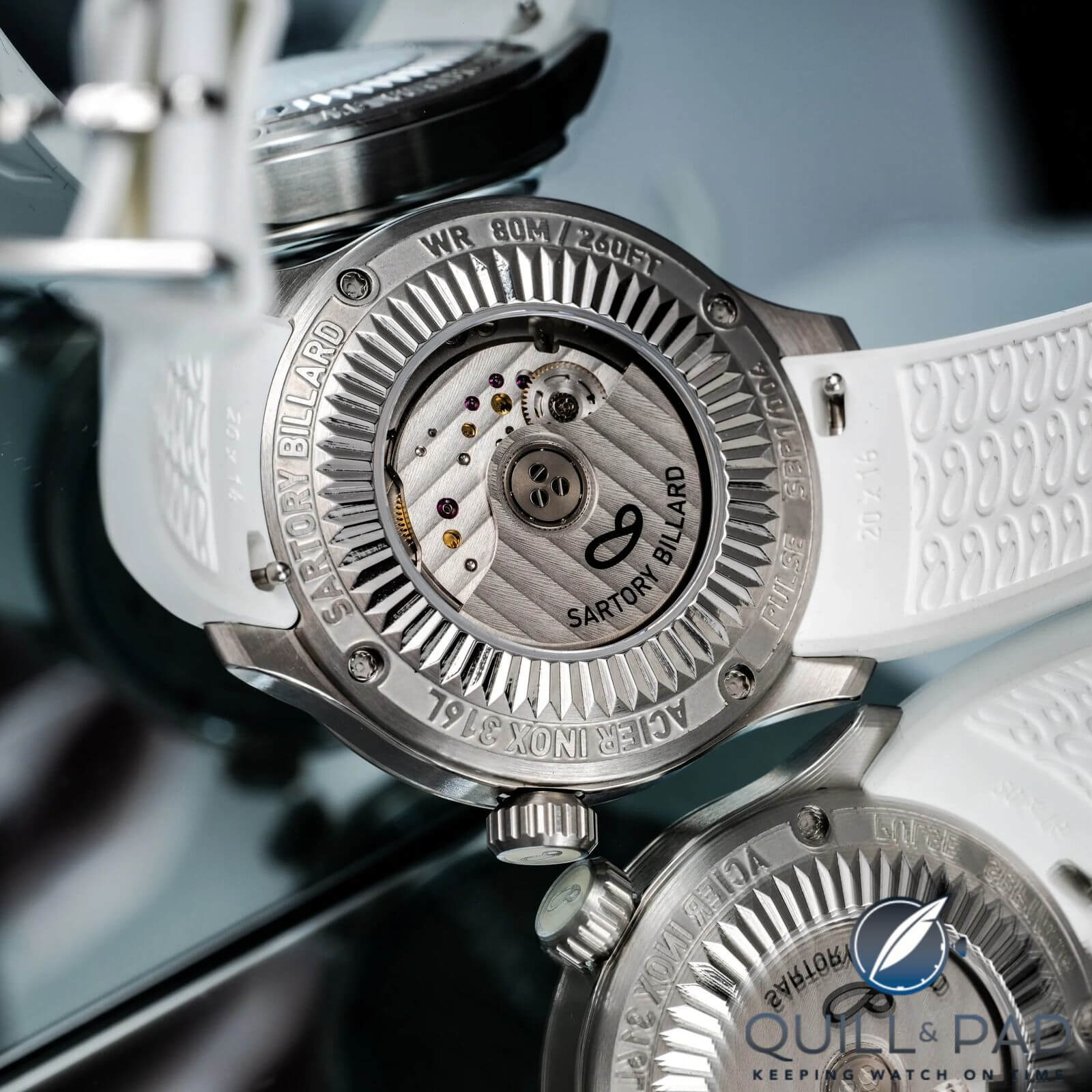
Even at just 0.2mm thick, those sapphire discs weigh more than a standard set of brass hands. Dragging them around the dial requires a beefy engine. Sartory-Billard chose the La Joux-Perret G100, which boasts a solid 68-hour power reserve. But honestly, the SB10 asks a lot of this movement, and by the time you bolt on that patented jump-hour module, the power reserve drops to 48 hours. Making this watch an automatic was a good move. A manual wind might have felt more romantic, but having a rotor means the heavy sapphire discs aren’t a problem.
Ergonomics and the Steel Shell
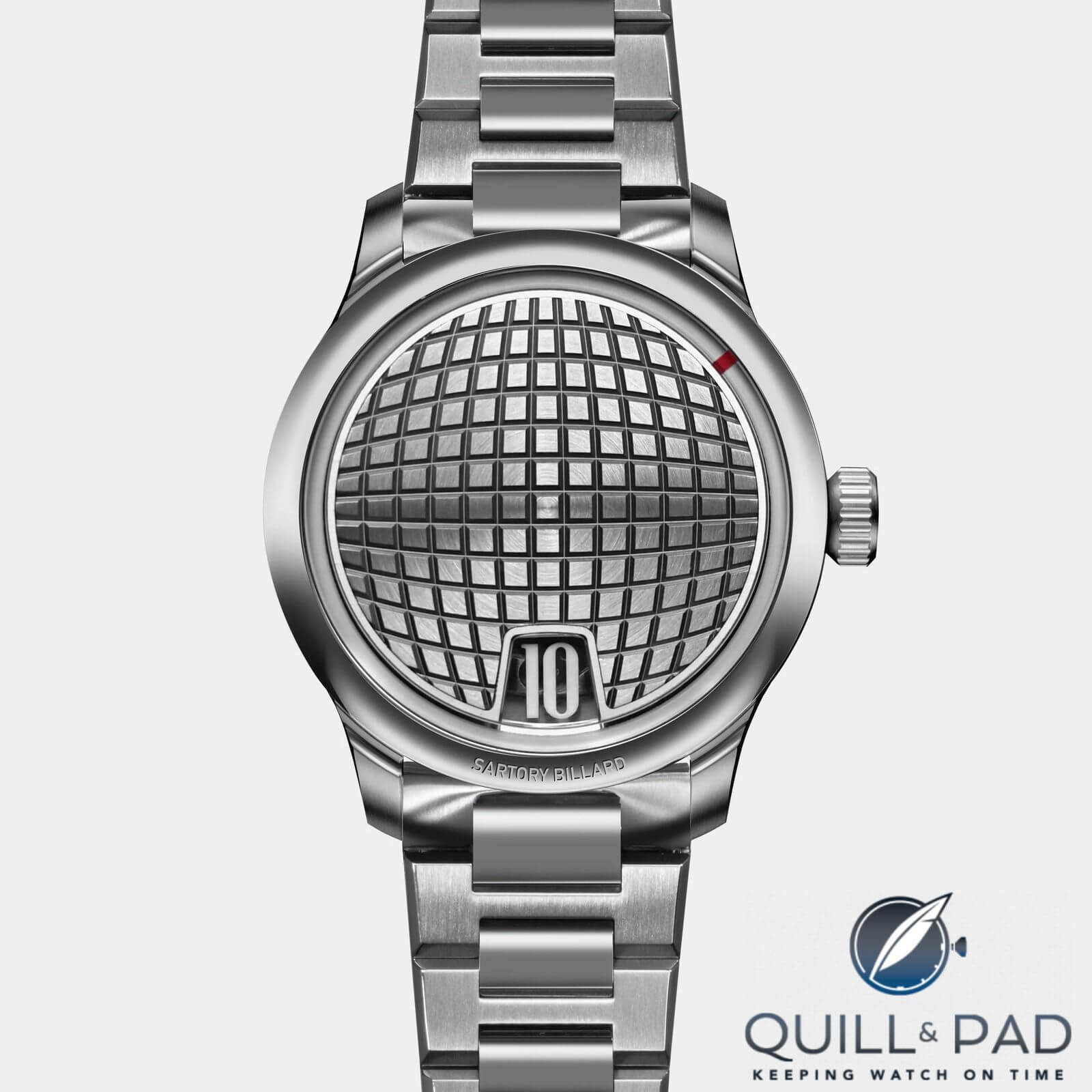
For all the architectural beauty up top, the SB10 sits in a disciplined steel shell. We’re talking 316L stainless steel, hitting a sweet spot at 39.5mm in diameter. With the modular movement, stacked sapphire discs, and protruding central cabochon, you’d expect this to sit on the wrist like a hockey puck, but instead it clocks in at just 11.5mm thick, paired with a compact 44mm lug-to-lug length. The alternating brushed and polished finishes trick the eye into making it wear even slimmer.
You get 80 meters of water resistance, which is more than you’ll ever need for a watch designed to drop jaws at dinner parties rather than explore shipwrecks. Add a quick-release rubber strap (available in plenty of colors) or an articulated steel bracelet, and you’ve got something that’s pretty wearable outside, too.

The Verdict
The moment you see a watch featuring the words “independent,” “patented module,” or “jumping hour,” you can usually expect a painfully high price tag. We’re living in an era where five-figure asking prices are considered “entry-level” for bespoke indie creations. But the Sartory-Billard SB10 Disco Ball is priced at £3,225. For that price, you’re getting a patented jumping hour module, custom typography, suspended sapphire discs, a heavily modified La Joux-Perret engine, and an engine-turned cabochon dial.
Because Sartory-Billard is a true independent operation, production is low. The 2026 allocation is spoken for, gone into the collections of enthusiasts who recognize this watch’s value proposition. But for those willing to get in line and wait, the SB10 Disco Ball offers something rare on the pre-owned market. Like me, you likely fell in love with this design because it proves that independent horology is alive and well, and doesn’t need to be so inaccessible.
Sartory-Billard SB10 Jumping Hour ‘Disco Ball’ – Key Specifications
-
Reference: SB101SDIBA
-
Case Material: Stainless steel with polished and brushed finishes
-
Case Diameter: 39.5 mm
-
Case Thickness: 11.5 mm
-
Lug-to-Lug: Approximately 44–44.5 mm
-
Movement: Swiss-made La Joux-Perret G100 automatic caliber
-
Complication: Patented jumping-hour mechanism
-
Power Reserve: 55 hours
-
Frequency: 28,800 vph (4 Hz)
-
Dial: Guilloché steel cabochon with distinctive Disco Ball micro-faceted pattern
-
Time Display: Jumping hours and rotating sapphire minute disc
-
Crystal: Sapphire crystal
-
Water Resistance: 80 meters (8 ATM)
-
Strap Options: Rubber strap in multiple colors or stainless steel bracelet
-
Special Feature: Light-reflecting, three-dimensional Disco Ball guilloché design
-
Original Retail Price: €3,800 (rubber strap configuration)
