
Like in the good old days: black enamel and a pedometer-style self-winding movement
Moritz Grossmann belongs to that small but important club of watch brands whose collections contain almost no pieces that fail to capture my interest. Some releases go beyond mere intrigue and prompt historical research – a process that almost invariably leads to delightful little discoveries. One such release is the Hamatic Enamel 200th Anniversary – the seventh commemorative edition launched in 2026 to mark the 200th anniversary of the birth of Moritz Grossmann, the Glashütte watchmaker after whom the brand is named. The most striking feature of this anniversary edition is its black enamel dial with applied Breguet-style Arabic numerals. An enamel dial is a feature that ensures an enduring, virtually timeless appeal – provided, of course, that neither the owner nor the watchmaker servicing the timepiece manages to crack it.
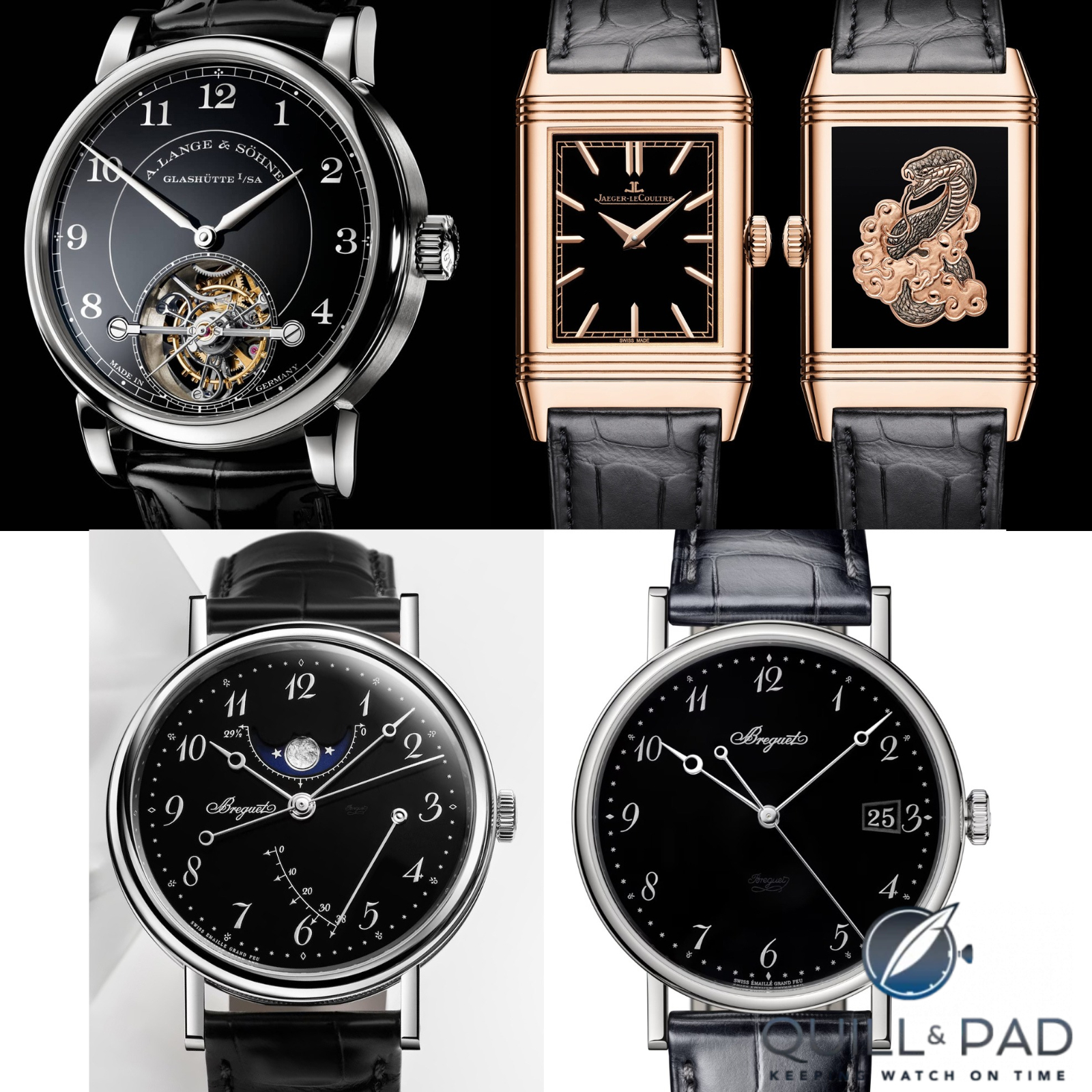
Black enamel dials – what other timepieces keep company with Moritz Grossmann’s Hamatic Enamel 200th Anniversary edition? From left to right, top to bottom: A. Lange & Söhne 1815 Tourbillon Black Enamel; Jaeger-LeCoultre Reverso Tribute Enamel “Snake” (front and back); Breguet Classique Phase de Lune 7787PT; and Breguet Classique 5177PT. Photos courtesy of the respective brands.
It is also worth noting that black enamel appears on wristwatch dials extremely rarely. Among recent releases from prominent watchmakers, one might mention the limited-editions, A. Lange & Söhne 1815 Tourbillon Black Enamel and Jaeger-LeCoultre’s Reverso Tribute Enamel “Snake,” as well as two non-limited models from Breguet: the Classique Phase de Lune Ref. 7787PT/2N/9VU and the Classique Ref. 5177PT/2N/9V6. Grand Feu enamel dials are well known for being difficult to produce; while white enamel dials are the most common, the mastery required for black enamel is considered one of the most demanding.
The difficulty lies in the temperamental nature of the pigments used to achieve a deep black hue. Even minor imperfections – such as subtle shifts in shade toward brown or green, variations in saturation, or tiny surface flaws – that might go unnoticed on a white enamel dial become immediately apparent on a black one. In this sense, black enamel acts as a kind of “black mirror” that is entirely unforgiving of any defects.
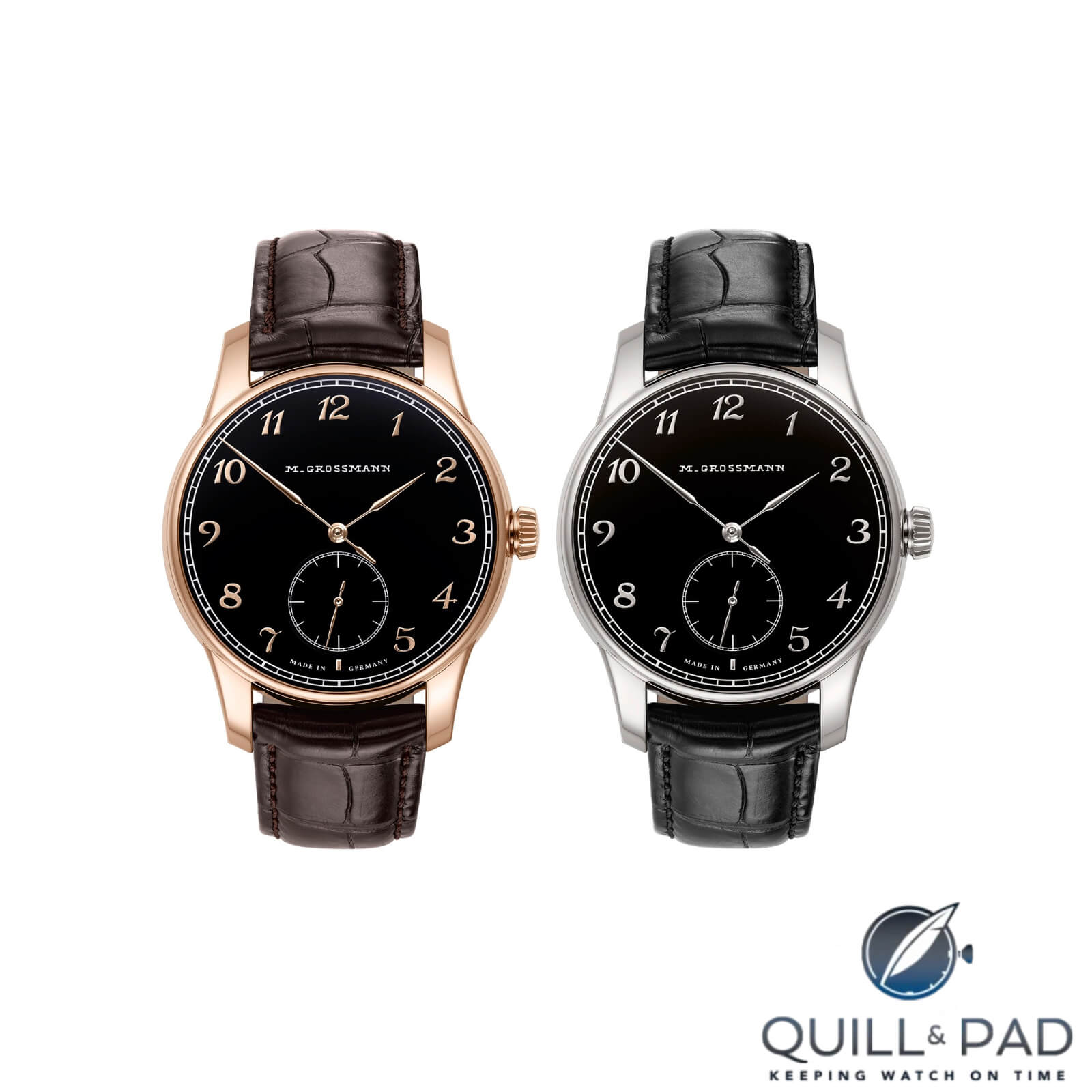
Moritz Grossmann Hamatic Enamel 200th Anniversary, in white and rose gold. Both versions have been released as limited editions of eight pieces each.
A clue to another key feature of the Hamatic Enamel 200th Anniversary is right there in its name. As is well known, “Hamatic” is a blend of two words: “[ham]mer” and “autom[atic].” This neatly sums up what it does: it’s an automatic watch – not one with a conventional full-sized rotor, but with an unusual design that uses an oscillating weight, which Moritz Grossmann describes as a “hammer-winding” mechanism.
For this model, the brand uses a special version of the movement, although it differs only slightly from the standard caliber 106.0, which also uses the hammer-winding system. The difference is an additional commemorative engraving, “1826” (the year of Moritz Grossmann’s birth), on the balance bridge. In every other respect, the standard and anniversary versions of the calibre are identical.
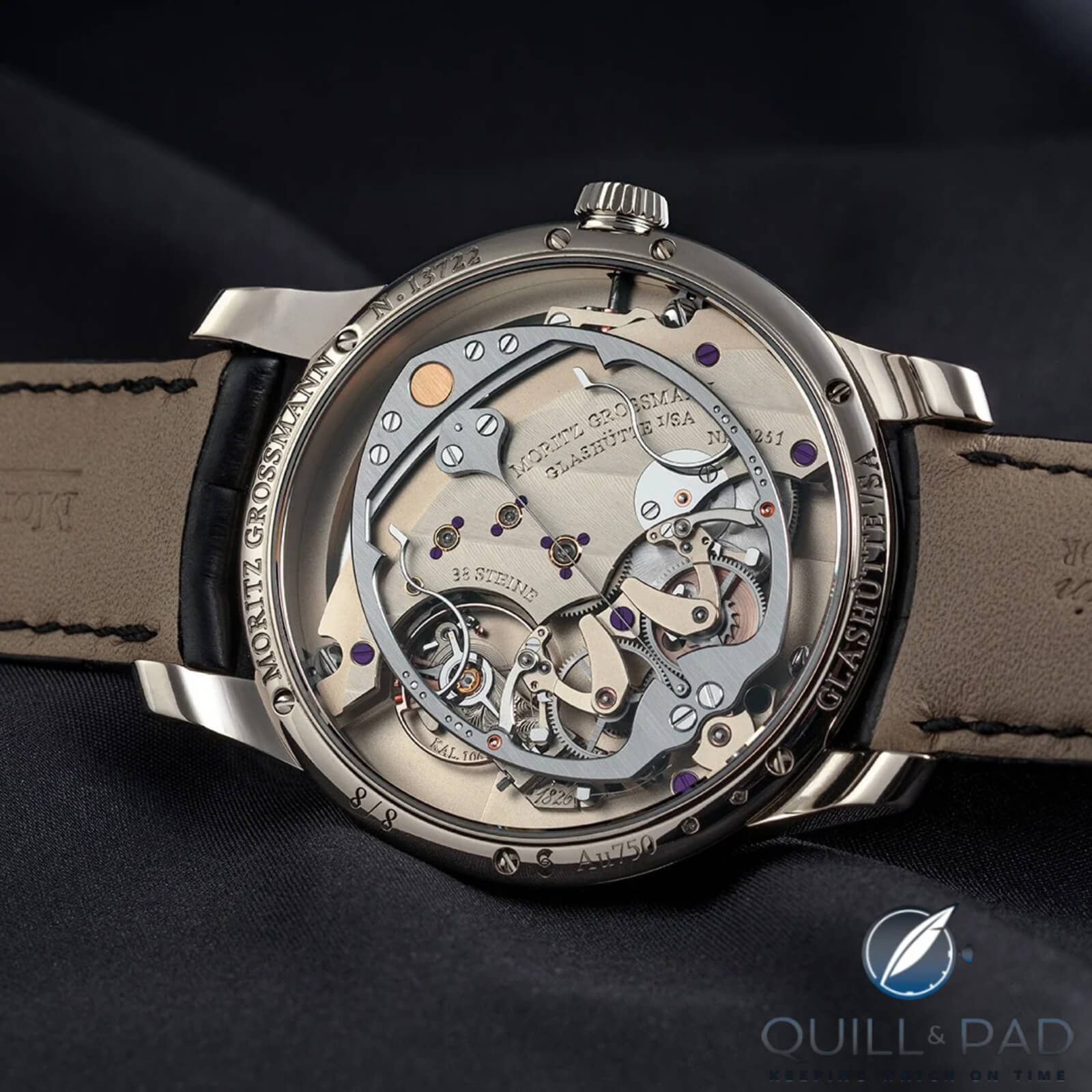
Moritz Grossmann Hamatic Enamel 200th Anniversary, back view. Caliber 106.0 is visible through the sapphire caseback.
The automatic winding system developed in the Moritz Grossmann workshops and implemented in caliber 106.0 stands out from other contemporary automatic winding mechanisms because of its sheer, dramatic spectacle – a feature that, in fact, conceals a highly sound technical rationale. To begin with, the term “hammer winding” is perhaps not entirely accurate. A more historically appropriate term would be masse oscillante à secousses (which can be translated as “an oscillating weight triggered by jolts”) – this is precisely how Abraham-Louis Breguet described the winding mechanism of his own automatic watches. Breguet is credited with inventing this system around 1780 as an alternative to what would eventually become the most prevalent modern design: a centrally mounted rotor capable of full, unrestricted rotation.
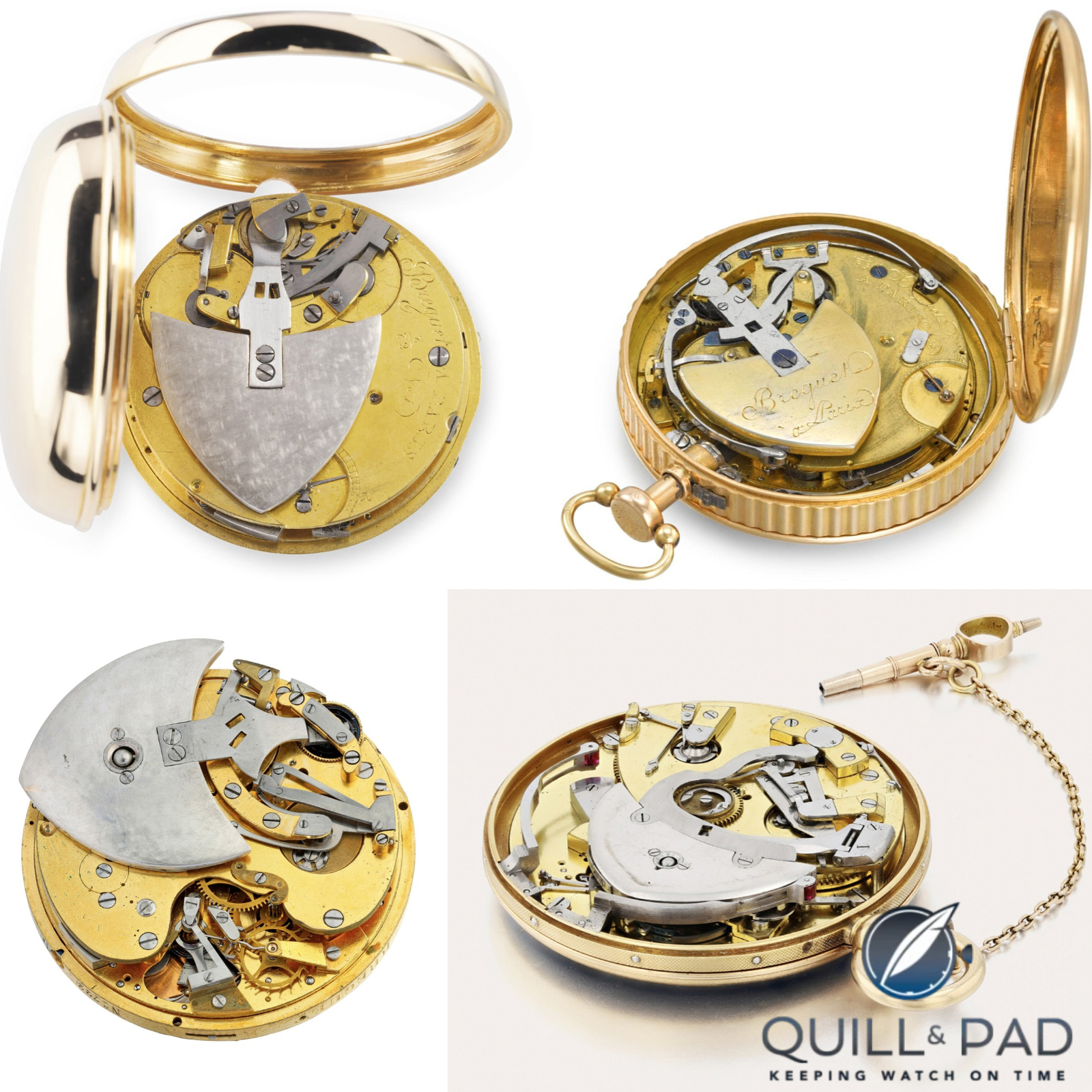
Various implementations of the masse oscillante à secousses winding system in Abraham-Louis Breguet’s Perpétuelle self-winding pocket watches (from left to right, top to bottom): Breguet No. 1-8/82 (1782; image credit: Breguet); No. 8-10/83 (1783; image credit: The Clockmakers’ Charity, sciencemuseumgroup.org.uk); No. 722(65) (1792–1793; image credit: Breguet); and No. 4548 (1827; image credit: Sotheby’s).
Looking closely at the technical aspects of automatic winding for pocket watches makes it clear why Abraham-Louis Breguet decided to develop an alternative winding mechanism. A pocket watch is typically carried in a specific, vertical orientation, with the numeral 12 at the top. In a pocket watch with a full-rotor winding system, the rotor naturally settles at the point of minimum potential energy – that is, at the bottom. In this position, for small oscillations of the rotor, the energy gain is roughly proportional to the square of the angle of its deviation from the vertical; in other words, it is a higher-order small quantity relative to the angle of deviation. For example, with a deviation of about 0.1 radians (around 6 degrees), the relative change would be proportional to the square of that value — 0.01. This clearly makes a full-rotor winding system effective only when the rotor reaches a large amplitude – for example, around 60 degrees (approximately 1 radian). It is hard to imagine a gentleman or lady carrying a pocket watch and walking with enough vigor to cause such a significant deviation of the rotor from the vertical. At the very least, this wouldn’t happen during a normal walk – unless, perhaps, you were jumping on a trampoline.
From a technical standpoint, Abraham-Louis Breguet’s solution was remarkably elegant: he designed a winding mechanism featuring a masse oscillante à secousses, so that, under the influence of a special spring, the line connecting the attachment point to the center of mass (or inertia) of the weight would rest in a nearly horizontal position. This orientation is highly energy-efficient for a winding system, as the energy gain becomes roughly proportional to the rotor’s angle of deflection; this allowed pocket watches equipped with such a mechanism to accumulate energy effectively, even during a leisurely stroll by the owner. That’s why it is no coincidence that this method of winding came to be known as “pedometer wind.” This term was first applied to this type of automatic winding mechanism by the Swiss watchmaker Louis Recordon, who had settled in London, in his 1780 Great Britain patent (number 1249).
Today, there is no consensus regarding who exactly invented this winding mechanism, though the credit is most frequently attributed to Breguet. One argument in Breguet’s favor is that Recordon had met with him before 1780 and subsequently became his London agent; it is therefore quite plausible that Recordon was aware of the French watchmaker’s innovative developments. That said, this same argument could also be interpreted in the opposite direction.
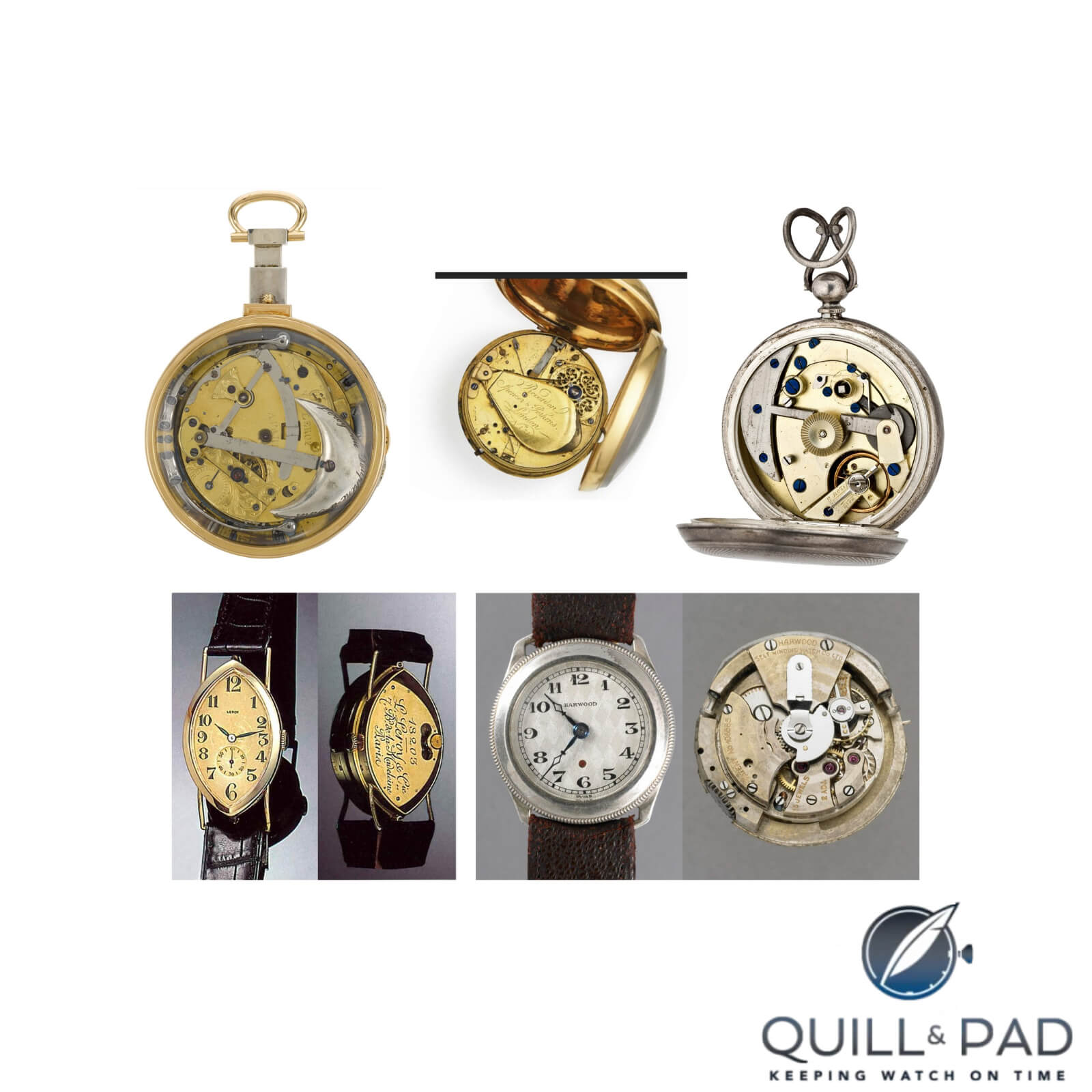
A brief history of the pedometer-wind mechanism following Breguet’s original invention (from left to right, top to bottom): a Leroy à Paris pocket watch, No. 2407 (circa 1790; image credit: Sotheby’s); a Recordon pocket watch (circa 1780–1785; image credit: bruun-rasmussen.com); an August Ritter von Loehr pocket watch (1880s; image credit: Heritage Auctions, HA.com); an L. Leroy wristwatch (1929; shown with the case back open; image credit: Antiquorum); and a Harwood wristwatch (1929; shown with the movement; image credit: The British Museum).
Ultimately, neither the original system with a full-size rotor capable of unrestricted, continuous rotation – an invention attributed to either Abraham-Louis Perrelet or Hubert Sarton – nor the alternative pedometer-wind system gained widespread adoption in the late 18th or throughout the 19th century, primarily because of the significantly higher production costs compared with a hand-wound timepiece of similar quality. Breguet, for instance, used platinum for the oscillating weight, chosen specifically for its exceptionally high density. In 1878, the Austrian railway engineer August Ritter von Loehr attempted to adapt the pedometer-wind mechanism for mass-produced pocket watches; according to estimates (via Watch-Wiki), approximately 4,000 units were manufactured in round cases. Additionally, the Swiss firm Hahn Frères & Cie. produced watches based on Loehr’s patent featuring square cases – the production volume is unknown to me, but I’d suggest the figures were of the same order of magnitude.
Attempts were also made to incorporate a pedometer-style winding mechanism into wristwatches. It appears that the French watchmaker Léon Leroy was the first to do so, in 1922; however, it seems that only a few examples were ever produced (at least three are known to exist). In 1923, the English watchmaker John Harwood patented an automatic winding system for wristwatches that used a centrally mounted weight capable of only limited, partial rotation. The movement of this rotor was restricted by spring-loaded buffers, or “bumpers,” which is why this type of automatic mechanism is known as a “bumper” movement. After Rolex patented a central-rotor design that allowed full, unrestricted rotation, many other manufacturers – unable to circumvent Rolex’s patents – relied on various versions of the bumper mechanism throughout the 1930s to the 1950s, a period when the popularity of automatic wristwatches was on the rise. Eventually, once the patents expired, movement manufacturers abandoned the bumper design, and it is no longer used today.
The history of pedometer- or bumper-style winding mechanisms in wristwatches continued with the Ra Tourbillon Automatique, launched by Audemars Piguet in 1986. The developers – Swiss watchmakers Maurice Grimm and André Beyner of Ebauches SA – used this winding system for an unexpected purpose: to reduce the overall thickness of an automatic watch. They succeeded, and for a long time – until quite recently – the Ra Tourbillon Automatique held the title of the thinnest automatic tourbillon.
It’s worth noting that many movements featuring bumper or pedometer winding systems used a unidirectional winding scheme, including the highly advanced version found in Audemars Piguet’s Ra Tourbillon Automatique. However, there were also bumper-style automatic movements with bidirectional winding, such as the Revue caliber 80, introduced in 1947.
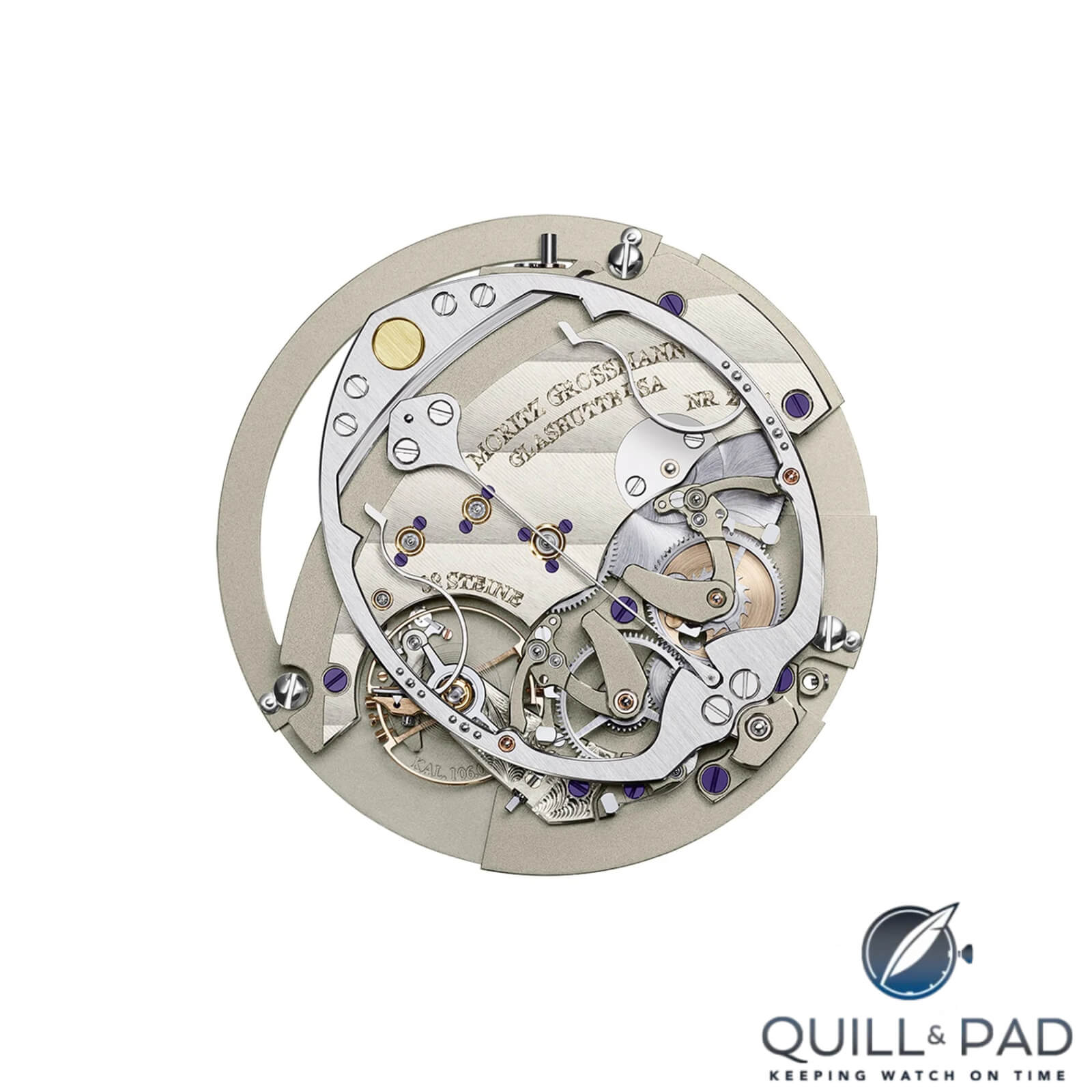
Caliber 106.0 is the movement powering the Hamatic watch. It has been produced without any visible modifications since 2019.
Against this historical backdrop, caliber 106.0—first unveiled by Moritz Grossmann in 2018, with the Atum Hamatic wristwatch featuring this movement officially launched a year later – holds a special place. For this caliber, the German manufacturer developed a pedometer-style hammer-winding mechanism with bidirectional winding. While one might initially see this movement as a tribute to the past and the rich history of self-winding mechanical watches, the watchmakers at Moritz Grossmann showed that they could evolve the concept into a highly practical product. They succeeded: in addition to the bidirectional winding system, which roughly doubles the efficiency of a hammer-winding mechanism, caliber 106.0 incorporates another clever technical solution. At first glance, the unique open-worked structure of the oscillating weight stands out; the design is clearly engineered to maximize the distance between the center of oscillation and the center of inertia. From a technical standpoint, this is effectively equivalent to equipping a standard 30 mm movement with a 60 mm central rotor. Naturally, this further enhances the efficiency of the winding system by roughly doubling the length of the lever arm.
Its technical distinctiveness and highly successful engineering solutions are complemented by an aspect of great importance to any connoisseur of high-end horology: beauty. The Calibre 106.0 is truly beautiful, notably for its rich array of contrasts: contrasts in materials, finishes, scale (large versus small), open-worked versus solid elements, and circular versus linear forms. The list could go on, but perhaps the best approach is simply to gaze upon the Hamatic Enamel 200th Anniversary and admire it – ideally firsthand.
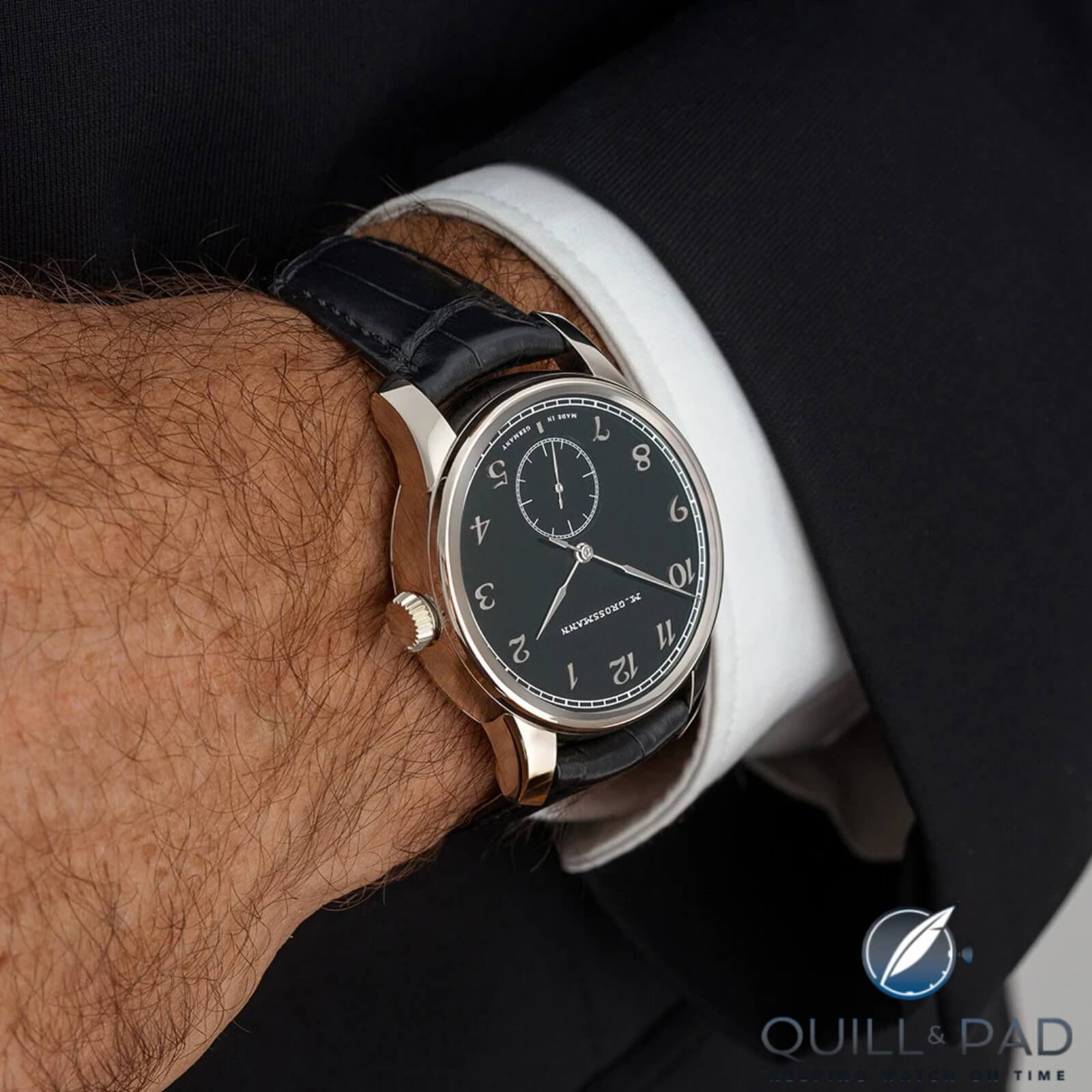
Hamatic Enamel 200th Anniversary – better to try it firsthand.
Quick Facts — What to Know About
Models and maker: Hamatic Enamel 200th Anniversary in 18k rose gold Ref. MG-004000 and Hamatic Enamel 200th Anniversary in 18k white gold Ref. MG-004079 by Moritz Grossmann.
Edition: Limited to 8 pieces in 18k rose gold and 8 pieces in 18k white gold.
Case: 18k rose gold or 18k white gold, polished; sapphire crystal with anti-reflective coating on one side; exhibition caseback fixed on 7 screws; winding crown at 3 o’clock.

Case dimensions: Diameter 41 mm; thickness 11.35 mm.
Dial: Black enamel dial with applied rose gold or white gold Arabic numerals; small seconds at 6 o’clock.
Movement: Caliber 106.0, bidirectional bumper automatic winding; running at 3 Hz (21,600 vph), with a 72-hour power reserve; 38 jewels; diameter 36.4 mm; thickness 5.15 mm; diameter of balance wheel 10.0 mm; special ‘1826’ engraving on balance cock.
Strap and clasp: Hand-stitched alligator leather with prong buckle in 18k gold.
Price: Approx. US$71,500 (€63,500 excl. taxes).
All images, except where otherwise noted, courtesy of Moritz Grossmann.
Read more like this:
Hands-On: The Armin Strom x Exquisite Timepieces Mirrored Force Resonance Zeitgeist Blue
Ahead of the Curve: The Greubel Forsey GMT Balancier Convexe in Blue
Chasing the Naples Night: The DOXA SUB 200T Afterglow x Exquisite Timepieces
