
How to Choose Between Buying a Vacheron Constantin or H. Moser & Cie Watch
By Nina Scally
Look closely at the modern Swiss watch industry today and you’re quickly forced to pick a side depending on what actually matters to you in a luxury watch today. Imagine a velvet-lined tray sitting right in front of you. On one side of the tray rests a Vacheron Constantin watch – a grand old patrician of Geneva. It’s an institution so deeply woven into the historical fabric of the industry that questioning its authority feels almost like questioning the existence of time itself. Then, on the other side you have a watch from H. Moser & Cie. Yes, this brand has a historic 19th-century name over its door, but today the brand is still a disrupter, who just so happens to employ some of the most gifted traditional watchmakers on earth.
You can’t really compare these two watchmakers if all you’re planning on doing is glancing down a spec sheet or arguing with someone over their respective power reserves. You can save that for the internet forums. As a serious collector or watch enthusiast, you have to respect that this is more a clash of horological philosophies. To understand how a collector might choose between a Traditionnelle and an Endeavour, we have to look past the materials laid before us and dissect the very soul of each of these entities and how they approach the art of mechanics. I’m talking more about who each watchmaker creates the tiny metal wheels that turn the hands of time or the meticulous design of a dial and what that represents within the company’s broader catalogue. And when you strip it all back, both Vacheron Constantin and H. Moser & Cie are tackling the same hurdle: how to sell what can be considered by some as an obsolete mechanical object to today’s millionaire. As a matter of fact, they’re both managing to do it, despite having completely different design languages.
The Weight of Centuries Versus an Incredible Comeback
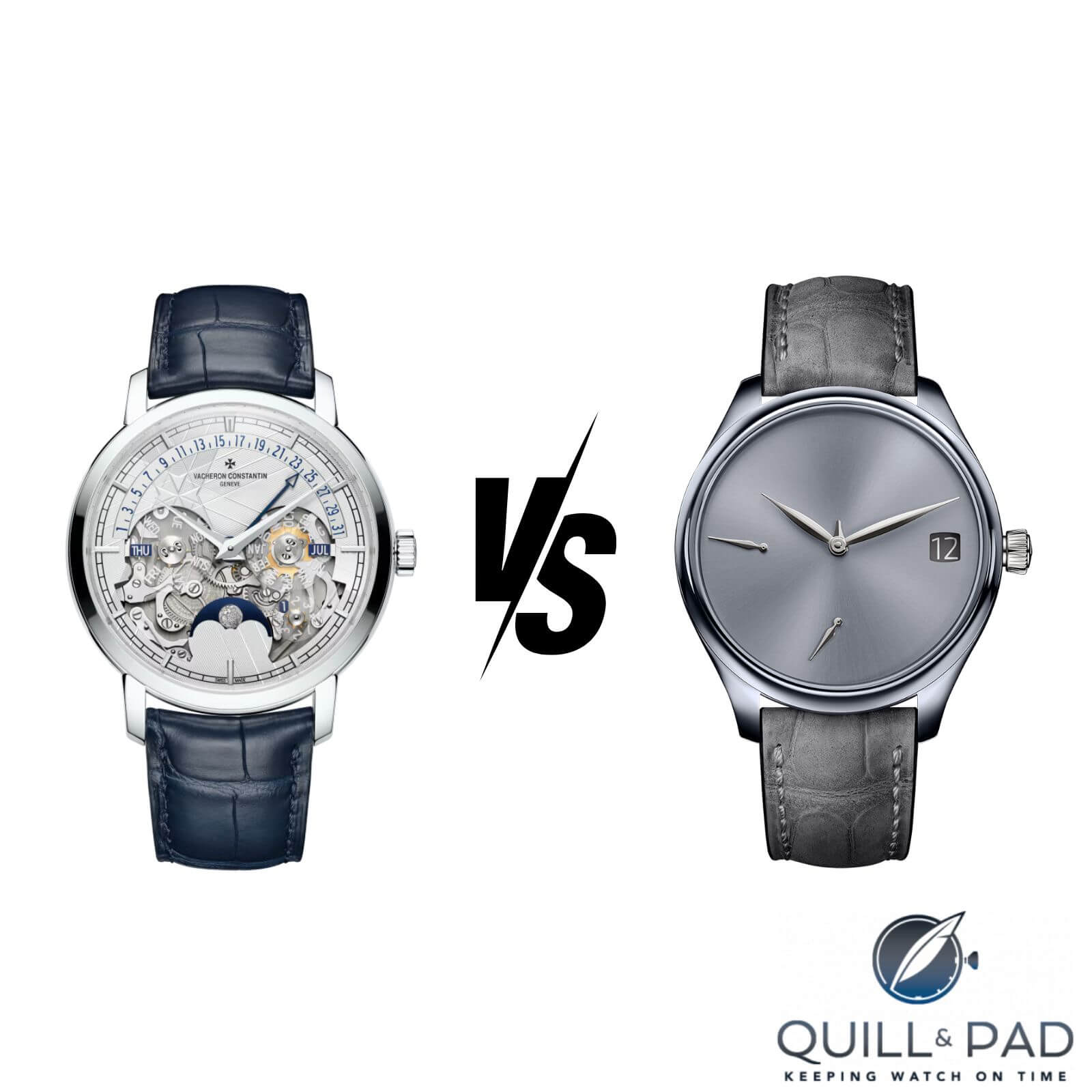
Let us talk about baggage for a moment, because in the luxury watch industry, historical baggage is normally considered your greatest possible asset. Vacheron Constantin operates with the longest continuous, uninterrupted history of any watchmaker in the world, having kept the lights on and the lathes turning since Jean-Marc Vacheron signed his first apprentice all the way back in 1755. Think about the sheer gravity of that for a second. This brand survived the French Revolution, multiple global conflicts, and the utter devastation of the quartz crisis, even the corporate consolidation of the luxury market.
Even so, this continuity is also somewhat of a burden, because when you design a new dial or engineer a new calibre at Vacheron, you’re answering to the ghosts of Francois Constantin and a lineage of master watchmakers who defined the brand’s aesthetic codes right from the beginning. This is classical Genevan watchmaking, don’t forget, and nobody messes with that. Every single decision must bow down to the company’s monolithic heritage. If you’re a VC designer, you can’t just suddenly decide to make a neon green carbon fibre sports watch that looks like a spaceship. Vacheron Constantin is the ultimate guardian of the temple.
Looking at the story of H. Moser & Cie, things are a little different. Heinrich Moser was a brilliantly successful Swiss entrepreneur who actually made his fortune in Russia during the 19th century by producing highly respected pocket watches and expanding his trading network significantly. Unlike Vacheron, however, the brand fell dormant during the brutal quartz years, completely vanishing from the horological map until it was bravely resurrected in the early 2000s by Dr Jürgen Lange and eventually acquired by the Meylan family.
Though this broken lineage might seem like a weakness, Edouard Meylan and his team soon realised this break in history could play into their hands quite well. H. Moser & Cie was essentially rebuilding the house from the ground up, so tradition wouldn’t quite as well for the watchmaker as it had for its competition. The maison possessed the technical chops to finish a movement just as beautifully as the holy trinity, but even better, it wasn’t creatively tethered to a 200-year-old catalogue. What Moser represents is the art of a comeback. Clearly, if you have the prowess to back it up, a resurrected name can afford you the freedom to practically do what you wish.
Institutional Finishing Meets Minimalist Subversion
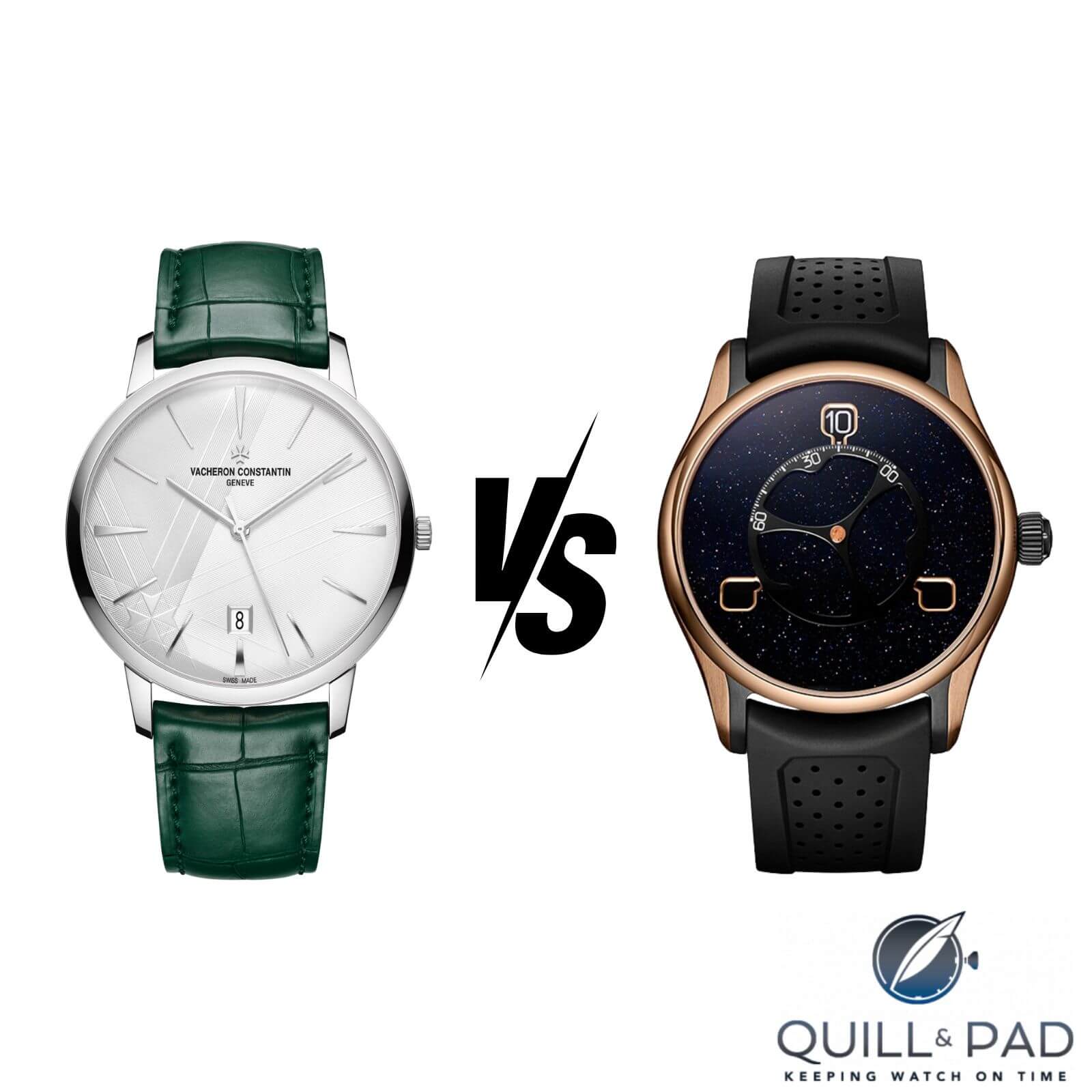
Aesthetics is the clear defining factor between these two languages. As I just mentioned, creativity was key to Moser’s innovative legs to grow the arms and legs of the company further. But Vacheron Constantin speaks the visual language of classical complexity, so each dial acts as a deeply layered text meant to be read by the initiated. Examples would be its traditional hand-turned guilloche displays, where rose engine lathes carve interlocking patterns into solid gold dial blanks. The watchmaker’s cases also feature stepped lugs, precise fluting, and a disciplined architectural presence that immediately identifies them as products of the highest Genevan order.
And then there’s the Maltese Cross. Vacheron weaves this emblem into everything it creates. You’ll find it forming the shape of a tourbillon cage, hidden in the links of a bracelet, or subtly integrated into a clasp. The aesthetic of each watch is governed by the requirements of the Poinçon de Genève, the Hallmark of Geneva. This institutional standard dictates how a movement performs and how every single microscopic surface must be decorated. Screw heads must be polished and their slots chamfered. Pinion leaves must be polished. The anglage applied to the bridges must be executed by hand with flawless interior angles. Every watch feels profoundly institutional.
Moser, on the other hand, decided that the best way to make a statement in a crowded market was to simply stop talking altogether. The brand introduced the Concept dial, which costs upwards of CHF 60,000 and is completely devoid of the hour markers, minute track and brand logo. What you’re left with is the intense colour and texture of its signature fumé dials, which are incredibly difficult to produce to begin with. H. Moser & Cie Moser forces you to engage entirely with the material execution of its watches. Its cases follow this same logic, with deeply sculpted designs that bear organic, fluid hollows made from metal work that stands in stark contrast to Genevan geometry.
The Calibre Chronology
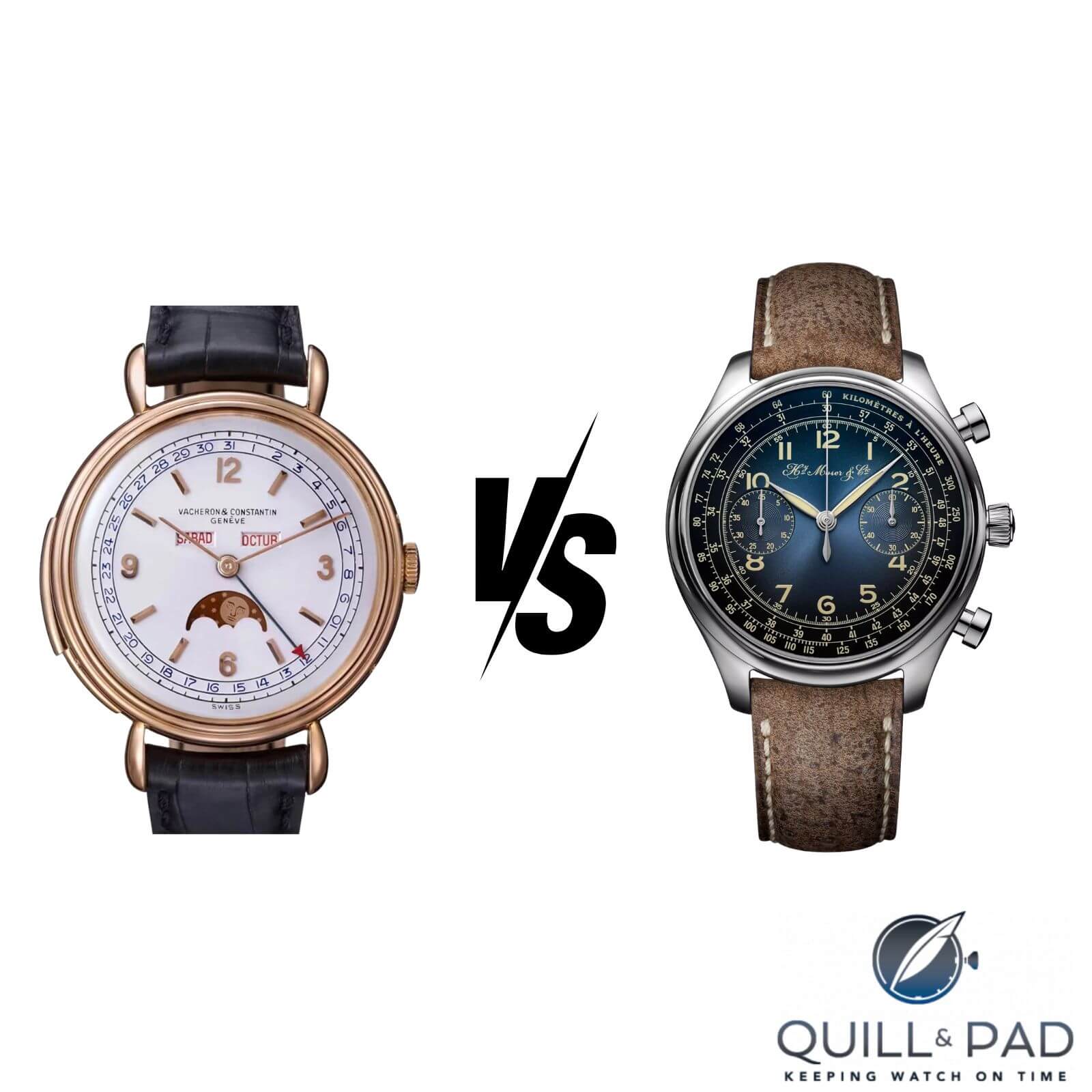
Only through the back of a VC or H. Moser & Cie watch case, can you really appreciate the different approaches each brand takes to the architecture of their respective movements? Vacheron Constantin relies on a back catalogue of calibres that master complexities like the ultra-thin complication. Consider the legendary Calibre 1120, for a second – a movement so thin and so beautifully engineered it has been shared amongst the holy trinity but only ever truly perfected by Vacheron. Then there are engines like the Calibre 1142 – the absolute pinnacle of the lateral clutch, column-wheel chronograph. The flawless mirror polishing on the caps of the column wheel is a complete marvel. At the end of the day, Vacheron excels in the grand complications, the minute repeaters that sound like crystal bells, and the perpetual calendars of the high-end sphere.
Moser also brings an ace to the table with its movement-making capability. The brand has a sister company called Precision Engineering AG, which is how it can manufactures its own hairsprings and escapements entirely in-house, giving it an almost unprecedented level of control over the beating heart of its watches. These aren’t standard hairsprings, either. Moser developed the Straumann double hairspring, where two identical hairsprings are mounted opposing each other on the balance staff. As they expand and contract, the center of gravity remains centered, eliminating the gravitational errors that Abraham-Louis Breguet invented the tourbillon to solve.
Furthermore, H. Moser & Cie approaches movement architecture in a unique way, having developed an interchangeable escapement module that means the entire regulating organ can be unscrewed and removed as a single unit during a service, then replaced with a freshly cleaned and regulated module. This cuts down the time the watch spends away from the collector considerably. Combined with its traditional hand finishing, its double-crested Moser striping on the bridges, and innovative engineering, HMC calibres are such a compelling investment.
The Great Sport-Chic Compromise: Overseas and Streamliner
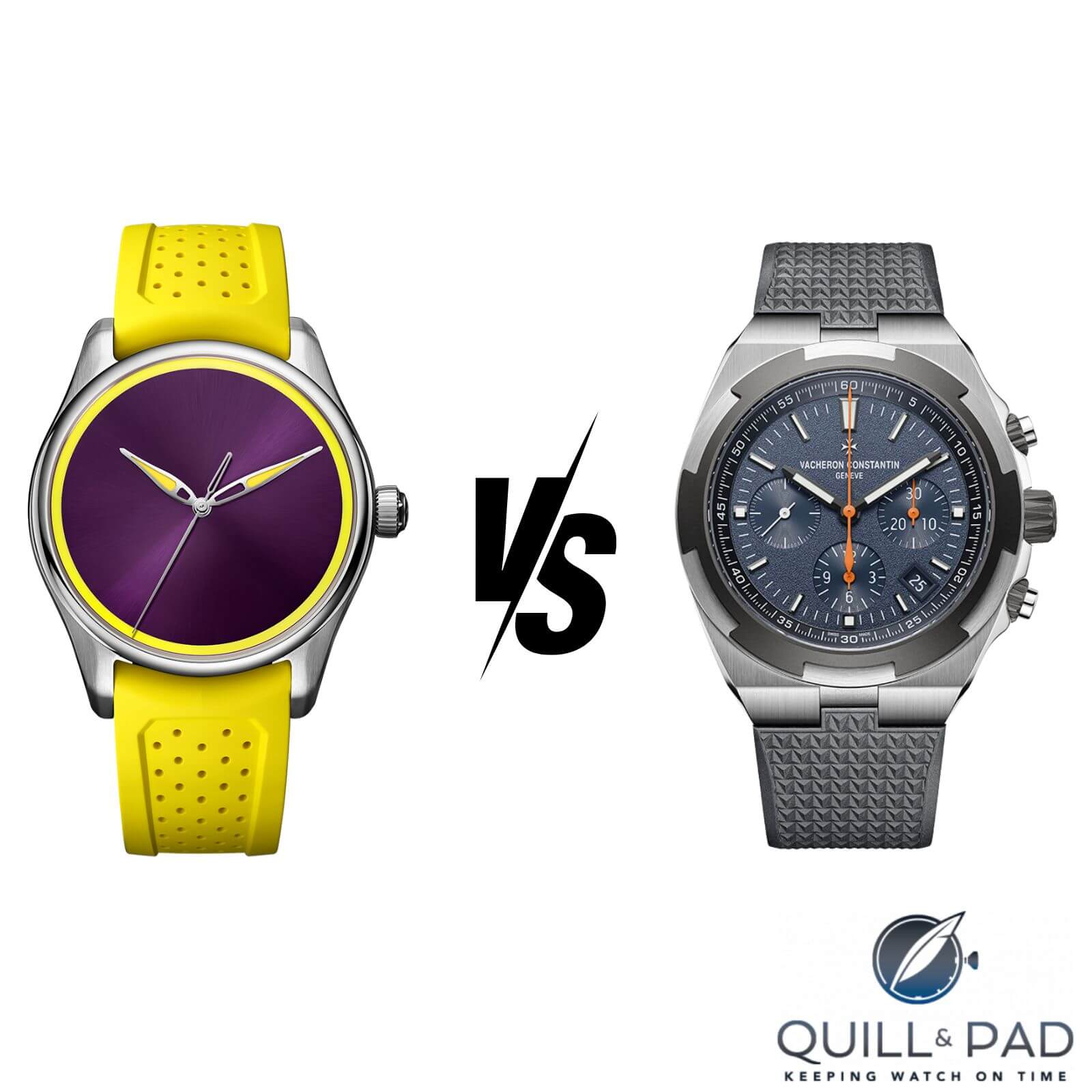
Now we reach the topic of the integrated sports watch. Regardless of how many beautiful grand complications these brands produce behind closed doors, this is the actual battlefield where both entities fight tooth and nail for our attention and our wallets.
Vacheron Constantin entered this fray by evolving its design language from the aforementioned Jorg Hysek 222 into the modern Overseas collection. If you didn’t already know, the Overseas is the maritime king of the luxury sports watch world. Rather than possessing the pop-culture recognition of the Royal Oak or the Nautilus, its bezel is a brilliantly executed nod to the Maltese cross, and the bracelet links echo that same geometric motif. Vacheron approached the sports watch by trying to elevate it, for starters. The brand gave it quick-release bracelet systems long before they became an industry standard, and the finishing of its movements adhered to the punishing Hallmark of Geneva standards. Pretty impressive. To summarise, this is a sports watch for someone who probably owns a boat but would never actually dream of getting sea spray on their cuffs.
Then we have the Moser Streamliner. When Moser finally decided to enter the integrated sports watch market, everyone was expecting another derivative octagonal clone with visible bezel screws. Instead, Edouard Meylan completely bypassed the Genta playbook and looked to the aerodynamic curves of 1920s high-speed trains and seventies automotive design. The Streamliner has no standard lugs, no sharp, aggressive angles. Instead, it’s a fluid, pebble-like cushion case that flows seamlessly into a fascinating bracelet design. Rather than using traditional links, its articulated links evoke the scales of a reptile or the plates of an armadillo, draping over a liquid-like flexibility. H. Moser & Cie decided to add a chronograph, using the Agengraphe calibre developed by Jean-Marc Wiederrecht at Agenhor. It hides the winding rotor between the dial and the movement, allowing for a completely unobstructed view of the mechanism through the caseback.

The Rule-Breaker and the Traditionalist
Beyond the metal and the mechanics, the choice between these two brands often whittles down to how a collector wants to feel as a part of the watch community. Vacheron Constantin is the Grandee, operating with scholarly confidence, catering to the highly educated collector through its Les Collectionneurs program (where it actively buys back, restores, and sells its own vintage pieces with factory warranties). Also, let’s not forget its bespoke Les Cabinotiers department, which produces unique, highly complicated commissions for the ultra-wealthy. Owning a Vacheron suggests you have settled into a deep, mature appreciation for horological permanence.
Moser, on the other hand, operates more dangerously, possessing a wicked sense of humour. Remember the Swiss Alp Watch? The brand housed a traditional rectangular movement inside a replica of an Apple Watch, just to mock the smartwatch craze. Then there was the Swiss Mad Watch, featuring a case made out of real Swiss cheese combined with resin. Moser understands that the modern collector is highly educated and highly cynical, but probably a little bit bored with endless marketing drivel. Wearing a Moser signals you understand all the rules of haute horlogerie, but just don’t take yourself too seriously.
At the End of the Day
We have spent all this time dissecting the differing philosophies behind both brands’ heritage, dial design, movement architecture, and integrated bracelets, but there is more to compare. If you resonate with the history of a company and you find reassurance in the standards of the Genevan seal, then Vacheron Constantin is the only logical option. Buying one of these is like taking custody of two and a half centuries of legacy.
But if you’re the sort of collector who enjoys sheer engineering and you believe that stripping away a brand logo expresses luxury better than anything else, then H. Moser & Cie will capture your heart completely. Both represent independent watchmaking, neither of which is better than the other. Rather, it simply boils down to what kind of statement you actually want to make when you roll up your shirt sleeve.
Read more like this
The Inventor and the Survivor: Breguet Vs Vacheron Constantin
Watches & Wonders 2026: See for Yourself
An Overview of the New Czapek & Cie Antarctique Titanium Cosmic Blue Releases

