
A Watchmaker’s Technical Look At The Mirrored Force Resonance Fire By Armin Strom: A Dual-Balance Watch With A Difference
This article by Justin Koullapis takes a technical look at the Armin Strom Mirrored Force Resonance. It was first published in the Horological Journal, the magazine of the British Horological Society, in April 2017. It is republished here with permission.
The Armin Strom Mirrored Force Resonance Fire
Launched in London at Salon QP in November 2016, the Armin Strom Mirrored Force Resonance Fire wristwatch has captivated everybody from collectors to seasoned watch writers. This isn’t surprising given the mesmerizing appearance of its twin balances and the unusual, long, sinuous grey spring gently oscillating along the middle of the watch. What is this new watch all about and does it live up to the hyperbole?
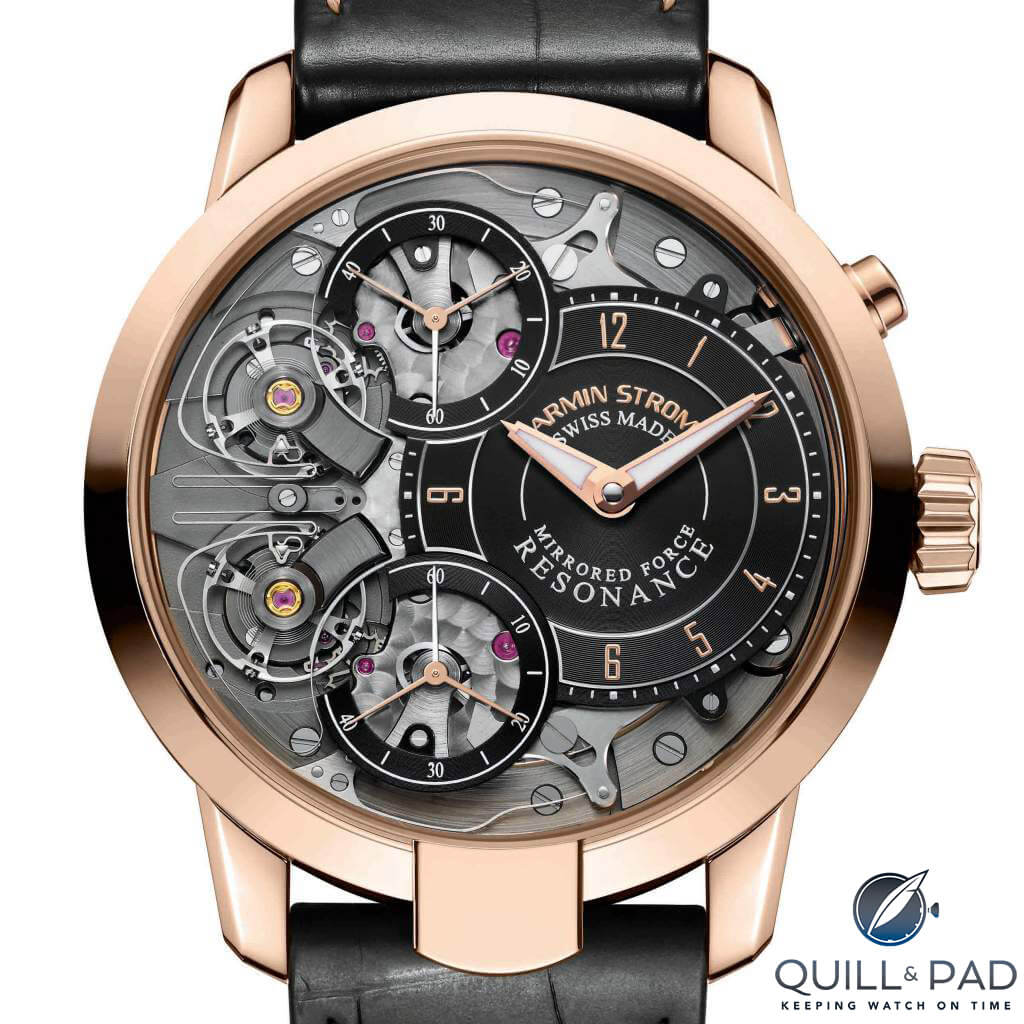
Armin Strom Mirrored Force Resonance Fire
What is resonance?
The watch has two movements, and the makers claim that it operates as a resonant system. This is by no means the first watch to do so, but it is certainly in a very exclusive club.
There are two wheel trains, each with its own escapement.
Each train has its own stylized triple-tipped second hand; these can be simultaneously reset to zero by pressing the pusher at 2 0’clock. The two trains run in opposite directions, hence the name, Mirrored.
Armin Strom technical director Claude Greisler, who conceived the watch, told me that for the strongest visual effect, he specifically wanted the balances to tick in opposition, hence the mirrored train directions. The technical extent of this statement is unclear because there are other watches that operate as synchronized couples (for example, the F.P. Journe Chronomètre à Résonance) whose trains run in the same direction and whose balances swing in opposite directions anyway (180 degrees out of phase with each other). Indeed, this anti-phase is the most common mode of stable oscillation in resonant watches and clocks.
Aside from this twinning, the Armin Strom Mirrored Force Resonance’s trains are quite normal. The point where the mechanisms begin to diverge is at the very furthest outpost of the moving parts, where the tail of the balance spring normally terminates. Armin Strom Caliber ARF15 has an unpegged stud, which is normally an immovable terminus; instead it is mounted along the length of the long flexible arm that the brand calls the clutch spring.
It is fascinating to watch the balance spring studs rock back and forth as the watch runs. My measurements of their motion, based on footage of the watch, indicated a working range that peaks at about seven degrees.
The comparatively tiny amount of energy transmitted via the studs is enough to rock the clutch spring, and is plenty to bring the two escapements into synchronization. A visual indicator of whether the balances have remained synchronized is whether the seconds hands stay in step. A state of synchronization means that the oscillations of the balances effectively remain perfectly in phase with each other – neither can pull away from the other due to gaining or losing too much.
Bear in mind that simply having two movements in the same case does not confer synchronization. The coupling between them has to be of a certain kind, and escapements would normally have to be tuned to each other fairly closely. More about this later.
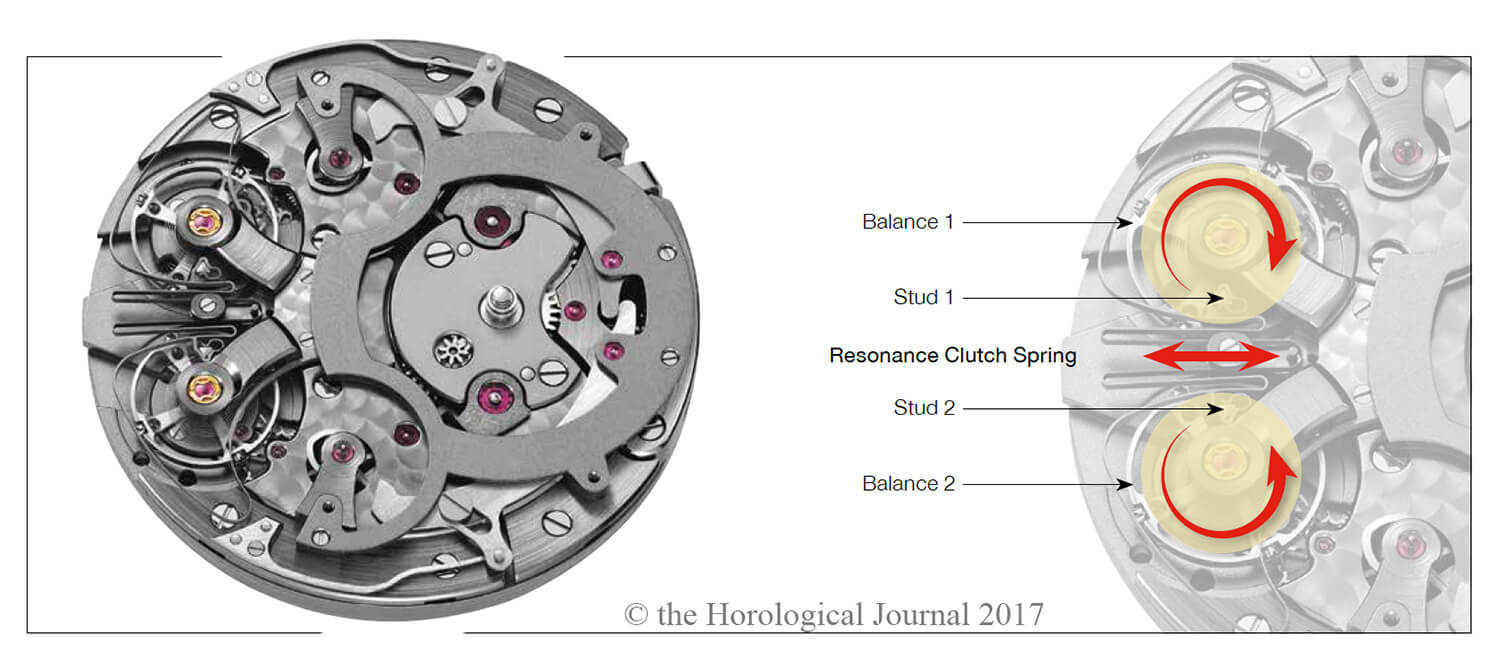
Armin Strom Caliber ARF15 with dial removed: the device for setting the seconds to zero can be seen; the illustration at right shows how the oscillating balances are linked by the motion of the clutch spring
Some technical considerations
Studs
Usually, moving the stud puts a watch out of beat, but the large motion of the studs in the ARF15 is of no consequence because it is averaged on either side of the escapement’s quiescent point. The stud’s displacement is in proportion to the swing of the balance. In other words at the zero, or quiescent point, where it matters most, the stud is actually not displaced at all. Beyond the escaping angle (where beat condition matters not), the stud displacement is very large.
The clutch spring
This long and graceful carbon steel spring loops around the balances, symmetrically incorporating the studs from both halves of the movement. The design of this part was subject to numerous revisions before it satisfactorily performed the dual functions of successfully linking the balances while also creating a strong visual effect, gently pumping left and right as it goes. There is so much complex geometry to this spring, with various swellings and narrowings, not to mention the sprung mountings for the triangular studs, that the only practical way I can see it might have been made is by wire erosion EDM (electrical discharge machining), although the makers have not indicated this.
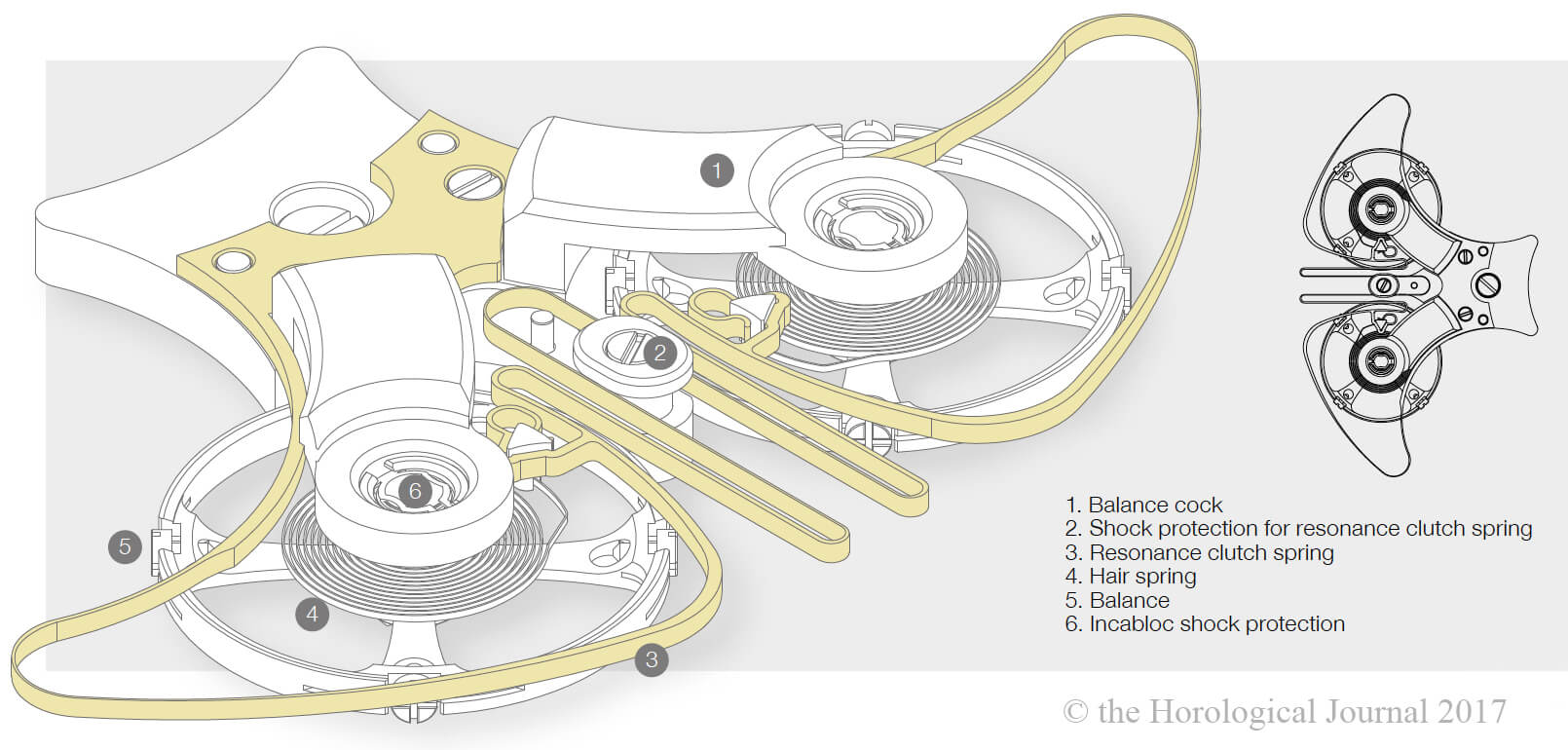
As a beam (taller than it is wide) there is very little tendency for the spring to droop. For safety, however, there’s a bobbin installed mid way between the balances. The spring closely passes either side of this bobbin, without touching, and in case of a shock, the bobbin would curtail any upward or downward whipping.
How does it work?
In the context of a pair of watch balances, or for that matter other mechanical oscillators like clock pendulums, synchronization (what the makers call “resonance”) means that there is no practical phase difference between the multiple oscillators; they stay in step with each other. Vibrational energy that would normally be lost to things like their mounting supports is captured and retained within the system.
In Caliber ARF15, energy that in normal watches would typically be dissipated by the balance gently tugging at the balance cock (and ultimately rocking the wearer’s arm!) is captured and used by its counterpart.
For the oscillators to stay in step with each other, they have to be fairly well matched in the first place. It’s difficult for a five-year-old lad to keep in step with his six-foot-tall dad for more than a few paces, simply and practically due to the big difference in cadence between their respective “oscillators.” On the other hand, a platoon of soldiers, being within a few percent of each others’ heights, and with the discipline of hundreds of hours’ worth of drill, have no trouble with the same exercise.
Regarding this matching, Greisler told me that the ARF15’s escapements will resonate even if their daily rates vary (from each other) by as much as 250 seconds per day. This is a wide margin compared, for example again, with the Journe watch, whose twin balances have to be adjusted to within 5 seconds’ rate of each other before they will resonate.
The reason for this large bandwidth evident in the ARF15 is the strong coupling imposed on its balances. It may seem a bit opposite, but a strong coupling actually implies a mechanically weak, or flexible, connection to the frame of the watch (i.e., the clutch spring). Conversely, multi-balance or multi-pendulum systems that have highly rigid mountings are said to be weakly coupled (to each other).
Horologists are minded to favor very rigid mountings for their oscillators because rigidity helps in other areas of the discipline. When the oscillator is strongly attached to its mounting, much of the energy it dissipates is sent into that mounting. In traditional clocks, material like cast iron is purposely used for making pendulum support frames because in spite of this material’s apparent solidity, it damps both outbound and inbound vibrations. Random interference by doors slamming, lorries trundling by, or nearby clocks ticking are consequently less likely to affect the performance of the pendulum in question.
Clocks and watches made as resonant systems have to date been highly distinctive and therefore expensive. Being thus very well made, the oscillators in such systems are closely matched, have a high Q, and have rigid mountings, meaning that they will remain synchronized with only the minutest amount of energy transfer between them, although they do require to be closely regulated (their frequencies have to closely match). As such, their operating in a sustained state of synchronization can be inferred to be a good indicator of the mechanical rigor of their construction.
Micro-perturbations are sensitively felt that would otherwise be swamped in less perfect systems. To employ a literary analogy, only a princess is capable of feeling the pea hidden under 20 feather beds because she is highly refined and accustomed to perfection in every aspect of her sophisticated existence.
This “rigor factor,” may we call it the R-Factor, reflects:
- How loosely the balances are coupled (i.e., how rigid the mounting is).
- How closely their frequencies have to be matched before they will.
Artificial “connections” between the oscillators, like the ARF15’s clutch spring, mean they are likely to resonate more easily, even under conditions that are sub-optimal. But there is evidence to suggest that timekeeping stability under these conditions of enforced resonance is also likely to be lower.
For instance, Abraham-Louis Breguet performed experiments on pairs of clocks mounted to a common frame with the pendulums hung off a very heavy bracket. He noted that with the bracket at full mass, the pendulums would synchronize when they differed from each other by up to three seconds’ rate, but not at four. He then filed away part of the bracket, introducing some flexibility. This time, they would synchronize at up to ten seconds, but not at 13 seconds. Finally, he hung the pendulums off a much lighter bracket and found they would synchronize at up to 21 seconds difference, but under these conditions the clocks “did not go too well.”
His words, quoted above, encapsulate my concern about synchronized oscillators that are made with such a high degree of enforced communication that they will synchronize over a large range of frequencies. It seems unlikely that such a wide ability to synchronize comes without any cost. Perhaps there is long-term instability due to lack of isochronism? For oscillators with different frequencies to synchronize, their amplitude must periodically rise and fall, and the greater the rate difference between the oscillators, the bigger the changes in amplitude. Of course, some watches can be made almost completely isochronous, making them superior to pendulums in this regard.
In considering the “rigor” of a synchronized watch or clock, it’s worth considering the range of frequencies the system will tolerate before the device loses synchronization. It might be very small, maybe even just one. Here, think of the Journe watch or the Breguet clock, whose oscillators need to be tightly constrained to within a few seconds per day of each other or the timepiece will fail to operate.
Is this a good thing? Well, if what you’re after is high precision, then I would argue definitely yes. The Journe watch is a chronometer. However, there are trade-offs; such a watch is highly intolerant of effects that alter its tuned state (strong shocks and vibrations, pronounced temperature changes, diverging conditions between its two trains in the state of oil, and so on).
A watch like the ARF15, on the other hand, is less fussy – it can tolerate up to 250 seconds per day variance between its oscillators before they fall permanently out of step with each other. There is an electronic analogue to this: if we design a radio receiver to have a wide bandwidth when tuned to a frequency, it will be prone to spurious additional signals at the output.
For watch balances to remain synchronized while still enjoying fattened bandwidth must make it more exposed to effects that are potentially detrimental to precision. On the other hand, this tight coupling between its balances probably allows greater latitude in adjusting.
Another consideration is the shape and size of the ARF15’s clutch spring – it looks likely to quiver if the watch receives a shock. Such a percussion traveling up the spring to the studs will surely introduce additional variable forces into the system, something that “normal” balances wouldn’t be prone to.
Resonance or synchronism?
The elephant in the room with discussions about “resonant” watches and clocks is that, by strict definition, all working watches and clocks operate in resonance.
Oscillators are said to resonate when they receive energy from an external source, the frequency of which matches their own, with the received energy just sufficient to overcome losses. One can tell that an oscillator is resonating because its amplitude spikes. In horology, this spike occurs at the one and only frequency at which the machine can operate and is determined by the parameters of the balance and spring or the length of the pendulum. In other words, resonance is the normal state of operation for any watch or clock.
The New Shorter Oxford English Dictionary describes “resonance” as ” . . . a condition in which an object or system is subjected to an oscillating force having a frequency at or close to that of a natural vibration of the object or system; the resulting amplification of the natural vibration [Italics mine].” It further highlights the definitive phenomenon of the large associated increase in oscillator amplitude – in a watch, the balance settles at a high amplitude (compared with its non-resonant, i.e., non-working) state.
In discussions about multi-oscillator systems, it is more appropriate to speak of synchronized coupled oscillators. The pair synchronizes because energy that is otherwise dissipated to the cosmos (via the clock case or balance spring stud) is detected, and used, by the matched oscillator. They therefore seem more impervious to external disturbances than single oscillators. The working frequency cannot change because this is a function of the mechanical construction of the balance/pendulum, and so the effect of the communicated energy is seen as a periodic shuttling of amplitude between the pair.
Conclusion
Perhaps we should not assume that Armin Strom wanted to make a “more precise” watch. The brand’s motive might actually be the one that presents itself at face value: to produce a watch that a) operates “in resonance,” and b) is visually bewitching. In both these outcomes, the makers have succeeded laudably and in the process have created one of the genre’s more memorable watches.
Acknowledgements
The author is very grateful to Douglas Bateman, John Haine, Stephan Gagneux, Timothy Treffry, Martin Foster, Bryan Richmond-Dodd, and the staff at Upton Hall, who all very kindly shared constructive comments and helped supply additional material for this article.
Notable synchronized/resonant clocks and watches:
- Arnfield et al: BHI 150th Anniversary Clock, 2008
- Abraham-Louis Breguet: King George IV Double pendulum regulator, 1825
- Breguet & Fils: Montre Plate à Deux Mouvements, 1814
- Hezekiah Conant: Four-Pendulum Isochronal Clock made by E. Howard & Co. for Tiffany & Co., ca. 1887
- Hezekiah Conant: Large Four-Balance Marine Chronometer, made by Tiffany & Co., ca. 1890
- École Professionelle de la Vallée de Joux: Double Regulateur, No. 810, ca. 1935
- Florian Frisch & Claude Schauerte: Single-Movement Double-Pendulum clock, 2002
- Stefan Gagneux: Dual-Pendulum clock, 2001
- Beat Haldimann: H101 Resonance Classic clock, 2000
- Beat Haldimann: H2 Resonance Tourbillon watch, 2005
- Antide Janvier: Double-Pendulum astronomical regulator, ca. 1800
- F. P. Journe: Chronomètre à Résonance wristwatch, 2001 (originally made in 1984)
- Deryck Noakes, Buchanan: No. 4, Solar-Sidereal observatory regulator, 2006
- David Walter: Double-Pendulum clock (“WRDII”) with planisphere and wandering moon, 2016
Some clocks and watches with multiple oscillators that do not operate in resonant mode:
1. John Harrison: Sea Clock H1

The “two” bar-style balances here are connected incontrovertibly by a pair of steel ribbons that cross near the pivot points. The balances are therefore so intimately bound together that they cannot really be considered two balances at all, but rather a single oscillator of complex geometry.
2. Prof. Philip Woodward: double-pendulum clock W5
Professor Woodward consciously chose the lengths of the two pendulums in this clock so that their frequencies would be very awkwardly mismatched, reducing the chance of them entering any kind of coupled relationship.
3. W.H. Shortt: Shortt Free Pendulum Master and Slave
This high-precision system requires its two one-second pendulums to be mounted so that they swing at right angles to each other, obviating the state of synchronization they would otherwise without fail enter.
4. Philippe Dufour: Duality wristwatch, 1996
Philippe Dufour told me expressly that this watch does not operate in resonance. He says that one balance would be adjusted to slightly gain, and the other to lose, by an equivalent amount; the differential gearing supplying the two escapements then takes the average.
You can learn more about the Horological Journal and subscribe at www.bhi.co.uk/horological-journal/what-is-the-horological-journal.
———-
You might also enjoy:
A Synchronistic Technical Tour De Force: Armin Strom’s Mirrored Force Resonance
Back In Black: Armin Strom’s Bold Edge Double Barrel With Refined, Novel Finish
Watch Modding By The Brand: Quill & Pad Team Members Play With The Armin Strom Watch Configurator And Share Their Results
Trackbacks & Pingbacks
-
[…] available speak in often obscure copy/paste dictionary and Wikipedia definitions. In October 2017, we published a detailed horological breakdown of how resonance technically works in relation to the Armin Strom Mirrored Force Resonance by a watchmaker, but that only specifically related the […]
Leave a Reply
Want to join the discussion?Feel free to contribute!


You make me proud
DdT