
A third attempt to make a chime, in vintage guise
It is rare to come across a truly authentic vintage reissue – one where the historical prototype was made by the same brand, the original design is treated with respect, and there is clear technical continuity. This year, Angelus hits the mark on all three counts by reviving its enigmatic 1958 release, the Tinkler, the world’s first watch to combine an automatic movement with a quarter-repeater.
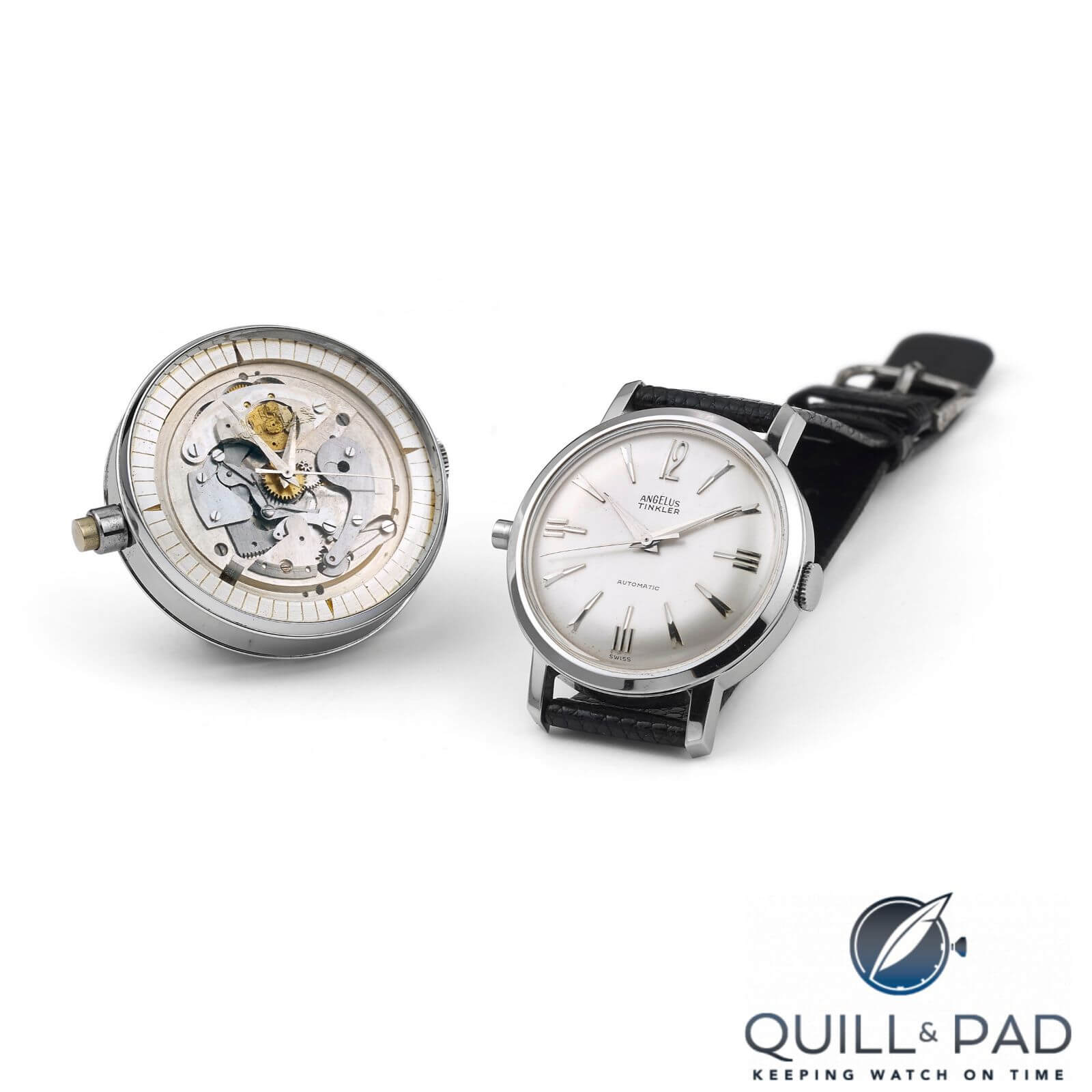
The original historical Angelus Tinkler of 1958, alongside a prototype showcasing its repeater mechanism.
Since its founding in 1891, Angelus has never been one of the major players in the market; however, it managed to distinguish itself through a series of successful developments that left a significant mark on 20th-century watchmaking. Most notable in this regard are the Panerai diver’s watches with an eight-day power reserve – created in 1956 for the Egyptian Navy – which were equipped with the SF 240 caliber, the world’s smallest eight-day alarm movement, introduced by Angelus in 1936. Originally designed for travel clocks and other timepieces, it gained its greatest fame as the movement powering large (very large) military-style watches.
Other Angelus creations that have firmly won the hearts of collectors include alarm wristwatches and, above all, chronographs, some of which featured various calendar complications. In fact, discovering a rarity like a “big date” chronograph – launched by the brand in 1948, a full 46 years before A. Lange & Söhne famously reintroduced the complication – is not merely an interesting footnote in the brand’s history; it is a genuine point of pride. This is precisely why Angelus enjoys such a strong reputation among collectors: the brand offers the chance to uncover pieces on the vintage market that are truly worthwhile and technically fascinating.
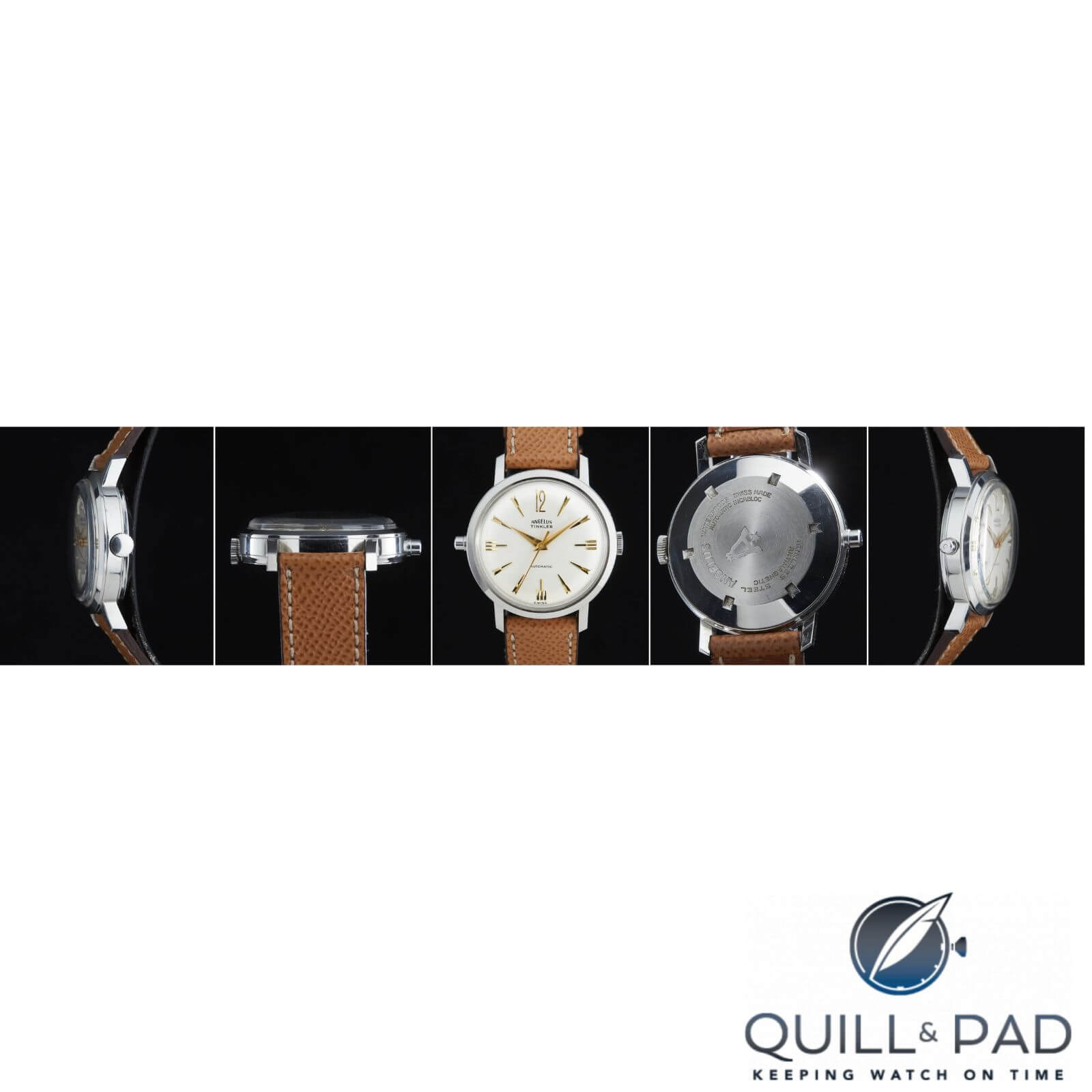
Every facet of the historical Angelus Tinkler – one of the few surviving examples to resurface on the market. Courtesy of analogshift.com.
The original Tinkler was a bold gamble for Angelus. The brand had a penchant for innovative technical solutions, and in this instance that trait was on full display. While it may not have been a commercial success – Angelus likely saw little profit from it – it left an indelible mark on the history of watchmaking. Creating a series-produced wristwatch with a repeater – even if only a quarter repeater, which is less complex than a minute repeater – was an ambitious goal. What made it even more ambitious was the brand’s intent to make the watch automatic, water-resistant, shock-resistant, and even anti-magnetic – in short, equipped with the cutting-edge technology of the time.
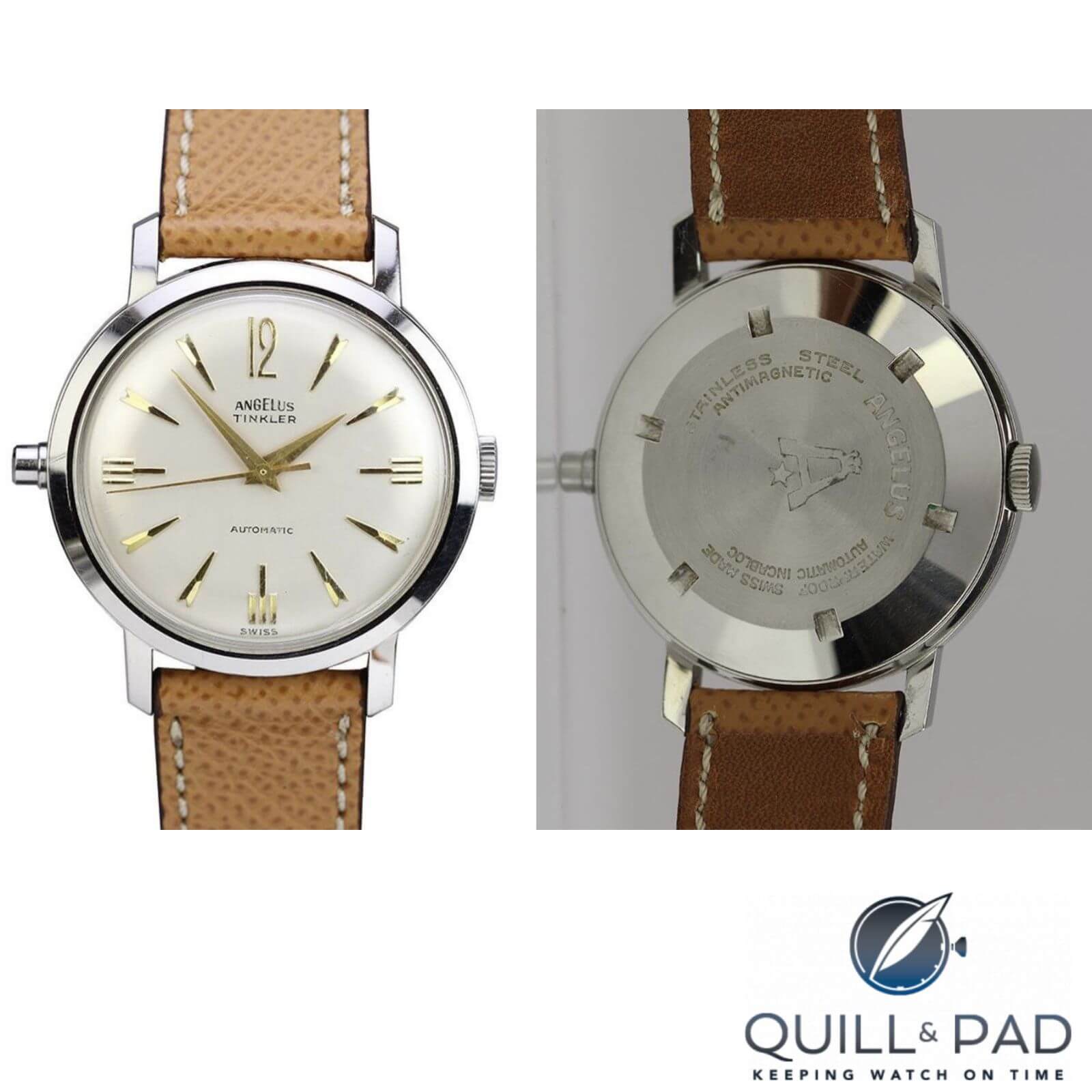
One of the few Angelus Tinklers from the original release to surface on the market. Courtesy of matthewbaininc.com.
To realize their vision, Angelus turned to the renowned Swiss movement manufacturer A. Schild (AS) in Grenchen. They opted for a modular architecture for the watch. By that time, automatic movements were no longer a technical rarity, so the team selected the AS 1580 caliber – known as the “Maximatic” and introduced that same year, 1958—as the base. The AS 1580 features a central rotor and a reversing gear system with two ratchet wheels, allowing bidirectional winding. The repeater module was designed with a simplified striking mechanism using a single hammer and gong: it signaled the hours with single strikes and the quarters with double strikes. It also lacked an “all-or-nothing” safety mechanism, meaning that if the pusher was not fully depressed, the watch could strike an incorrect time. Presumably, users were expected to be sufficiently careful and meticulous.
For the repeater’s activation button – positioned at 9 o’clock for the sake of symmetry – the designers opted for a pump-style shape. This is the most noticeable difference between the 1958 design and the modern one.
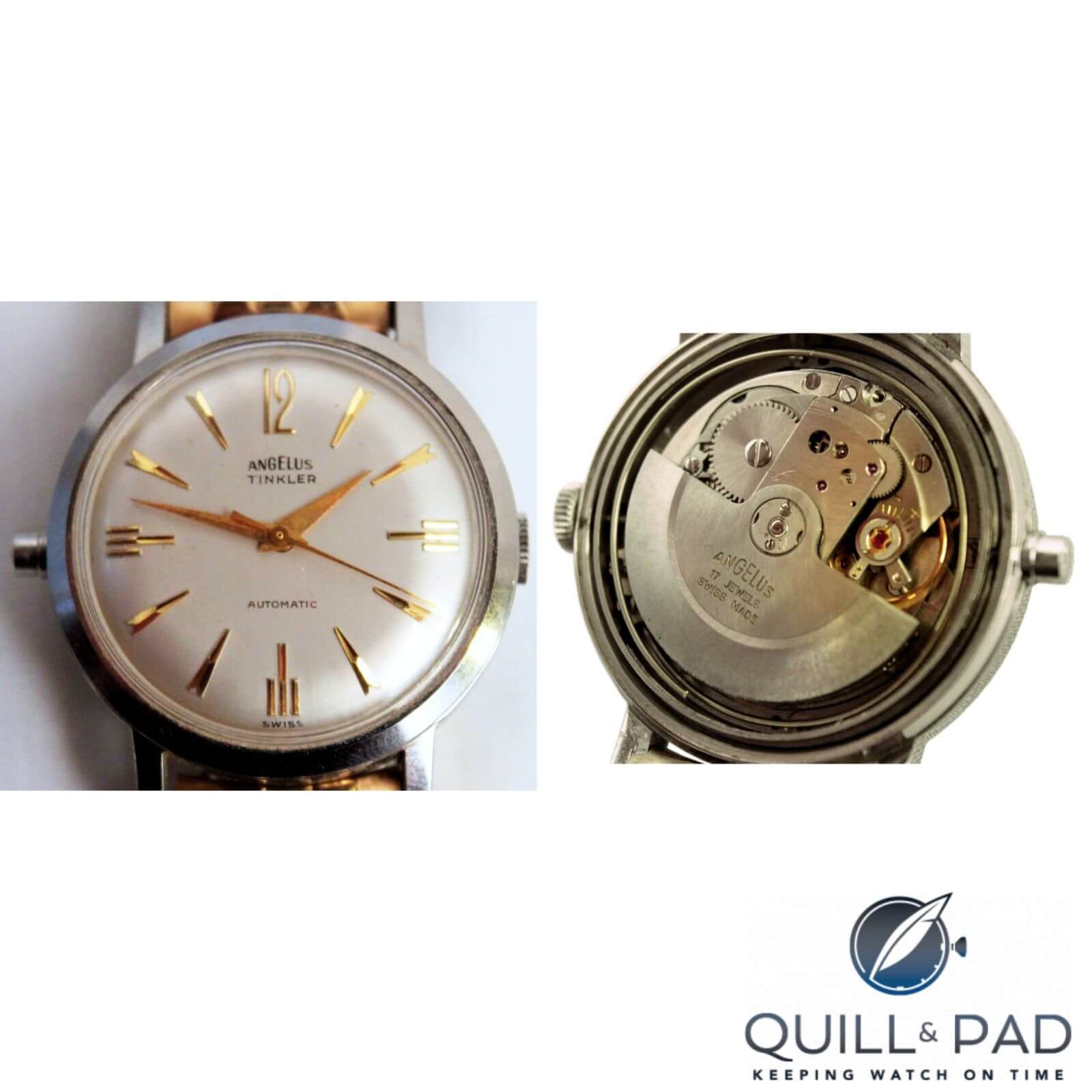
A rare historical Angelus Tinkler, sold on eBay.com in the 2010s. Among other things, this listing offered a rare glimpse of the movement. Courtesy of eBay.com.
Angelus’s ambitious plan to capture public interest with a repeating wristwatch and achieve solid sales ultimately didn’t succeed. According to Gisbert L. Brunner, writing for uhrenkosmos.com, the A. Schild factory required an order for 10,000 movements to justify the investment and ensure profitability; in reality, only a single trial run of 100 Tinkler timepieces – housed in stainless steel cases – was ever produced. While such developments, intended as talking pieces, might today be viewed as investments in publicity and brand recognition, the business landscape worked differently back then. Because the Tinkler failed to gain widespread market traction – largely due to its higher price point relative to the public’s expectations at the time – Angelus discontinued production after that initial trial series. This risky venture did not dampen the enthusiasm of Angelus’s management for creating repeating wristwatches; by 1978, the company had launched a new iteration featuring a five-minute repeater. For this version, they turned to different suppliers: the base caliber was provided by Eta (specifically the hand-wound caliber 2801), while the repeater module was supplied by Dubois Dépraz, a specialist in complication modules that had originally developed the five-minute repeater module for the Kelek brand.
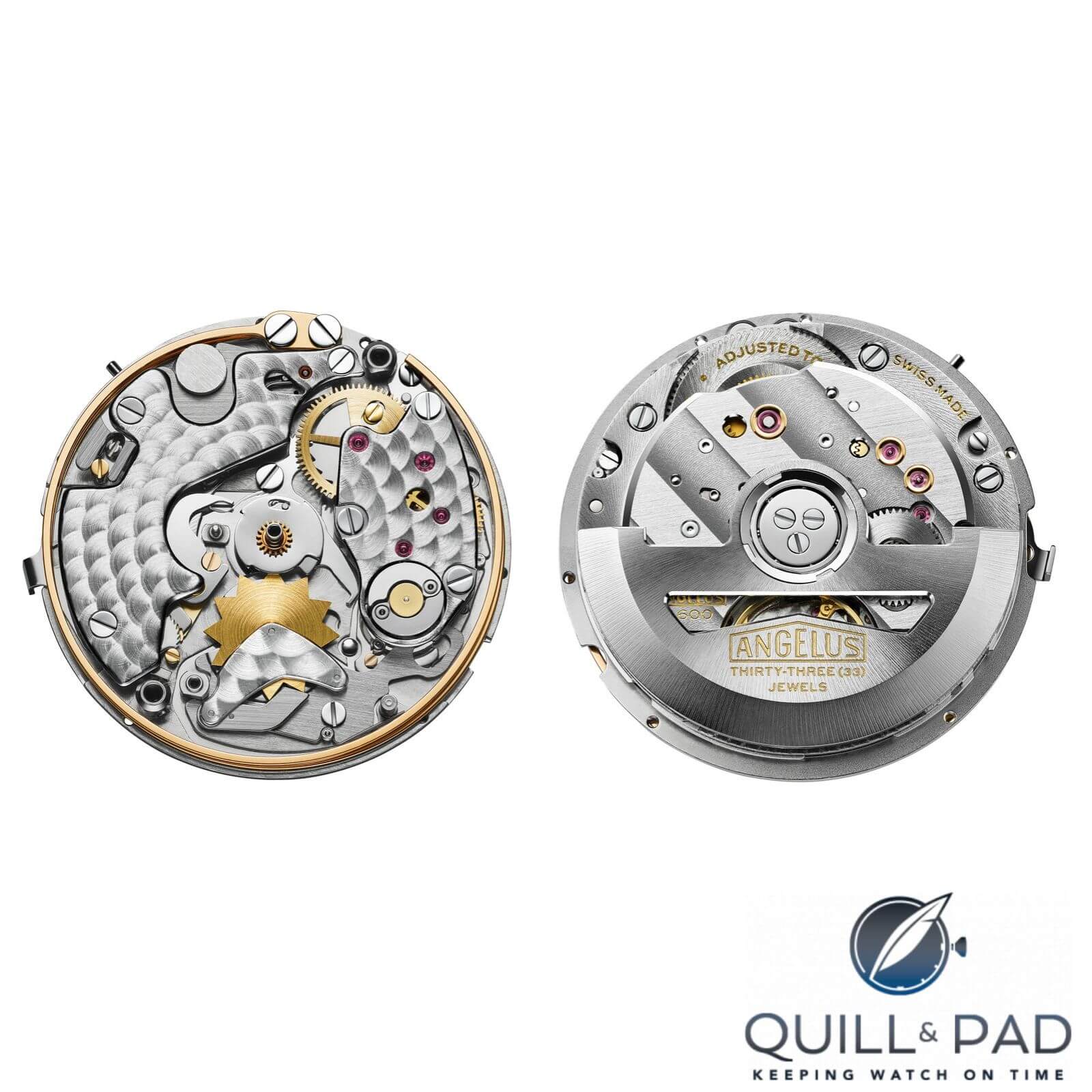
The Angelus A600 caliber is the movement powering the modern Tinkler 1958 Quarter Repeater.
The contemporary Tinkler 1958 Quarter Repeater marks Angelus’s third attempt at creating a wristwatch with a repeater function. It’s commendable that, in referencing the pioneering 1958 model, the brand has retained the core technical specifications: it is once again a quarter repeater and once again features an automatic movement. While the designation of the new Angelus A600 caliber might suggest an in-house movement, it is not – though this does nothing to diminish the watch’s overall appeal. The base is an advanced automatic caliber from La Joux-Perret (both brands are part of the Citizen Group), built on the G100 architecture, while the quarter-repeater module is supplied by complication specialist Dubois Dépraz – a name that also appeared in this story back in 1978 with their five-minute repeater module. The movement operates at a frequency of 28,800 vibrations per hour (4 Hz), a notable increase from the 18,000 vibrations per hour typical of the A. Schild 1580 movement used in the original version, and boasts an impressive 70-hour power reserve.
Interestingly, the quarter-striking mechanism of the Tinkler 1958 Quarter Repeater functions exactly like that of the 1958 original model: the hours are signaled by single strikes on the gong, while the quarters are indicated by double strikes.
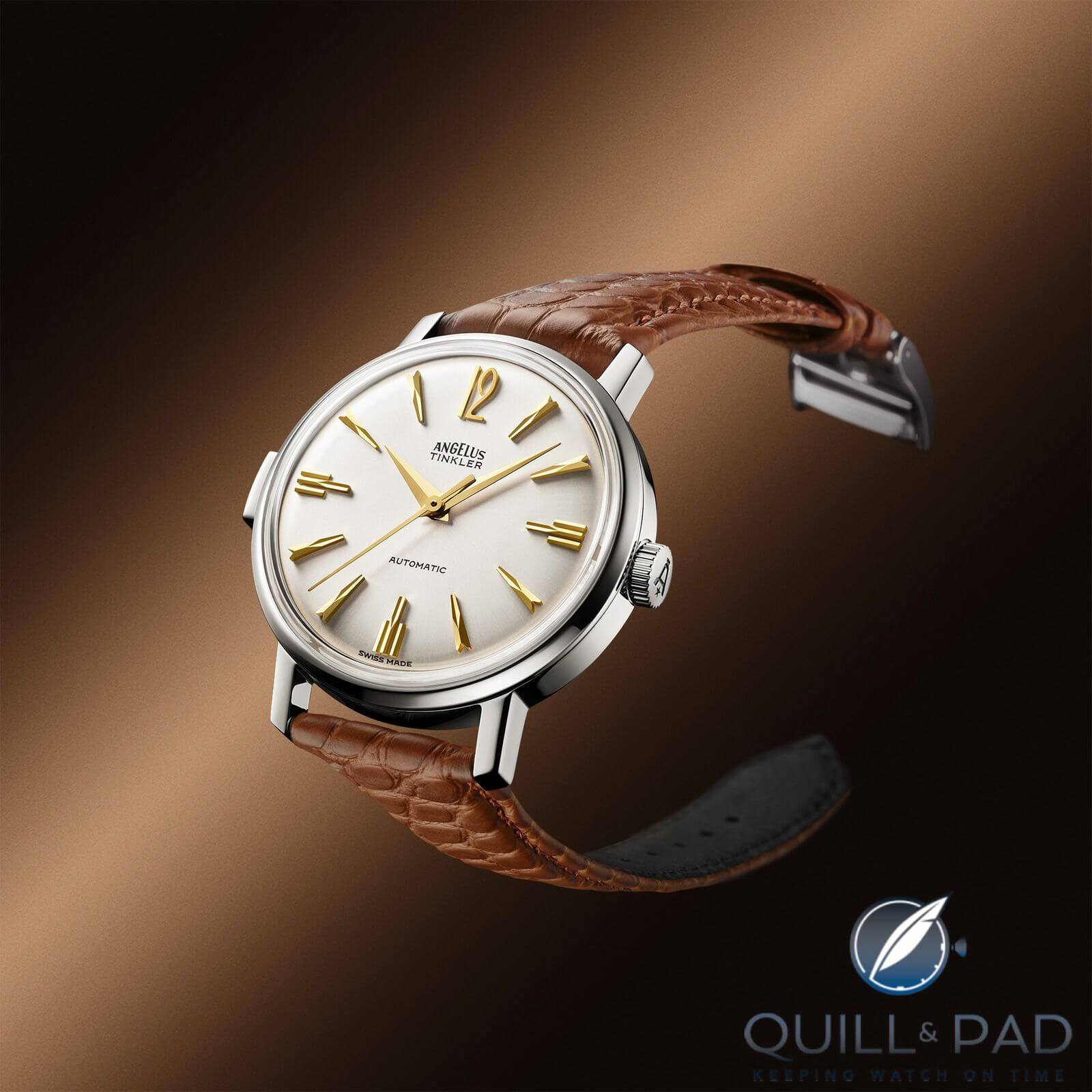
The Tinkler 1958 Steel, much like the historical Tinkler, features a 38mm stainless steel case with a screw-down case back.
The revived Angelus Tinkler model comes in a 38mm case – a compact size that fits the current trend toward smaller mechanical watches – with a height of approximately 12mm. Unlike the historical timepiece, which used a pump-style push-piece to activate the repeater, the new models feature a rectangular pusher that looks substantial alongside the winding crown. It’s also worth noting that the modern model’s box-shaped crystal is crafted from synthetic sapphire rather than plexiglass, and it has an anti-reflective coating on both sides, ensuring a crystal-clear view of the dial.
In addition to the steel version – a clear nod to the original 1958 steel model – Angelus also offers a yellow gold version.
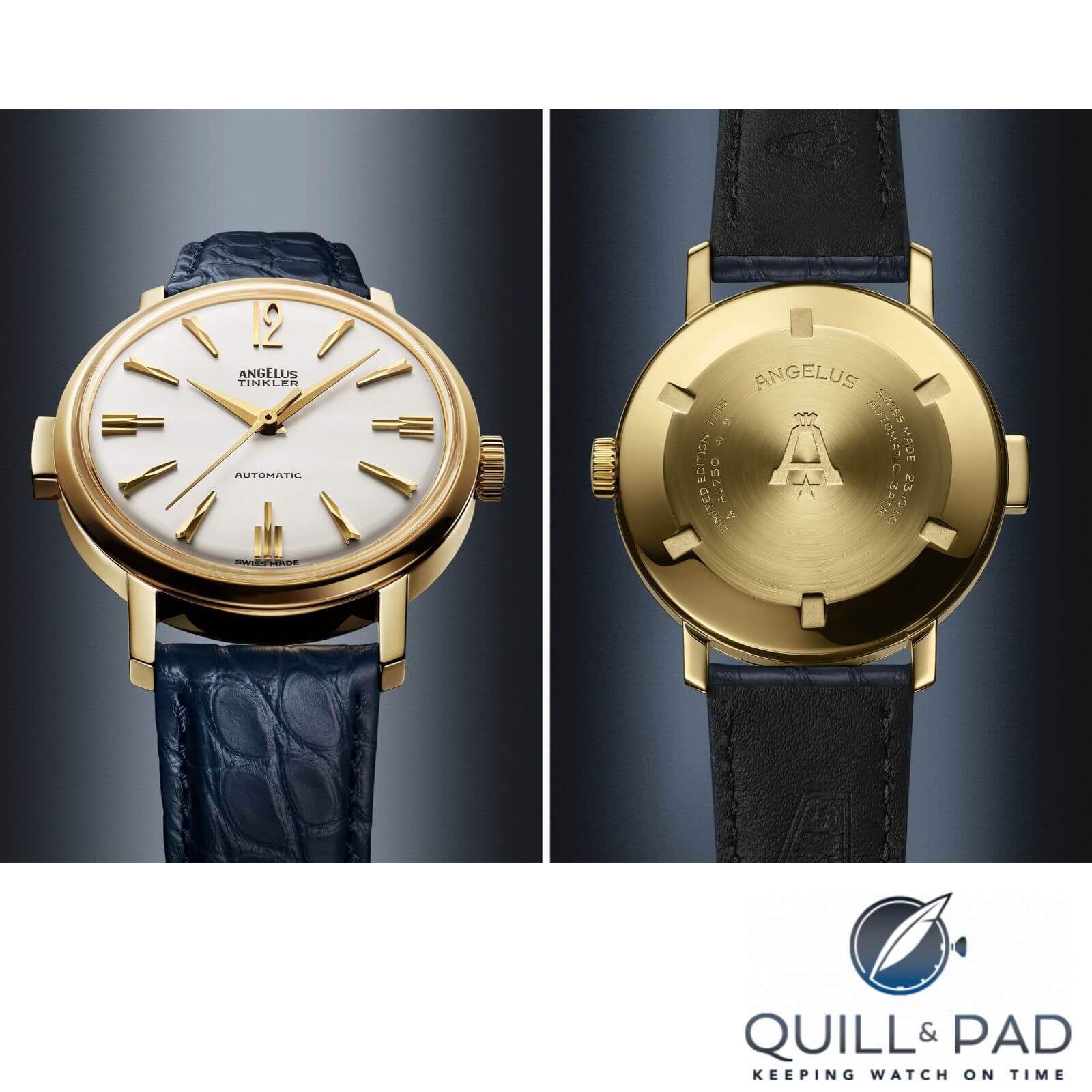
The second modern version of the Angelus Tinkler in yellow gold.
The Tinkler’s dial is clearly executed in a 1950s style – you don’t even need to look at the original model to recognize it. The design’s ties to that era are evident in the Dauphine-style hands, the box crystal, the domed dial base with a raised center, and the intricately crafted, faceted applied gold indices, which have a convex profile that follows the curvature of the dial, as well as the applied “12” numeral, borrowed from the Art Deco style of the 1930s and 1940s, a typical design feature of the 1950s. One last small yet significant detail: in the interest of greater authenticity, Angelus has reinstated the logo used on the historical Tinkler.
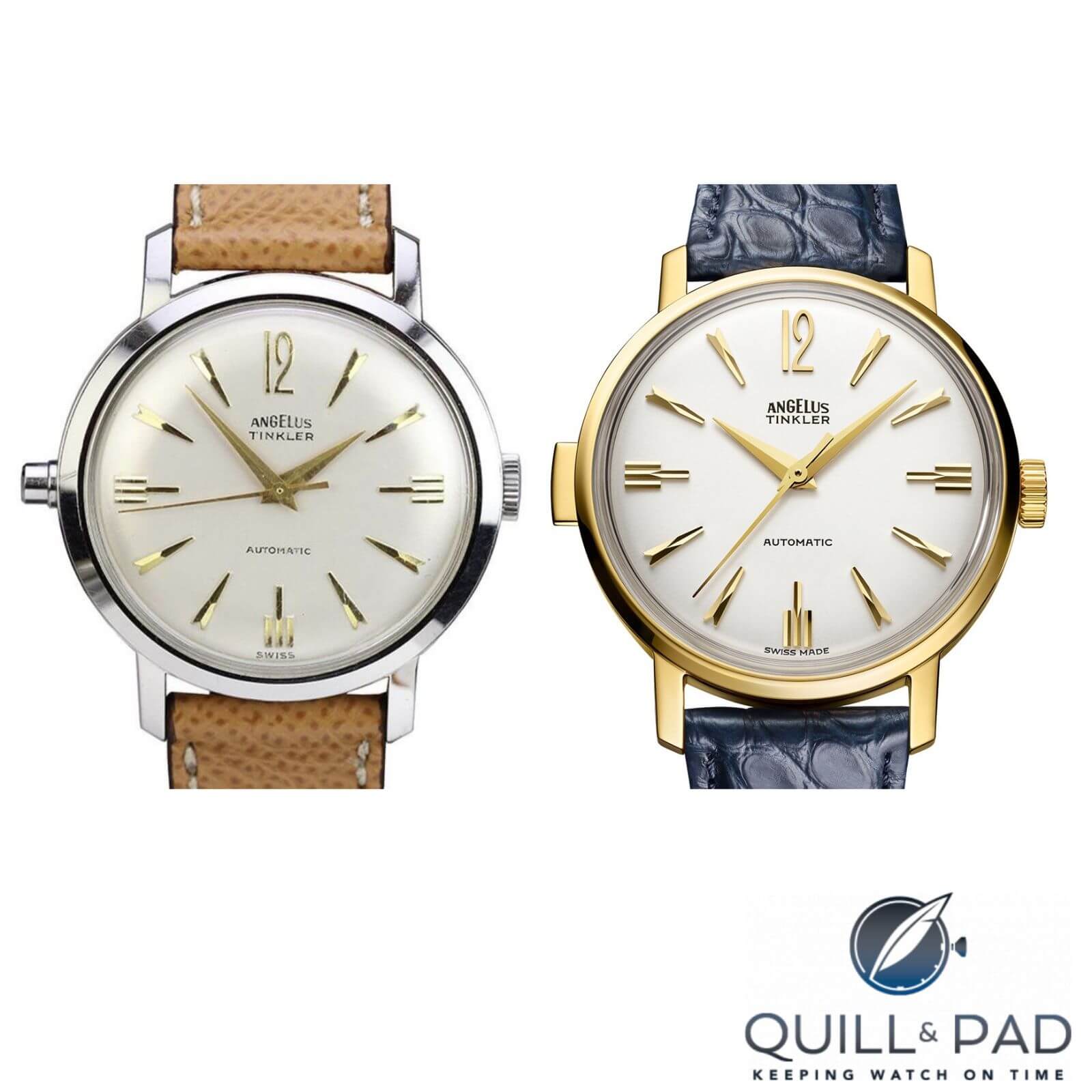
Comparing the dials of the historical (left) and modern Angelus Tinkler.

Contemporary quarter-repeater wristwatches occupy a niche in the market, and Angelus’s new attempt to revitalize this complication deserves full credit. The release is clearly aimed at capturing the interest of collectors and enthusiasts of complex mechanical horology and vintage design – a focus underscored by its high-end execution and corresponding price (approximately US$48,300 for the steel model). In this regard, the business concept behind the Tinkler 1958 differs fundamentally from that of the original historical timepiece, which Angelus once intended for the mass market – a plan that ultimately never came to fruition. Will this new business approach prove successful? We’ll likely find out in time, should future Tinkler 1958 releases appear.
Quick Facts — What to Know About
Models and maker: Tinkler 1958 Steel Ref. 0TKAS.W01A.C1468S and Tinkler 1958 Yellow Gold Ref. 0TKAQ.W01A.C1470Q by Angelus.
Edition: Limited to 25 pieces in stainless steel and 15 pieces in 18k yellow gold.
Case: Stainless steel or 18k yellow gold, polished; box sapphire crystal with anti-reflective coating on both sides; screw-down solid steel or 18k yellow gold caseback; winding crown at 3 o’clock; pusher to activate quarter repeater at 9 o’clock; water-resistant to 30 m.
Case dimensions: Diameter 38 mm; thickness 12.03 mm.
Dial: White domed, sunburst dial; applied golden indexes, faceted and curved; polished and faceted golden Dauphine hour and minute hands; golden central seconds hand.
Movement: Caliber A600, automatic: running at 4 Hz (28,800 vph), with a 70-hour power reserve; 33 jewels; diameter 28 mm; thickness 7.35 mm.
Bracelet and clasp: Saddle brown alligator leather with pin buckle in stainless steel for steel model; blue alligator leather with pin buckle in 18k yellow gold for gold model.
Price: Tinkler 1958 Steel approx. US$48,300 (€45,600 incl. VAT); Tinkler 1958 Yellow Gold approx. US$71,800 (€67,800 incl. VAT).
All images, except where otherwise noted, courtesy of Angelus.
Read more like this:
Party on the Wrist: Reviewing the Sartory Billard SB10 Jumping Hour ‘Disco Ball’
Chasing the Naples Night: The DOXA SUB 200T Afterglow x Exquisite Timepieces

